Is freeze-dried fruit bad for your teeth?
Crisp rather than sticky, but still concentrated fruit sugar. What the NHS advises about dried fruit and teeth, and the habits that make the difference.
On this page
- What the NHS says about dried fruit and teeth
- How freeze-dried fruit compares with fresh fruit and raisins
- Why crisp freeze-dried fruit is not a free pass
- Why freeze-dried fruit can make your teeth hurt
- How to eat freeze-dried fruit more kindly to your teeth
- Freeze-dried fruit powder and teeth
- Freeze-dried fruit and children's teeth
- When to ask a dentist about freeze-dried fruit
Freeze-dried fruit is concentrated fruit sugar, so the NHS advice for dried fruit applies to it: eat it as part of a meal, as a pudding for example, rather than as a between-meal snack, to reduce the risk of tooth decay. It is crisp rather than chewy, so it does not cling to teeth the way a raisin does, but the sugars and the fruit acids are the same ones packed into a tenth of the weight, and how often they are in your mouth matters more than how they feel going in.
The NHS does not publish separate advice for freeze-dried fruit. For teeth and portions it is simply dried fruit, and everything below follows from that.
What the NHS says about dried fruit and teeth
Two pieces of NHS guidance cover the question, and both are about dried fruit in general. On portions, the NHS counts 30g of dried fruit as one of your 5 A Day and says dried fruit is best enjoyed as part of a meal, as a dessert for example, rather than as a between-meal snack. On sugar, it says dried fruit such as raisins, dates and apricots is high in sugar and can be bad for your dental health because it sticks to your teeth, and that to prevent tooth decay it is best eaten at mealtimes rather than as a snack.
The NHS position, in plain words: dried fruit is high in sugar, it can be bad for your teeth, and it is better at the end of a meal than in the middle of the afternoon. A 30g portion counts as one of your 5 A Day, and a portion of fresh, frozen or tinned fruit is 80g.
We have not found NHS, Food Standards Agency or British Dietetic Association guidance that treats freeze-dried fruit as a separate category, so the honest answer is to apply the dried fruit advice. There is more on portions in does freeze-dried fruit count as 5 A Day.
How freeze-dried fruit compares with fresh fruit and raisins
| Food | Typical sugars per 100g | Sugars in a realistic helping | What happens in the mouth |
|---|---|---|---|
| Fresh strawberries | about 5 to 6g | about 5g in an 80g portion | Mostly water, cleared quickly by saliva |
| Freeze-dried strawberries | about 45 to 65g | about 5 to 6g in a 10g serving | Crisp at first, then a sweet paste once chewed |
| Freeze-dried strawberries, 30g NHS dried-fruit portion | about 45 to 65g | about 14 to 20g in 30g | A very large bowlful, and a lot of sugar in one go |
| Raisins | about 60 to 70g | about 18 to 21g in a 30g portion | Chewy and sticky, clings to teeth and between them |
These are typical ranges rather than figures for any particular product. They vary with the fruit, the variety, the ripeness and the producer, so the label on your own pack is the figure that counts.
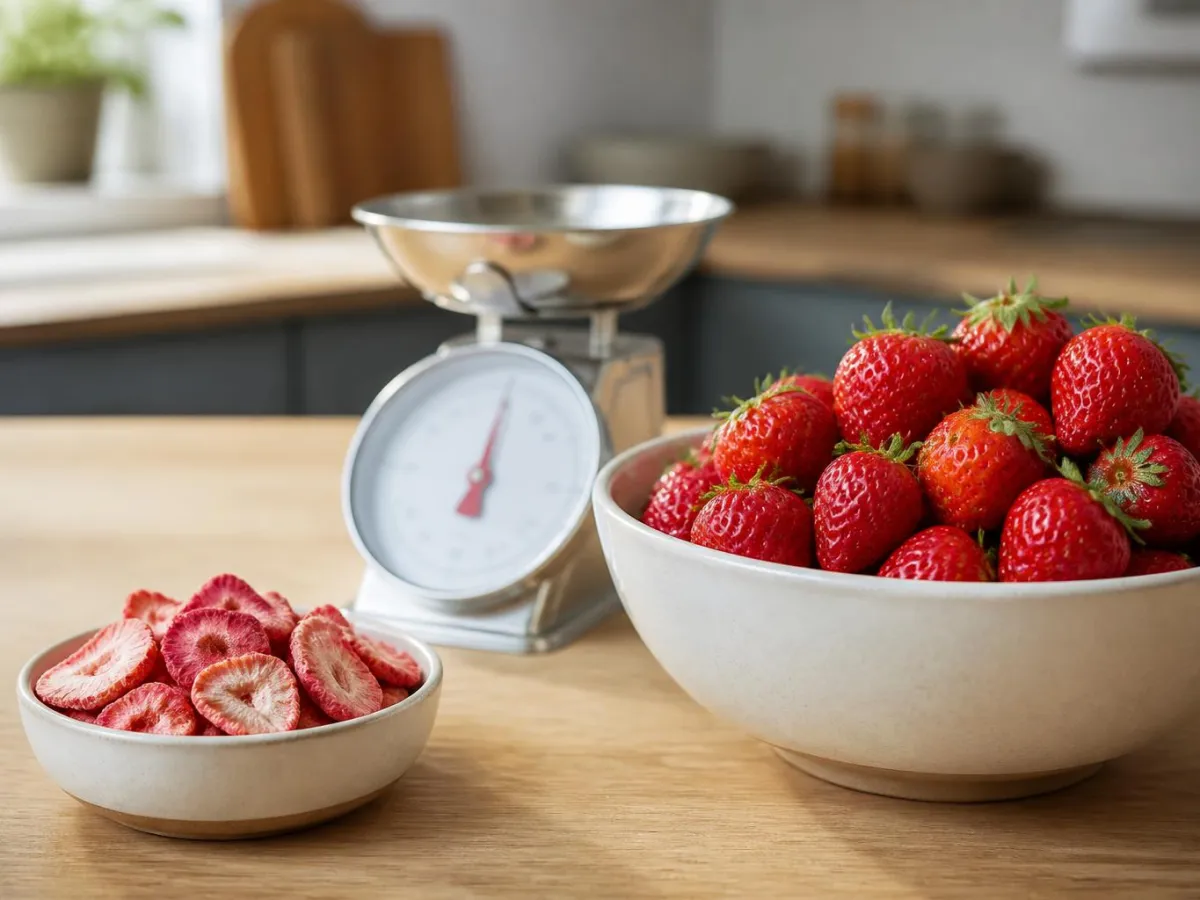
The comparison that matters is the middle row against the first. Strawberries are roughly 90 per cent water, and freeze-drying takes nearly all of it out, so about 100g of fresh fruit comes down to about 10g of freeze-dried pieces: a ratio of roughly 10 to 1. Nothing is added, because plain freeze-dried fruit needs nothing; the sugar is simply concentrated into a tenth of the weight, which is why a small handful is not the small thing it looks like. There is more on that in what freeze-drying actually does, and you can work out the equivalents for yourself with our fresh to freeze-dried converter. What changes is the speed: 100g of fresh berries takes a few minutes to eat and is mostly water, while 10g of crisp slices takes seconds and a second handful is easy. Three handfuls across an afternoon is three separate visits of concentrated sugar to your teeth, which is exactly the between-meal grazing the NHS advises against. There is more in sugar in freeze-dried fruit and freeze-dried strawberries.
Why crisp freeze-dried fruit is not a free pass
The texture difference is real. A raisin or a dried apricot is dense and slightly syrupy on the outside, so it presses into the grooves of the back teeth and stays there. A freeze-dried piece is a dry, brittle honeycomb with only a trace of moisture left in it: no sticky surface, it shatters when you bite it, and it dissolves in saliva within seconds.
Dissolving is not the same as disappearing, though.
- Once it has dissolved, the sugar is in solution and washing over every tooth surface, which is much the same as a sip of a sweet drink.
- Fine fragments still pack into the grooves of the molars and the gaps between teeth, especially with crumbly pieces and powder.
- Fruit is naturally acidic, and drying concentrates the citric and malic acids along with everything else. That sharp, bright taste is the acid, and acid softens tooth enamel, which is a separate issue from the sugar.
So crisp beats chewy on stickiness, which is a genuine point in its favour. It does not change the sugar, the acid, or the advice about when to eat it.
Do not let pieces sit in your mouth to dissolve slowly, however pleasant it is. A quick chew and swallow gives your saliva much less to deal with than a slice you nurse for a minute.
Why freeze-dried fruit can make your teeth hurt
Two quite different complaints get described the same way, and telling them apart is useful.
A short, sharp twinge in one tooth when something sweet or acidic touches it. Worn enamel, dentine exposed near the gum line, a cracked or leaking filling and early decay can all cause it, and freeze-dried fruit is a good detector because it is sweet and sharp at once. That is a reason to book a dental appointment rather than to change your breakfast.
A duller ache from the bite itself. Whole freeze-dried berries and thick slices are harder work than they look, and a sore tooth, a new crown or a recent filling will notice. Softening the fruit removes the problem: two to five minutes in a little cool water, or thirty seconds stirred into hot porridge or yoghurt. See rehydrating freeze-dried fruit and freeze-dried fruit in porridge and overnight oats.
None of this is advice about your own teeth, and we are not in a position to give any. A dentist who can look in your mouth is the only person who can say what is happening in it.
How to eat freeze-dried fruit more kindly to your teeth
| Habit | Why it helps |
|---|---|
| Eat it with a meal, not between meals | This is the NHS advice for dried fruit, and it is the single biggest lever |
| Weigh about 10g into a bowl | Stops a bag becoming three portions; 10g is roughly the fruit from 100g fresh |
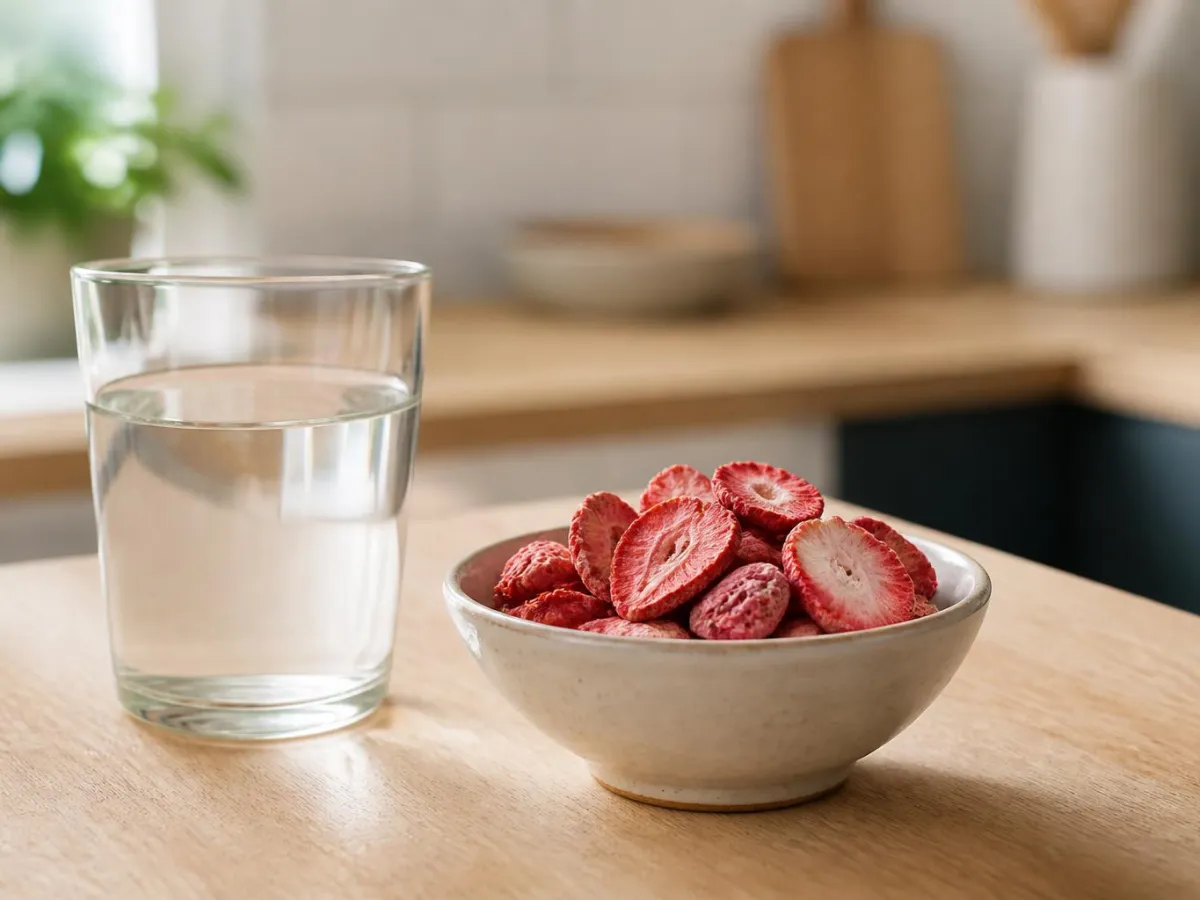
| Drink plain water afterwards | Helps clear the sugars and fruit acid left behind, and adds nothing sweet |
| Wait at least 30 minutes before brushing | NHS dental advice is not to brush immediately after eating, because acid softens enamel |
| Brush twice a day with fluoride toothpaste, including last thing at night | The NHS baseline for everyone, about 2 minutes each time |
| After brushing, spit rather than rinsing | Rinsing washes away the concentrated fluoride left on your teeth |
| Choose plain fruit over yoghurt-coated or chocolate-coated | The coating is added sugar and fat, and it is stickier than the fruit underneath |
| In a lunchbox, pack it with the sandwich rather than as a separate afternoon pot | Keeps it to one mealtime instead of an afternoon of grazing |
None of that is unique to freeze-dried fruit: it is the ordinary dried fruit advice, applied to something crunchy.
Freeze-dried fruit powder and teeth
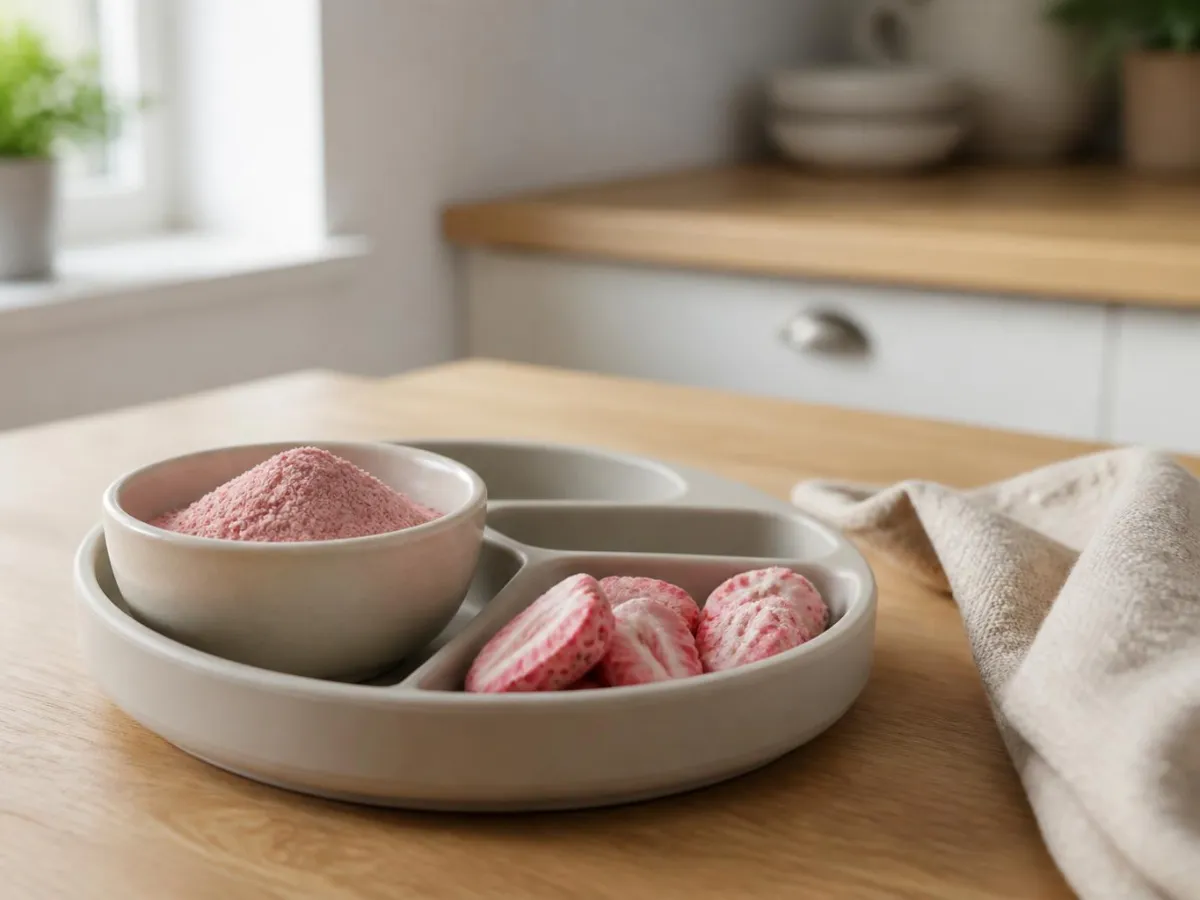
Powder behaves differently from pieces. It is the same fruit milled fine, so the sugar and acid are identical, but it clings readily and it usually ends up in something you sip: a smoothie, a milkshake, a flavoured glass of water. Sipping stretches a sweet, acidic drink over several minutes, which is the grazing problem in liquid form. Keep powdered drinks to mealtimes, drink them rather than nursing them, and follow with plain water. There is more in our guide to freeze-dried fruit powder.
Freeze-dried fruit and children's teeth
NHS advice on sweet foods for children, dried fruit included, is to keep them to mealtimes, and that matters more with children because habits set early. Freeze-dried fruit is popular in lunchboxes because it is light, colourful and does not bruise, so the practical move is to send a small pot to be eaten alongside the sandwich rather than saved for the walk home.
There is a separate safety point that has nothing to do with teeth. Crisp freeze-dried pieces can be a choking risk for babies and young children, so soften them in milk, yoghurt or a little water, or crush them to a powder and stir them in, and follow NHS weaning guidance on textures and on foods to avoid. For your own child, your health visitor or GP is the person to ask, and your dentist for their teeth. Our page on freeze-dried fruit for babies and toddlers goes through it properly.
When to ask a dentist about freeze-dried fruit
Ask rather than guess if a tooth twinges on sweet or acidic food, if an ache does not settle, if you can see a mark, a chip or a hole, or if something about your own mouth changes the sums: braces and retainers hold food against teeth, and a dry mouth means less saliva to clear sugar away, which is a known factor in tooth decay. A dentist can give advice for your teeth rather than for the average set. We cannot, and would not try.
The short version: freeze-dried fruit is fruit, and it is fine. Weigh out about 10g, eat it at the end of a meal rather than in the middle of the afternoon, drink a glass of water after it, and leave brushing for half an hour. That is the whole of it.
For the wider picture, start with whether freeze-dried fruit is healthy and then freeze-dried fruit and 5 A Day.
Good questions, short answers
Is freeze-dried fruit bad for your teeth?
It is dried fruit, so the NHS advice for dried fruit applies: it is high in sugar and best eaten as part of a meal, as a pudding for example, rather than as a between-meal snack, to reduce the risk of tooth decay. Freeze-dried pieces are crisp rather than chewy, so they do not cling like a raisin, but they dissolve into the same concentrated fruit sugars and acids. Keeping it to mealtimes, a glass of plain water afterwards and brushing twice a day with fluoride toothpaste are the habits that matter.
Is freeze-dried fruit better for your teeth than raisins?
On texture, probably a little, because a raisin is chewy and sticky and physically clings to teeth, while a freeze-dried piece shatters and dissolves. On sugar there is not much between them once you allow for the portion size. There is no NHS or Food Standards Agency guidance that separates the two, so the sensible approach is to treat freeze-dried fruit as dried fruit and keep both to mealtimes.
Why does freeze-dried fruit hurt my teeth?
There are two different sensations worth telling apart. A short sharp twinge in one tooth when something sweet or acidic touches it is a sign to get that tooth looked at, because worn enamel, exposed dentine, decay or a cracked filling can all cause it. A duller ache from the biting itself is usually about how hard whole freeze-dried berries are, and softening them in yoghurt or porridge solves it. Only a dentist who can look in your mouth can tell you which is which.
Should you brush your teeth straight after eating freeze-dried fruit?
No. NHS dental advice is not to brush immediately after eating, and to wait at least 30 minutes, because enamel is softened by the acid in food and drink. Rinse your mouth with plain water instead, then brush at your normal times, twice a day with fluoride toothpaste, including last thing at night. After brushing, spit rather than rinsing, so the fluoride stays on your teeth.
Is freeze-dried fruit bad for toddlers' teeth?
The NHS advice to keep sweet foods, dried fruit included, to mealtimes applies to children too, and it matters more because habits stick. There is also a separate safety point: crisp freeze-dried pieces can be a choking risk for babies and young children, so soften or crush them and follow NHS weaning guidance. Your health visitor, GP or dentist is the right person to ask about your own child.
Does freeze-dried fruit count as free sugars?
The sugars inside whole fruit, including whole dried fruit, are not counted as free sugars in NHS guidance, which covers sugars added to food and drink plus those in honey, syrups, juices and smoothies. That is a point about dietary guidelines rather than a clean bill of dental health, because the NHS is equally clear that dried fruit is high in sugar and can be bad for your teeth. Yoghurt-coated and chocolate-coated fruit does contain added, free sugars.