Does freeze-dried fruit have more sugar than fresh?
Per 100g, dramatically more. Per serving, no more than the fresh fruit it came from. Here is the arithmetic, fruit by fruit, in grams.
On this page
- Why freeze-dried fruit has so much sugar per 100g
- Sugar in freeze-dried fruit: typical values per 100g and per 10g serving
- Does freeze-dried fruit have added sugar?
- Do the sugars in freeze-dried fruit count as free sugars?
- Freeze-dried fruit vs raisins, sweetened dried fruit and fruit powder
- Is freeze-dried fruit fattening?
- What a 10g serving of freeze-dried fruit looks like
- Sugar in freeze-dried fruit for babies and children
- Sugar in freeze-dried fruit: the practical takeaway
Freeze-dried fruit holds far more sugar than fresh fruit per 100g, typically somewhere between 30g and 85g against roughly 4g to 20g in the fresh fruit it was made from, because freeze-drying takes the water out and leaves the sugars behind in a much smaller weight. Per portion it holds no more: a usual 10g serving carries only the sugar that was already in the 40g to 100g of fresh fruit that went into it, and nothing is added to a plain pack.
That distinction, per 100g against per portion, is where most answers to this question go wrong. The figure on the back of the pack is real, but it describes about ten servings at once.
Why freeze-dried fruit has so much sugar per 100g
Fresh fruit is mostly water: strawberries around 90 per cent, raspberries and apples about 86 per cent, bananas about 75 per cent. Freeze-drying freezes the fruit and draws that water off as vapour under vacuum, leaving the sugar, the fibre, the acids and the colour where they were. Nothing is boiled down or sweetened.
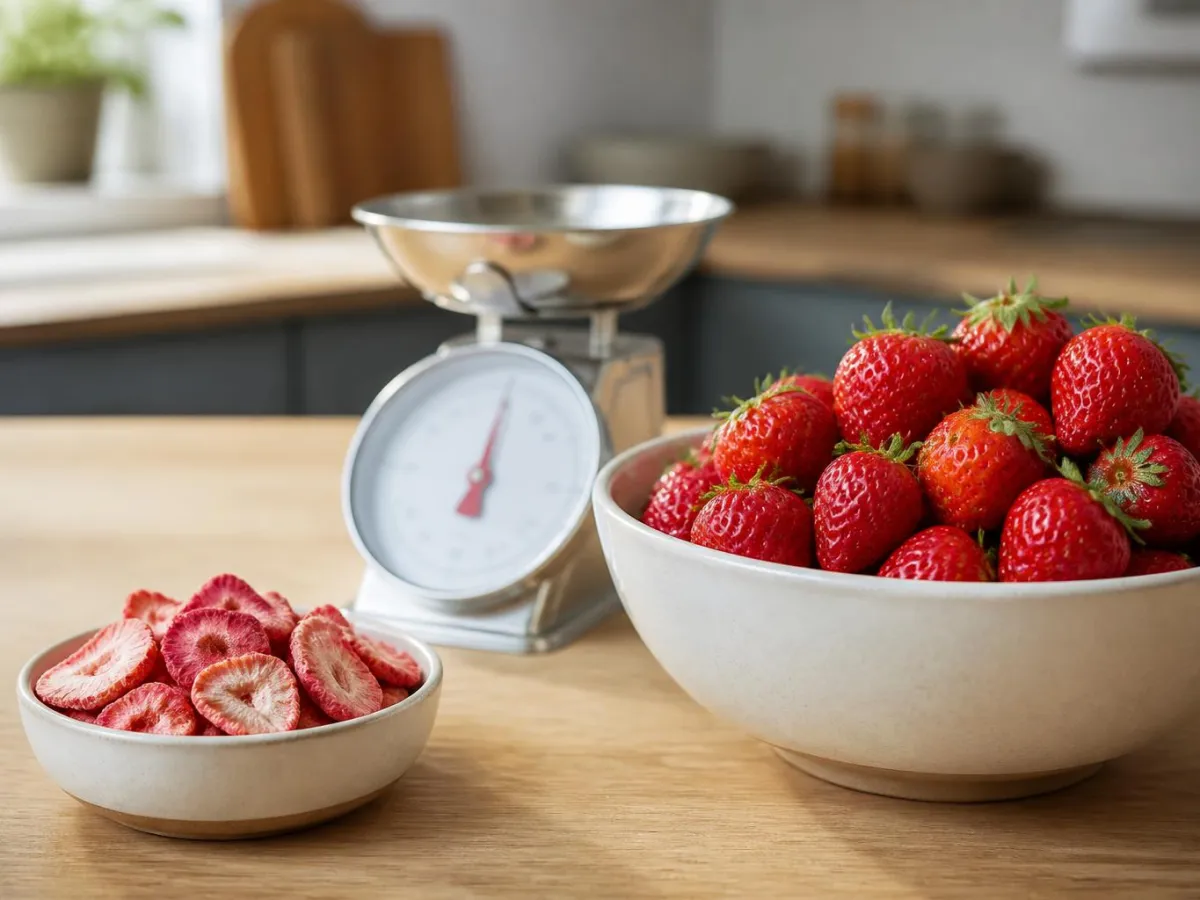
The effect is a weight ratio, and it follows from the water content: a fruit that is 90 per cent water leaves about a tenth of its weight behind, so it takes roughly 10kg of fresh strawberries to make 1kg of freeze-dried, about 7kg of raspberries or apples at 86 per cent water, and about 4kg of banana at 75 per cent. Every figure on the nutrition panel, sugar included, rises by that same multiple. Our guide to what freeze-drying is explains the process, and the fresh to freeze-dried converter does the sums either way.
Sugar in freeze-dried fruit: typical values per 100g and per 10g serving
| Fruit | Fresh, sugars per 100g | Freeze-dried, sugars per 100g | Freeze-dried, per 10g serving | Fresh fruit in that 10g |
|---|---|---|---|---|
| Strawberries | about 5 to 7g | about 50 to 70g | about 5 to 7g | about 100g |
| Raspberries | about 4 to 5g | about 30 to 35g | about 3g | about 70g |
| Blueberries | about 8 to 10g | about 50 to 60g | about 5 to 6g | about 60g |
| Blackcurrants | about 6 to 8g | about 30 to 40g | about 3 to 4g | about 50g |
| Cherries | about 9 to 12g | about 50 to 65g | about 5 to 6g | about 55g |
| Apple | about 10 to 12g | about 70 to 85g | about 7 to 8g | about 70g |
| Mango | about 13 to 14g | about 70 to 80g | about 7 to 8g | about 55g |
| Pineapple | about 9 to 12g | about 65 to 85g | about 7 to 8g | about 70g |
| Banana | about 12 to 20g | about 50 to 80g | about 5 to 8g | about 40g |
These are typical ranges drawn from published UK composition data and from what appears on retail labels, not measurements of any particular pack. Products vary with the variety, the ripeness at picking, the piece size and the producer, so the nutrition label on your own pack is the figure that counts. Banana has the widest range, because its starch turns to sugar as it ripens, so a pack made from just-yellow fruit sits far below one made from speckled fruit.
Read the table across, not down: the third column looks alarming, the fourth is the one that matters.
Does freeze-dried fruit have added sugar?
Plain freeze-dried fruit has no added sugar. There is nowhere for it to hide: the ingredients list should read "strawberries" or "mango" and stop, and under UK labelling rules any added sugar, glucose syrup, juice concentrate or sweetener has to be declared in that list.
Four things on a British shelf are easy to confuse with it:
- Sugar-infused dried fruit, the chewy kind sold for baking, especially cranberries, mango and pineapple. That is dried fruit, not freeze-dried: see freeze-dried versus dehydrated fruit.
- Yoghurt-coated and chocolate-coated berries, where the fruit inside may be freeze-dried but most of the sugar is in the coating.
- Fruit crisps and smoothie melts, which often contain fruit purée, rice flour or oil as well as fruit.
- Fruit-flavoured cereals, bars and biscuits using freeze-dried fruit as one ingredient among many.
Two labelling points help. A pack may only say "no added sugars" if no sugars or sweetening ingredients have been added, and where sugars occur naturally in the food the label should also indicate that. And no plain freeze-dried fruit can legally be called low in sugar or sugar-free: those claims require no more than 5g and 0.5g of sugars per 100g.
One habit is worth more than any label claim: turn the pack over. One ingredient, no percentages, no syrup.
Do the sugars in freeze-dried fruit count as free sugars?
The NHS advises adults to have no more than 30g of free sugars a day, and less for children: no more than 24g a day from age 7 to 10, and no more than 19g from age 4 to 6. It does not set a gram figure for children under four, but advises avoiding sugar-sweetened drinks and food with sugar added. Free sugars are those added to food and drink, plus the sugars in honey, syrups and unsweetened juices and smoothies. Sugar occurring naturally in milk, whole fruit and vegetables does not count.
Where does dried fruit fall? The definition of free sugars the UK government uses, set out in the guidance for its 2018 nutrient profiling model, excludes sugars naturally present in fresh, frozen, dried, stewed and canned fruit and vegetables, and includes those in purées, powders, pastes, juices, smoothies and extruded products. So plain freeze-dried slices and whole berries sit with intrinsic sugars, while freeze-dried fruit powder sits with free sugars, because milling breaks the cell structure open.
That is a rule about how dietary sums are done, not a licence to eat a bag in one sitting. However a sugar is classified, sticky concentrated fruit against your teeth behaves the same way, which is the subject of our page on freeze-dried fruit and teeth.
Freeze-dried fruit vs raisins, sweetened dried fruit and fruit powder
| Form of fruit | Typical sugars per 100g | A usual serving | Sugars in that serving | Sugars counted as free sugars? |
|---|---|---|---|---|
| Fresh strawberries | about 5 to 7g | 80g, one 5 A Day portion | about 4 to 6g | No |
| Plain freeze-dried strawberries | about 50 to 70g | about 10g | about 5 to 7g | No |
| Raisins and sultanas | about 60 to 70g | 30g, one 5 A Day portion | about 18 to 21g | No |
| Sweetened dried cranberries | often 60 to 75g, much of it added | 30g | about 18 to 22g | The added sugar does |
| Freeze-dried strawberry powder | about 50 to 70g | 5 to 10g | about 3 to 7g | Yes |
Typical ranges again, and they vary from product to product, so check your own label. The interesting row is the raisins. Gram for gram, plain freeze-dried fruit and raisins are in similar territory for sugar, but the servings people use are not: 30g of raisins is a handful you can eat without noticing, while 30g of freeze-dried strawberries loosely fills a mug and was made from about 300g of fresh fruit. The lightness is a useful brake. Juice goes the other way: the NHS counts it as free sugars in full and suggests limiting it to 150ml a day, however unsweetened.
Is freeze-dried fruit fattening?
By weight it is energy dense, at roughly 300 to 400 kcal per 100g against about 25 to 60 kcal in most fresh berries, and per serving it is not: 10g comes out at about 30 to 40 kcal. These are typical ranges rather than fixed figures, so use your own pack's label. The numbers by fruit are on our page about calories in freeze-dried fruit.
The honest caution is not about sugar chemistry. Crisp fruit dissolves on the tongue and gives little sense of having eaten anything, so a 100g pouch can vanish over an evening in a way a kilo of strawberries never would.
What a 10g serving of freeze-dried fruit looks like
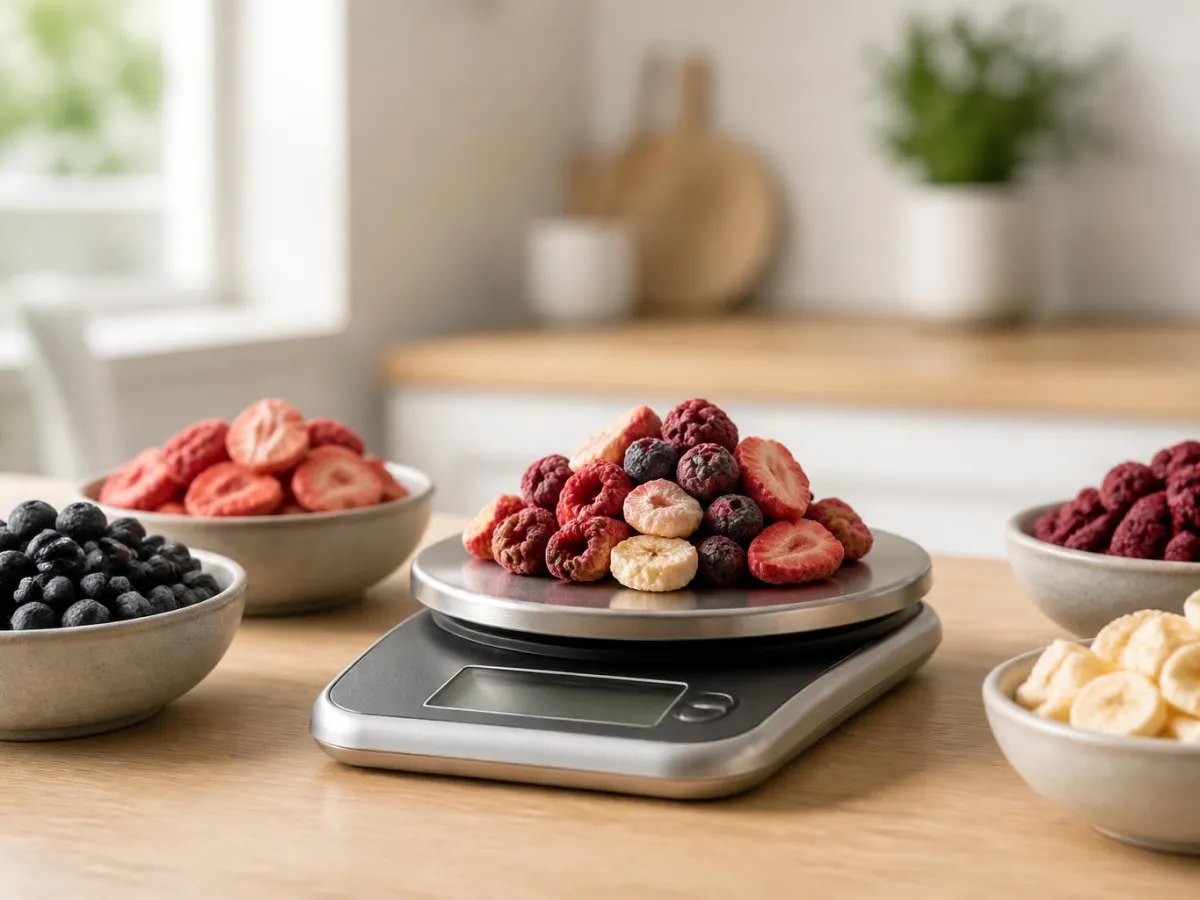
Weigh 10g once on kitchen scales and you will not need to again. It is roughly a small handful of strawberry slices, a generous tablespoon of raspberry pieces, or enough to cover a bowl of porridge. For recipe quantities, use the fresh to freeze-dried converter.
The NHS counts 30g of dried fruit as one of your 5 A Day and advises eating dried fruit with meals rather than as a between-meal snack, because it is sugary and sticks to the teeth. It does not publish a separate figure for freeze-dried fruit. Our page on freeze-dried fruit and 5 A Day works through that, and the wider nutrition section covers the rest.
Crispberry's own shop is not open yet, so there is nothing for sale on this site today and no prices, stock or delivery times of ours to quote. Our guide to freeze-dried fruit in UK supermarkets covers what British shops stock, and you can join the list to hear when that changes.
Sugar in freeze-dried fruit for babies and children
Children's daily free sugar maximums are much lower than adults', as the NHS figures above show, and babies do not need added sugar. Choose a pack whose only ingredient is fruit.
Crisp freeze-dried pieces are a choking risk for babies and young children. Soften them thoroughly in water, milk, yoghurt or porridge, or grind them to a powder and stir it in.
Follow NHS weaning guidance on starting solids at around six months and on choking, stay with your child while they eat, and give dried fruit with meals. Our page on freeze-dried fruit for babies and toddlers goes age by age, and your health visitor or GP is the person to ask about your own child.
Sugar in freeze-dried fruit: the practical takeaway
Read the per-100g sugar figure as what it is: the sugar in about ten servings, or in half a kilo to a kilo of fresh fruit. Check the ingredients say fruit and nothing else, weigh 10g once so you know the shape of a serving, eat it with a meal rather than grazing, and treat your own pack's label as the figures that apply. If you are watching sugar on medical advice, take that advice from your GP, practice nurse or a registered dietitian rather than from a table on a website.
Good questions, short answers
Does freeze-dried fruit have more sugar than fresh fruit?
Per 100g, yes, several times more, because freeze-drying takes out the water and leaves the fruit's sugars behind in a much smaller weight. Per serving, no: a typical 10g serving contains only the sugar that was already in the 40g to 100g of fresh fruit it was made from. Nothing is added to a plain pack, and the figures on your own label are the ones that count.
Does freeze-dried fruit have added sugar?
Plain freeze-dried fruit has none. The ingredients list should name the fruit and nothing else, and in the UK any added sugar, juice concentrate or syrup has to appear in that list. Sweetened, yoghurt-coated and chocolate-coated products are a different thing, and so is the chewy sugar-infused dried fruit sold for baking, so read the ingredients rather than the front of the pack.
Do the sugars in freeze-dried fruit count as free sugars?
Under the definition the UK government uses, sugars naturally present in dried fruit are not free sugars, while sugars in fruit purées, powders, pastes, juices and smoothies are. So plain freeze-dried slices and whole berries sit on the intrinsic side of that line, and milled fruit powder sits on the free sugars side. Added sugar of any kind always counts, whatever it has been added to.
Is freeze-dried fruit fattening?
It is energy dense by weight, at roughly 300 to 400 kcal per 100g, because the water that made fresh fruit bulky has gone. A realistic 10g serving is about 30 to 40 kcal, which is close to the fresh fruit it came from. Figures vary between products, so the label on your pack is the one to go by. The risk is not the fruit but the bag: crisp pieces are easy to eat by the handful, so weighing a serving once tells you what one looks like.
Why does freeze-dried fruit taste sweeter than fresh fruit?
Because the sugar and the acid are concentrated into a much smaller piece, and because there is no juice to dilute them on your tongue. The fruit has not been sweetened; it is the same sugar in a fraction of the weight, a tenth of it for strawberries. This is why a little goes a long way in baking and on breakfast.
How much freeze-dried fruit counts as one of my 5 A Day?
The NHS counts 30g of dried fruit as one of your 5 A Day and does not publish a separate figure for freeze-dried fruit. Because freeze-dried fruit is lighter and more concentrated than raisins, 30g is a very large amount of it, and a usual serving is nearer 10g. The NHS also advises eating dried fruit with meals rather than between them, to reduce the risk of tooth decay.