Freeze-dried fruit for dogs and other pets
Plain fruit, tiny amounts, and never grapes. What UK vet charities advise about freeze-dried fruit for dogs, cats, rabbits, guinea pigs, hamsters and birds.
On this page
- Can dogs eat freeze-dried fruit?
- Freeze-dried fruit and vegetables that are safe for dogs, and those that are not
- Why freeze-dried grapes are still raisins
- How freeze-dried fruit fits into a dog's treat allowance
- What to check on the pack before giving freeze-dried fruit to a pet
- Which pets can have freeze-dried fruit
- Can cats eat freeze-dried fruit?
- Can rabbits eat freeze-dried fruit?
- Can guinea pigs eat freeze-dried fruit?
- Freeze-dried fruit for hamsters
- Can birds eat freeze-dried fruit?
- Practical rules for giving freeze-dried fruit to pets
Dogs can have small amounts of plain freeze-dried fruit such as strawberry, blueberry, banana or de-cored apple as an occasional treat, but never grapes, raisins, sultanas or currants, which PDSA describes as containing toxins that are potentially fatal to dogs. Freeze-drying only removes water, so it cannot make an unsafe fruit safe: a freeze-dried grape is still a grape, and a dried grape is a raisin.
The rest of this page sets out which freeze-dried fruits and vegetables are safe for dogs, which are dangerous, how much is sensible for cats, rabbits, guinea pigs, hamsters and birds, and what to check on the pack. It follows the published guidance of the UK charities PDSA and RSPCA, linked at the foot of the page.
This is general information, not veterinary advice. It has not been reviewed by a vet. Nobody here has examined your animal. Please ask your own vet before you give any new food, especially if your pet is very young or very old, overweight, diabetic, on a prescription diet, or has kidney, liver, gut or dental problems.
One clarification first. This page is about plain freeze-dried fruit and vegetables, the kind people eat. It is not about freeze-dried raw meat pet food or meat treats, which are a different product entirely.
Can dogs eat freeze-dried fruit?
Yes, in principle, if the fruit itself is safe for dogs and nothing has been added to it. The honest starting point, though, is PDSA's: dogs do not need fruit or vegetables as part of their diet at all, but they can have a small amount as an occasional treat. Fruit is not something your dog is missing out on: the case for giving it is that your dog enjoys it, not that it does anything for them.
As a dog treat, freeze-dried fruit keeps for months in the cupboard and crumbles into tiny pieces, which suits training rewards. Its one significant disadvantage is the one most pages skip: the water has gone, so everything else is concentrated. Weight for weight, freeze-dried fruit carries far more sugar and far more energy than the fresh fruit it came from.
Freeze-dried fruit and vegetables that are safe for dogs, and those that are not
This table follows PDSA's lists of fruits and vegetables that are safe and unsafe for dogs, applied to the freeze-dried versions.
| Freeze-dried food | Safe for dogs? | What to watch |
|---|---|---|
| Strawberry, blueberry, cranberry | Yes, tiny amounts, plain only | PDSA lists these fruits as safe; the sugar is concentrated |
| Banana | Yes, tiny amounts, plain only | One of the sweetest fruits once the water has gone |
| Apple, pear | Yes, if seeds and core are gone | PDSA says de-seed and core; commercial packs normally are |
| Mango, pineapple, peach, nectarine, melon | Yes, stone, skin and rind removed | Commercial packs are already stoned and peeled |
| Peas, sweetcorn, carrot, green beans | Yes, plain only | Seasoned veg mixes may contain onion or garlic |
| Potato, sweet potato | Only if cooked before drying | PDSA says these must be cooked; packs rarely say either way |
| Grapes, raisins, sultanas, currants | No. Never | Potentially fatal; no amount can be called safe |
| Onion, garlic, leek, chive, including powders | No | PDSA: risk of severe, life-threatening anaemia |
| Anything containing xylitol, sometimes labelled birch sugar | No | Dangerous to dogs even in small amounts |
| Chocolate-coated or yoghurt-coated fruit | No | Chocolate is toxic to dogs; coatings add sugar and fat |
| Macadamia pieces in a fruit and nut mix | No | PDSA lists macadamia nuts among toxic foods |
| Avocado | Not worth giving | The persin it contains is highly toxic to birds and rabbits; for dogs the flesh is a lower risk, but it is fatty and the stone is a choking and blockage hazard |
Two practical notes on the vegetable rows. Freeze-dried vegetables such as freeze-dried peas and freeze-dried sweetcorn are usually blanched briefly before drying, which is why they keep their colour. That is not the same as being properly cooked, so where PDSA says a vegetable needs cooking, do not assume the freeze-dried version qualifies. And read the ingredients on any savoury vegetable mix or veg crisp: onion and garlic powder are common, and both are on the unsafe list.
Why freeze-dried grapes are still raisins
This is the single most important thing on the page, so it gets its own section.
Grapes, raisins, currants and sultanas are all the same fruit, Vitis vinifera, in different states of dryness. The currants in that list are the small dried grapes sold for baking, not blackcurrants or redcurrants, which come from an entirely different plant: freeze-dried blackcurrants are not covered by the grape warning, though that is not a reason to start giving them to a dog. PDSA states that dogs can become extremely poorly, and sometimes die, after eating very small amounts, especially of the dried forms, and that the toxic dose varies from dog to dog and can be very small. It is impossible to predict which dogs will be badly affected, and a dog who has eaten grapes before without apparent harm is not protected.
Freeze-drying takes the water out under vacuum and changes nothing else, as our guide to what freeze-drying actually does explains. There is no cooking and no chemistry, which is exactly what makes freeze-drying good at preserving food and useless as a safety measure. A tray of freeze-dried grapes is a tray of very light, very brittle raisins.
This matters most to two groups of people. Anyone with a home freeze-dryer may well have grapes in the machine, because they are one of the fruits hobbyists try first, and the finished result looks nothing like a raisin. And anyone buying a tropical or mixed berry blend should read the ingredients, because sultanas and raisins turn up in dried fruit mixes routinely.
If your dog has eaten grapes, raisins, sultanas or currants in any form, including a freeze-dried one, ring your vet or an out-of-hours emergency vet immediately. PDSA's advice is not to wait to see whether symptoms develop.
How freeze-dried fruit fits into a dog's treat allowance
PDSA's general rule for dogs and cats is that treats should not take up more than 10 per cent of the daily food allowance, and that the usual food should be reduced by the same amount so the animal is not simply eating more. That rule is about all treats added together, not about fruit specifically, and it is the reason a "harmless" handful is rarely harmless.
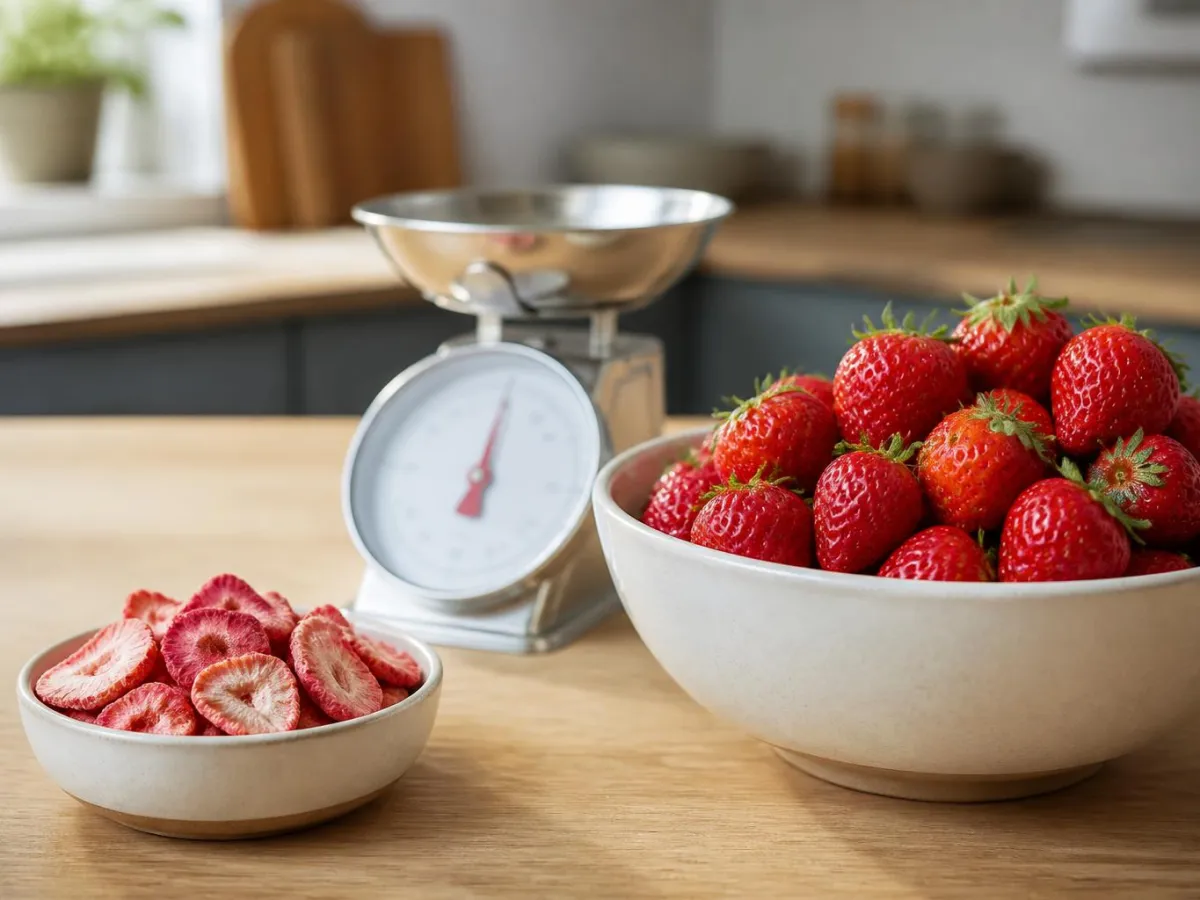
Freeze-dried fruit makes the arithmetic counter-intuitive, because the pieces weigh almost nothing while carrying the full sugar load of the fresh fruit. Fresh strawberries are about 90 per cent water, so taking it away leaves roughly a tenth of the weight behind: about ten parts of fresh fruit for one part freeze-dried. Here is what that looks like for plain freeze-dried strawberries.
| Plain freeze-dried strawberry | Roughly the fresh fruit it came from | Typical sugars |
|---|---|---|
| 1g | about 10g | about 0.5 to 0.6g |
| 5g | about 50g | about 2 to 3g |
| 10g, one human serving | about 100g | about 5 to 6g |
These are typical values and ranges, not a specification. Sugar content varies with the fruit, the variety, the ripeness and the producer, so the label on your pack is what counts. Our fresh to freeze-dried converter does the same sums for other fruits and amounts, and the sugar in freeze-dried fruit page explains the concentration effect in more detail for people.
For context on the human side: the NHS counts 30g of dried fruit as one of your 5 A Day, and advises eating dried fruit with meals rather than between them, to reduce the risk of tooth decay, which our page on freeze-dried fruit and teeth covers in full. None of that transfers to animals. Dogs and cats have no 5 A Day, and the sensible amount for a pet is very much smaller than a human portion. We are not printing a figure in grams, because the right amount depends on your dog's size, weight, condition and the rest of their diet. That is a question for your vet.
What to check on the pack before giving freeze-dried fruit to a pet
- The ingredients list. For freeze-dried blueberries it should read "blueberries" and stop. One word is the goal.
- Added sugar or sweeteners. Some dried fruit is sugar-infused. Sugar-free products are worse, because xylitol is the risk.
- Coatings. Yoghurt and chocolate coatings rule a product out. Our chocolate-covered freeze-dried strawberries are for people.
- Raisins and sultanas hiding in a blend. Check every mixed pack, every time.
- Onion and garlic in savoury vegetable mixes. Including as "flavouring".
- Whole pieces versus crumbs. Crisp pieces can be crumbled, which is safer for small animals and useful for training.
Which pets can have freeze-dried fruit
| Pet | Does it need fruit? | What UK vet charities advise |
|---|---|---|
| Dog | No | PDSA: dogs do not need fruit or vegetables, but can have a small amount as an occasional treat; treats no more than 10 per cent of the daily food allowance |
| Cat | No | PDSA: cats are obligate carnivores and need meat; fruit and vegetables only in very small quantities as an occasional treat, within the same 10 per cent |
| Rabbit | No | RSPCA: mostly hay and grass, with fruit and root vegetables in very small amounts as an occasional treat |
| Guinea pig | No | PDSA: hay and grass should be 80 to 90 per cent of the diet; fresh fruit in very small amounts because it is high in sugar |
| Hamster | No | PDSA: a teaspoon or two a day of fresh fruit, vegetables and herbs; avoid overfeeding sugary fruit |
| Parrot or other pet bird | Fruit and vegetables, yes | RSPCA: about three-quarters pellets and about one quarter washed fruit and vegetables; avocado is highly poisonous |
Can cats eat freeze-dried fruit?
Usually they will not want to. Cats are obligate carnivores: PDSA explains that they need meat to get nutrients such as taurine and arginine, which their bodies cannot make. Fruit and vegetables are not part of what a cat needs, although PDSA notes many can be given in very small quantities as an occasional treat.
In practice a crumb of plain freeze-dried fruit is unlikely to do harm and equally unlikely to be eaten: cats cannot taste sweetness, which is why the question matters less for them than for dogs. The same 10 per cent treat rule applies, and the same foods are off the list: onion, garlic, chives and leeks, chocolate and caffeine. Grape toxicity is far better documented in dogs than in cats, but there is no reason to test it.
Can rabbits eat freeze-dried fruit?
Only in very small amounts, and it is a poor choice of treat. The RSPCA is clear that most of a rabbit's diet should be fresh hay and grass, with some leafy greens and a few pellets, and that root vegetables and fruit such as carrots and apples should be given only in very small amounts as an occasional treat, because a rabbit's natural diet does not include them.
Two things make freeze-dried fruit a worse fit than fresh for rabbits. It is dry, and rabbits get a useful amount of moisture from fresh greens. And it is concentrated sugar in a form that is very easy to overfeed, because a generous-looking pinch weighs almost nothing. Sugary, low-fibre food is associated with dental and digestive problems in rabbits, and nothing crisp replaces the long fibre of hay, which is what keeps their guts moving and their teeth worn down. If you want to give an occasional treat, a shred of freeze-dried apple is plausible; a handful is not.
Can guinea pigs eat freeze-dried fruit?
The same answer, with one addition. PDSA advises that hay and grass make up 80 to 90 per cent of a guinea pig's diet, plus a daily selection of fresh greens and vegetables and a small amount of pellets, and that fresh fruit should be given in very small amounts because it is high in sugar.
The addition is vitamin C. Guinea pigs cannot make their own vitamin C and need it from their food, and PDSA's recommendation for that is a daily portion of fresh greens high in vitamin C, not dried fruit. Do not treat freeze-dried fruit as a vitamin C strategy for a guinea pig. Treat it as a sweet, an occasional one, and talk to your vet if you are worried about your guinea pig's diet.
Freeze-dried fruit for hamsters
Hamsters are the one small pet for which freeze-dried fruit fits reasonably naturally, because PDSA describes a small daily portion of fresh fruit, vegetables and herbs as good for variety, and puts the amount at a teaspoon or two a day. A crumb of plain freeze-dried fruit can sit inside that.
The warnings are about sugar and about weight. PDSA cautions against overfeeding sugary fruit and vegetables because of obesity and diabetes, and singles out Russian dwarf hamsters as particularly prone to diabetes. Since freeze-dried fruit is roughly ten times as concentrated as fresh by weight, a piece that looks like a modest nibble is not equivalent to the same-sized piece of fresh fruit. If your hamster is a dwarf species, ask your vet before offering sweet treats of any kind.
Can birds eat freeze-dried fruit?
Pet birds are the one group here that genuinely needs fruit and vegetables. The RSPCA advises that about three-quarters of a parrot's diet should be nutritionally complete pellets and about one quarter washed fruit and vegetables, listing options such as carrots, broccoli, peas, de-seeded apples, grapes, pomegranates and blueberries.
Note the difference: grapes are on the RSPCA's list for parrots and are one of the most dangerous foods for dogs. Species matters more than the food does.
Freeze-dried fruit is not a replacement for that quarter of the diet, because the RSPCA specifies washed fresh fruit and vegetables, and the water, weight and texture are all part of why. Dried pieces are best thought of as foraging enrichment rather than food. The absolute rule for birds is avocado: the RSPCA says avocado is highly poisonous to parrots and must not be given, and the persin it contains is dangerous to rabbits too. If you keep birds, an avian vet is worth asking before you change anything about the diet.
Practical rules for giving freeze-dried fruit to pets
Buy plain, read the ingredients, give tiny amounts, and never give grapes, raisins, sultanas or currants to a dog in any form, freeze-dried included. Crumble rather than offering whole crisp pieces, count whatever you give towards your pet's treat allowance rather than on top of it, and remember that the missing water is what makes a small pinch a surprising amount of sugar. If your pet is diabetic, overweight, very young, very old or on a prescription diet, ask your vet first and take their answer over anything written here.
For the human side of the same caution about crisp pieces and concentrated sugar, see freeze-dried fruit for babies and toddlers. Crispberry's own shop is not open yet, and when it opens it will sell food for people rather than pet products.
Good questions, short answers
Can dogs eat freeze-dried fruit?
Small amounts of plain freeze-dried fruit such as strawberry, blueberry, banana or de-cored apple are generally fine as an occasional treat, provided nothing has been added. Grapes, raisins, sultanas and currants must never be given, and neither must anything containing onion, garlic, chocolate or the sweetener xylitol. PDSA points out that dogs do not need fruit or vegetables at all, so this is a treat rather than a food they are missing. Ask your vet before introducing anything new, particularly if your dog has a health condition.
Can dogs eat freeze-dried strawberries?
Plain freeze-dried strawberries with no added sugar, sweetener or coating are on the safer side, because PDSA lists strawberries among the fruits dogs can have in very small quantities as an occasional treat. Remember that freeze-dried fruit is concentrated: the water has gone, so gram for gram it carries roughly ten times the sugar of the fresh berry. Crumble a piece rather than offering a whole crisp berry, and keep it well inside your dog's treat allowance.
Are freeze-dried grapes safe for dogs?
No. Grapes, raisins, sultanas and currants all come from the same fruit, Vitis vinifera, and PDSA describes them as containing toxins that are potentially fatal to dogs, with dried forms being especially dangerous. The toxic dose varies from dog to dog and can be very small, so there is no amount that can be called safe. Freeze-drying removes water and nothing else, so a freeze-dried grape is simply a very light raisin. If your dog has eaten any, ring your vet straight away rather than waiting for symptoms.
Can cats eat freeze-dried fruit?
Cats are obligate carnivores, which means they need meat for nutrients such as taurine that they cannot make themselves. PDSA says cats do not need fruit or vegetables in their diet, although many can be given in very small quantities as an occasional treat. Most cats show no interest in fruit at all, and there is no reason to encourage it. If you do offer a crumb of plain freeze-dried fruit, keep it within the 10 per cent of daily food allowance that PDSA suggests for treats.
Can rabbits and guinea pigs eat freeze-dried fruit?
Only in very small amounts as an occasional treat. The RSPCA advises that a rabbit's diet should be mostly hay and grass, with fruit and root vegetables given only in very small amounts, and PDSA says hay and grass should make up 80 to 90 per cent of a guinea pig's diet, with fresh fruit kept small because it is high in sugar. Dry crisp pieces are not a substitute for hay, which is what their guts and teeth actually need. Guinea pigs also need vitamin C from their food, and PDSA recommends fresh greens for that rather than dried fruit.
Can hamsters eat freeze-dried fruit?
A crumb of plain freeze-dried fruit is usually acceptable as part of the small daily portion of fruit, vegetables and herbs that PDSA describes, which is a teaspoon or two a day of fresh food. Because freeze-dried fruit weighs about a tenth of the fresh fruit it came from, the same amount by volume is far more sugar than it looks. PDSA warns against overfeeding sugary fruit and vegetables because of obesity and diabetes, and notes that Russian dwarf hamsters are particularly prone to diabetes. Check with your vet if you are unsure.