
Fresh to freeze-dried converter
Explore how assumed water content changes weight. The results are modelled amounts, not a measurement of the fruit used to make yo...
Little calculators that take the guesswork out of swapping fresh for freeze-dried.
Explore how assumed water content changes weight. The results are modelled amounts, not a measurement of the fruit used to make yo...
Our tools are free calculators for freeze-dried fruit and vegetables, written for UK kitchens and working in grams and millilitres throughout. The one you can use today, the fresh to freeze-dried converter, turns any weight of fresh fruit or veg into its freeze-dried equivalent and back again, for 18 common foods.
There is nothing to download, nothing to sign up for and no app. Type a number in, read the answer off the screen, and get on with your baking or your packing.
The converter exists because freeze-dried food breaks the mental arithmetic most of us do with fruit. A pouch that weighs 40g holds what was once several hundred grams of fresh fruit, so neither the pack weight nor the look of a handful tells you much. Put a weight in and the converter tells you:
Four sorts of people tend to need it: bakers swapping fruit in a recipe, walkers working out pack weight, parents and anyone else checking what a small serving really adds up to, and people with a home freeze-dryer trying to predict a yield.
| Tool | The question it answers | Status |
|---|---|---|
| Fresh to freeze-dried converter | How many grams of fresh fruit are in this freeze-dried weight, and the other way round, for 18 foods | Available now |
| Rehydration water calculator | How much water to add to a given weight of freeze-dried fruit or veg, and how long to leave it | In the works, no date promised |
| Price per 100g comparison | Which pack is better value once you compare by weight rather than by pack | In the works, no date promised |
| Freeze-dryer batch cost calculator | What one batch costs to run at your own pence-per-kWh electricity rate | In the works, no date promised |
Until the cost calculator is ready, the numbers and the method behind it are set out in our guide to the running costs of a home freeze-dryer.
Every fresh fruit and vegetable is mostly water. Freeze-drying freezes that water and then draws it off as vapour under vacuum, leaving the solids behind with only a little residual moisture. Our converter assumes a finished product at about 3 per cent moisture, which is typical of commercial freeze-dried fruit and drier than air-dried fruit usually ends up; the difference is set out in freeze-dried versus dehydrated fruit. The rest is arithmetic:
ratio = 97 ÷ (100 − water content of the fresh food)
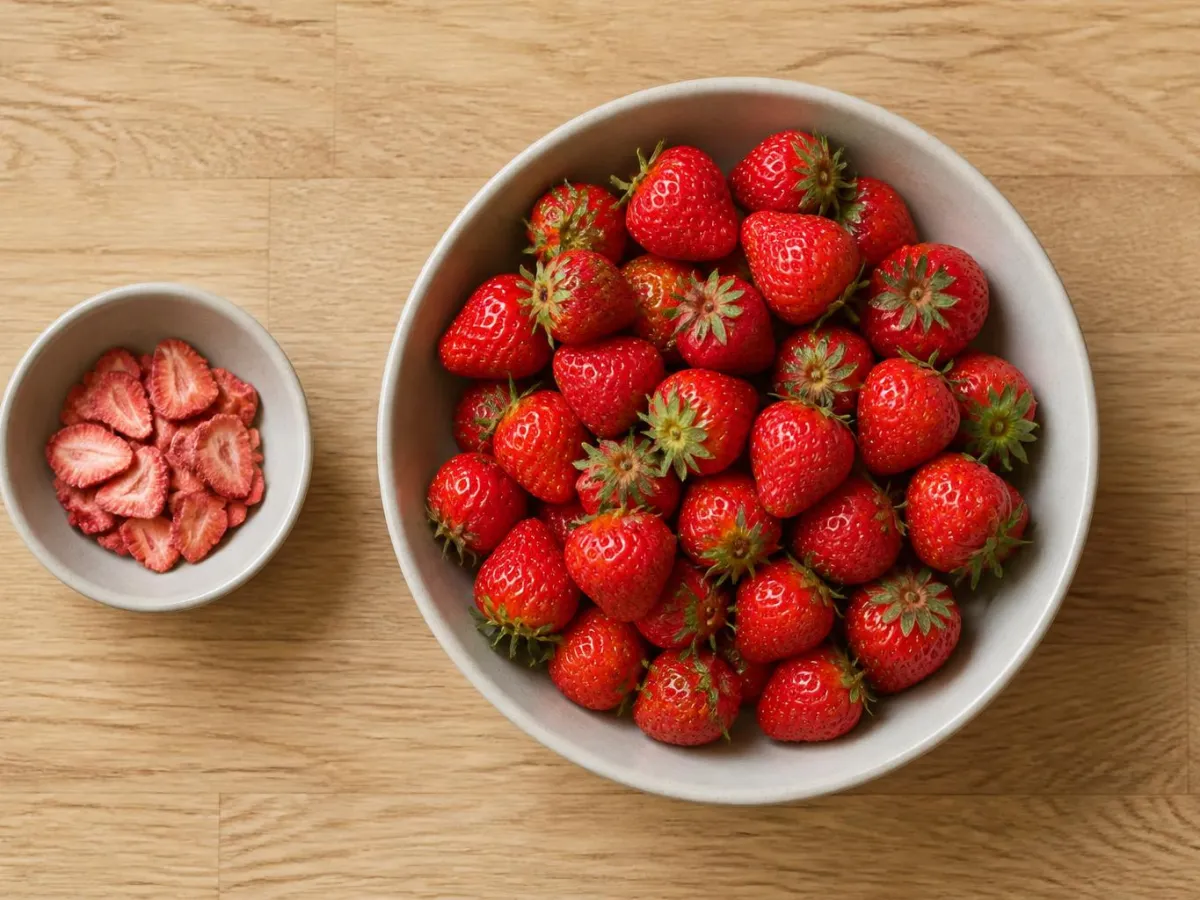
Take strawberries, which are roughly 91 per cent water. Drying 100g of them leaves about 9g of solids, and those 9g come out of the machine at about 9.3g once you allow for the moisture still in there. So the ratio is about 11 to 1, and a 10g handful of freeze-dried strawberries began life as a little over 100g of fresh fruit. A banana is only about 75 per cent water, so it holds on to getting on for three times as much of its weight: the ratio is closer to 4 to 1.
| Food | Typical water when fresh | Fresh to freeze-dried | 10g freeze-dried is about |
|---|---|---|---|
| Strawberries | 91% | 11 to 1 | 108g fresh |
| Raspberries | 86% | 7 to 1 | 69g fresh |
| Blueberries | 84% | 6 to 1 | 61g fresh |
| Apple | 86% | 7 to 1 | 69g fresh |
| Banana | 75% | 4 to 1 | 39g fresh |
| Peas | 79% | 4.6 to 1 | 46g fresh |
| Sweetcorn | 76% | 4 to 1 | 40g fresh |
| Tomato | 94% | 16 to 1 | 162g fresh |
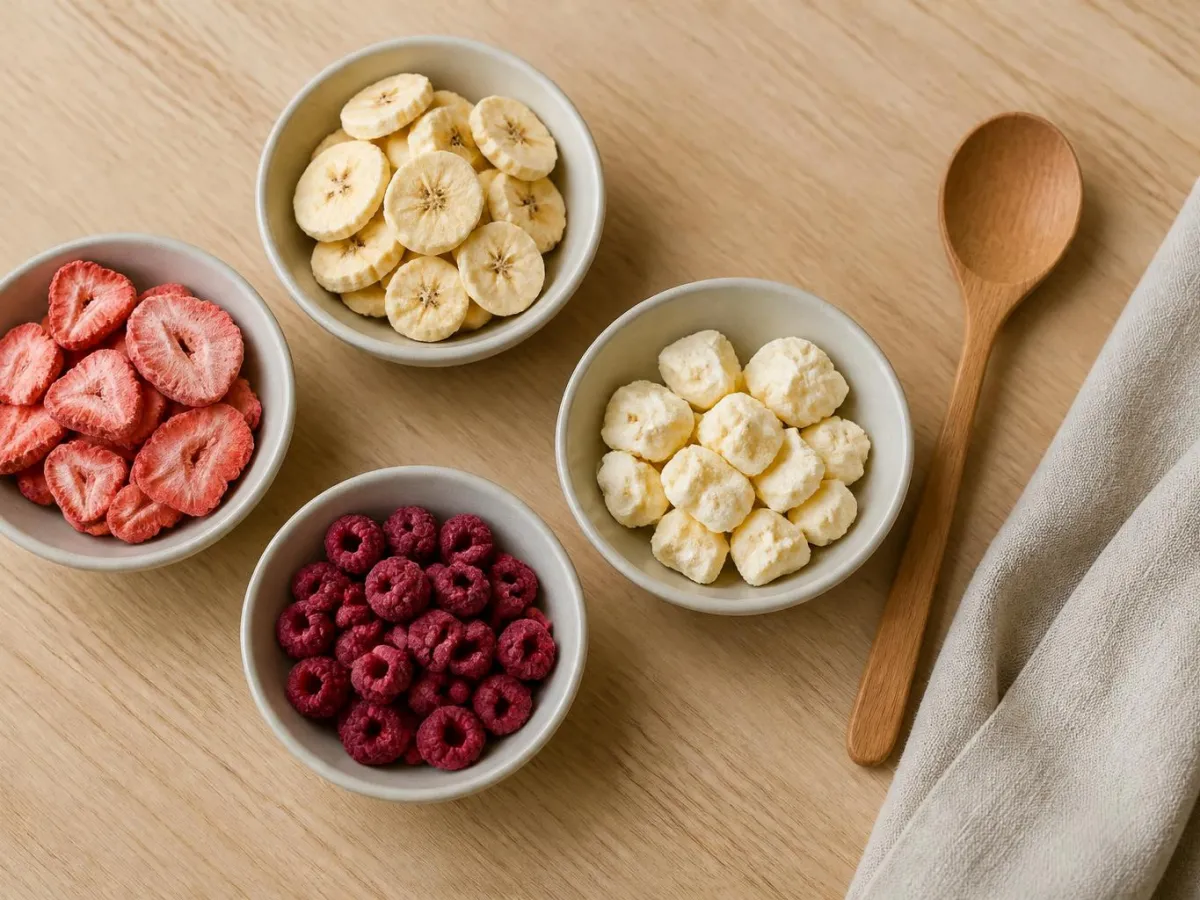
These are estimates built on typical water contents from published UK composition data. Varieties, ripeness, the season and how far a particular producer dries their fruit all move the numbers, so take them as a good working guide rather than an exact figure. The converter carries all 18 foods, including freeze-dried strawberries, berries, stone fruit and vegetables.
Baking. A muffin recipe asks for 150g of fresh blueberries. Divide by 6 and you need about 25g of freeze-dried blueberries. The batter loses the juice the fresh fruit would have given it, so add a splash of milk, 15 to 30ml, to bring it back.
Predicting a yield. A kilogram of fresh strawberries will come out of a freeze-dryer at roughly 90 to 100g. That is the figure to hold in your head before you fill a machine or a jar.
Packing for a walk. Fifty grams of freeze-dried strawberries in a rucksack stands in for roughly 540g of fresh ones, which is the whole reason they turn up in freeze-dried food for hiking and camping.
The concentration cuts both ways. Removing the water concentrates the fruit's own sugars and its calories just as much as everything else, so weight for weight freeze-dried fruit is far sweeter and far more calorific than the fresh fruit it came from; there is more on that in our page on sugar in freeze-dried fruit. Figures vary from product to product, so any typical range is only a guide and the label on your own pack is what counts. That concentration is why a typical serving is about 10g, not the 80g that counts as a portion of fresh fruit.
The NHS counts a 30g portion of dried fruit as one of your 5 A Day, and advises eating dried fruit with a meal rather than as a between-meal snack, to reduce the risk of tooth decay. It does not publish a separate figure for freeze-dried fruit. So when the converter tells you that your handful began as 108g of fresh strawberries, that number is genuinely useful in the kitchen, but it is not an official portion count. There is more on both points in our pages on freeze-dried fruit and 5 A Day and freeze-dried fruit and your teeth.
For babies and young children, crisp freeze-dried pieces can be a choking risk. Soften them in a little water or milk, or crush them to a powder and stir them into food, and follow NHS weaning guidance. Speak to your health visitor or GP about what suits your own child. Our page on freeze-dried fruit for babies and toddlers goes into it properly.
A ratio is not a nutrition label and not a texture prediction. The calculators will not tell you:
This section will grow. The rehydration, value-comparison and batch-cost calculators above are the next three on the list, and we are not putting dates on them until they are finished and working properly.
Our shop is not open yet either. Nothing on Crispberry is for sale today; the plan is to open in a few months, and you can join the list at the bottom of any page to hear when that happens and when a new tool appears.
Divide a fresh weight by the ratio for that fruit to get the freeze-dried weight, multiply to go the other way, and remember that the sugar concentrates along with everything else. Keep servings around 10g, eat dried and freeze-dried fruit with meals rather than between them, and let the fresh to freeze-dried converter do the sums so you do not have to.
Divide the fresh weight by the ratio for that fruit. Most fruit and veg sit between about 4 to 1 and 11 to 1, with very watery vegetables such as tomato higher still, so 150g of fresh blueberries at 6 to 1 becomes about 25g of freeze-dried. The converter does the sum for 18 foods in both directions, in grams.
Yes. Every Crispberry tool works in grams and millilitres, which is what UK recipes, kitchen scales and pack labels use. Nothing has to be converted out of imperial or volume measures first, and the converter reads in both directions.
The NHS counts a 30g portion of dried fruit as one of your 5 A Day, and advises eating dried fruit with a meal rather than between meals to reduce the risk of tooth decay. It does not publish a separate figure for freeze-dried fruit, so the fresh-weight number in the converter is useful for cooking but is not an official portion count.
Because the water has gone and everything else has stayed. Weight for weight, freeze-dried fruit is far more concentrated in sugar and calories than the fresh fruit it came from, which is why a typical serving is about 10g rather than 80g. Products vary, so the label on your pack is what counts.
Yes. They run in your browser, there is nothing to download and no sign-up. Our shop is not open yet, so nothing on the site is for sale today; you can join the list to hear when it opens and when a new tool goes live.
Join the list for new guides and easy recipes. One or two emails a month, never more.
We only use your email to send you our newsletter. Unsubscribe any time. See our privacy notice.