
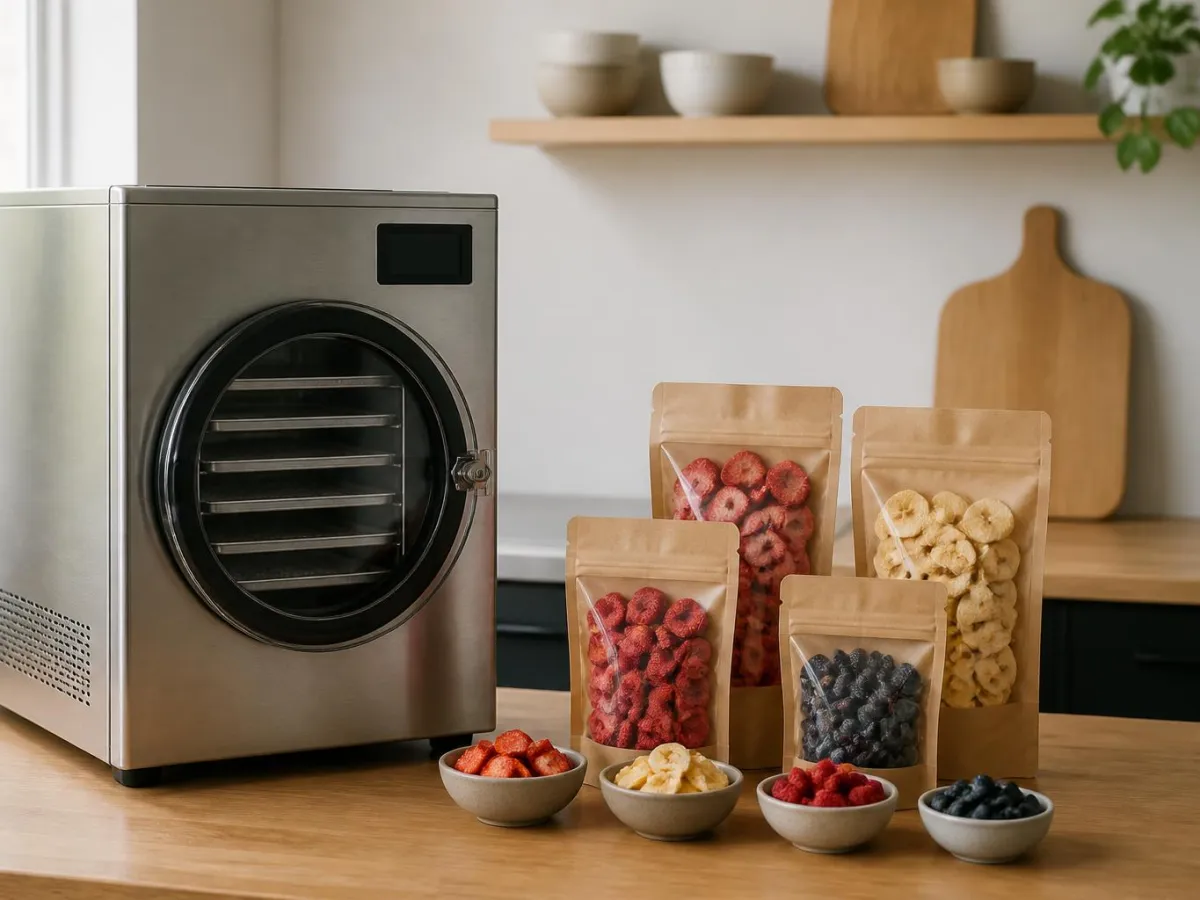
Is a home freeze dryer worth it?
For most UK households the arithmetic does not work. Here is the method for costing it yourself, a worked example per kilogram, an...
A four-figure machine that runs for a day or more per batch. Here is the UK buying picture, the running-cost arithmetic and an honest verdict.
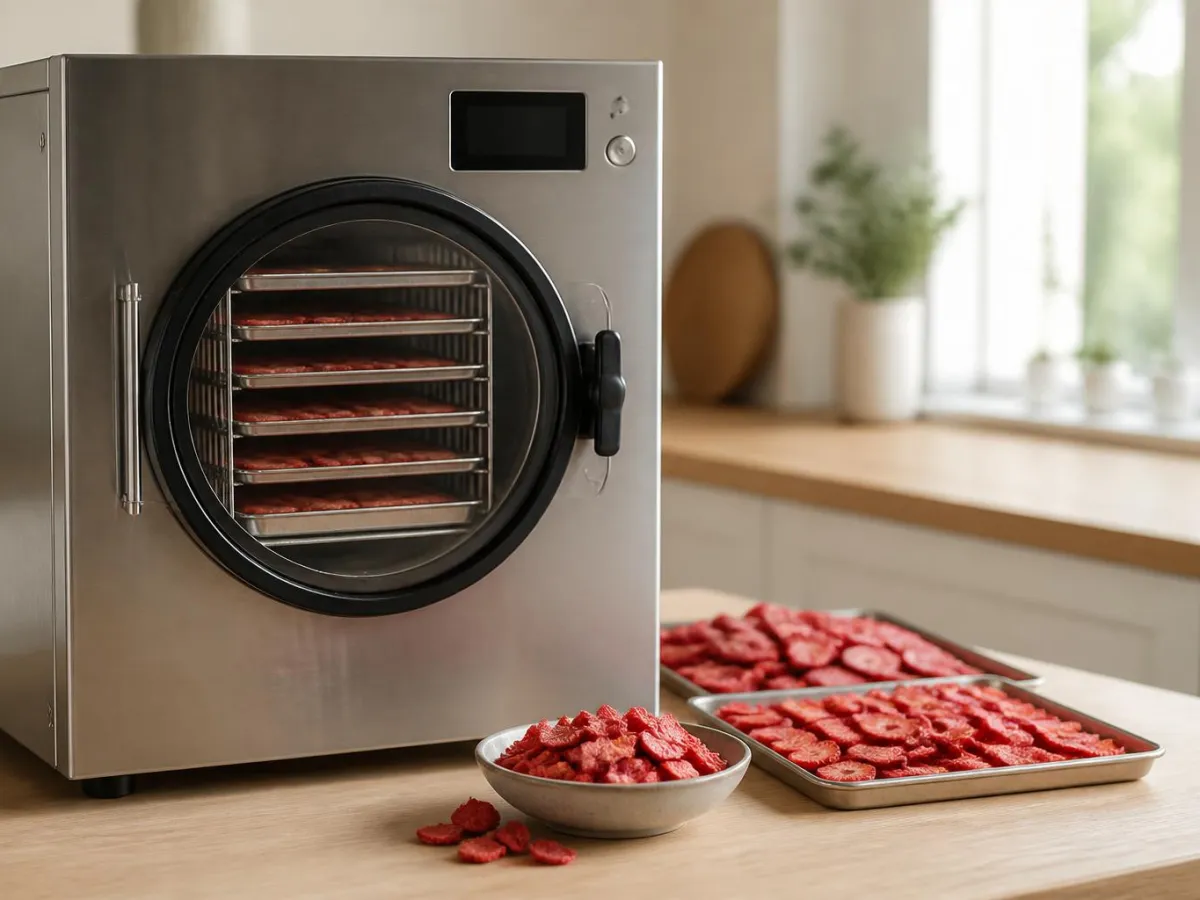
For most UK households the arithmetic does not work. Here is the method for costing it yourself, a worked example per kilogram, an...
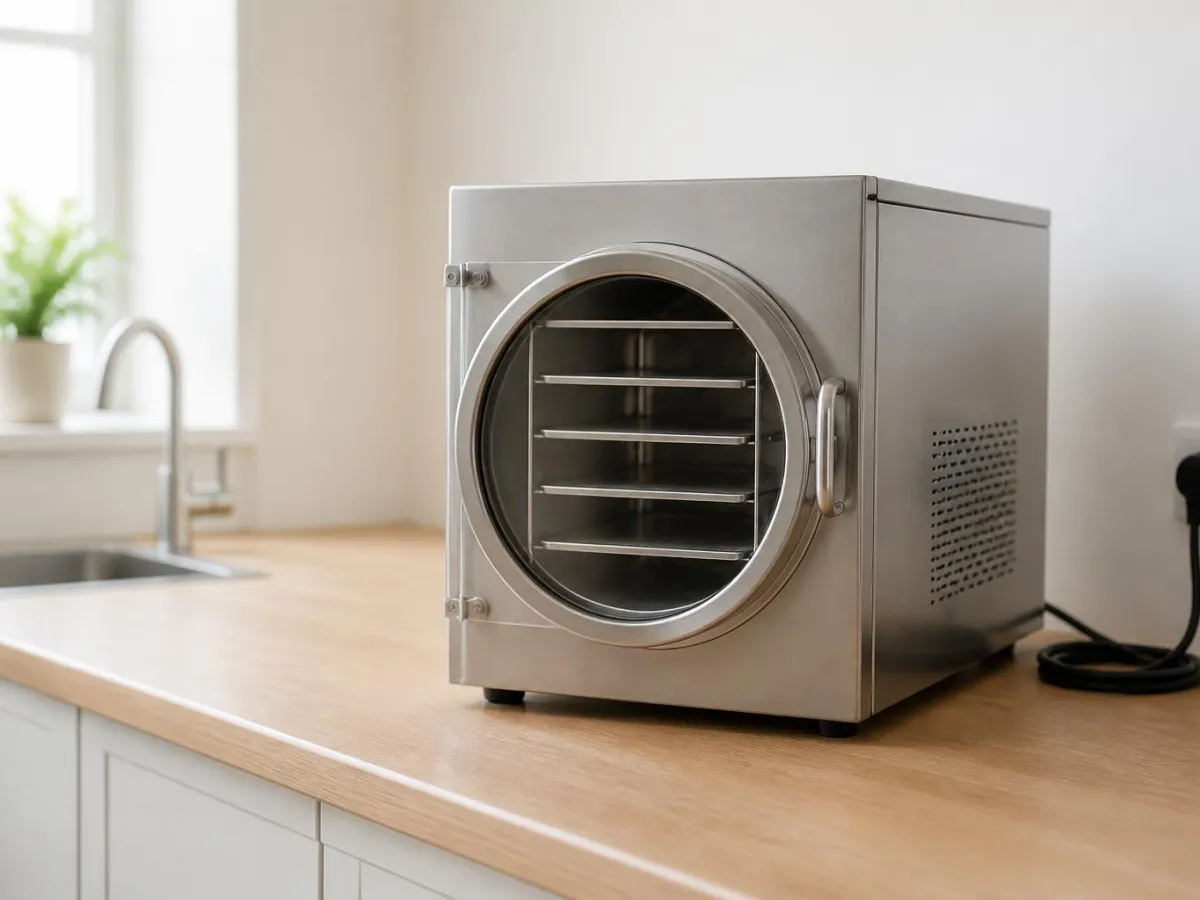
The electricity cost of a freeze-drying cycle is simple arithmetic: kilowatts, hours and your own unit rate. Here is the method, w...
A home freeze dryer is a small vacuum chamber with a freezer, heated shelves and a pump, which dries food from frozen so it stays crisp and keeps its shape; in the UK it is a four-figure purchase that runs for a day or more per batch. For most households the sums do not work: unless you regularly have surplus food you would otherwise waste, buying ready-made freeze-dried fruit is cheaper, quieter and far less trouble.
This section is the buyer's side of the story: what the machines actually do, how they differ from a dehydrator, what the UK buying situation looks like, what a batch costs in electricity, and who the honest answer suits.
Four things live in one cabinet: a refrigeration system that freezes the food hard, a vacuum pump that lowers the pressure until ice can no longer melt, gently heated shelves that push the ice into turning straight to vapour, and a cold surface that catches that vapour as frost. The change from solid ice to vapour without passing through liquid is sublimation, and it is the whole trick. Our guide to what freeze-drying is explains the process in full.
In practice you load trays, close the door, press start and wait. A batch commonly runs for 20 to 40 hours, and wet, sugary or thickly loaded trays run longer. The machine cannot be hurried, it is not silent, and it wants a permanent home on a solid floor with air around it rather than a spot on the worktop.
| Comparison | Home freeze dryer | Food dehydrator | Buying ready-made |
|---|---|---|---|
| Typical price to buy | Four figures, from around a thousand pounds upwards depending on size | Usually under £150 for a domestic model | Nothing to buy |
| Illustrative electricity per batch | About £5.25 to £10.50 | About £0.40 to £1.60 | None |
| Time per batch | 20 to 40 hours, sometimes longer | 6 to 12 hours for fruit | None |
| Water removed | Nearly all, leaving a few per cent | Most, but noticeably more is left | Nearly all |
| Result | Crisp, holds its original shape and colour | Chewy and leathery, shrunken and darker | Crisp |
| Time to soften in water | 2 to 5 minutes for slices | Slow, and never fully | 2 to 5 minutes |
| Space and noise | Floor-standing cabinet plus pump, running day and night | Worktop box, fan noise for a few hours | None |
| Best suited to | A regular glut of home-grown or surplus food | Everyday dried fruit, herbs and jerky | Almost everybody else |
The electricity figures are arithmetic, not measurements: they assume an average draw of about 1kW over 20 to 40 hours for the freeze dryer and 250W to 500W over 6 to 12 hours for the dehydrator, priced at the 26.32p per kWh direct debit electricity unit rate under Ofgem's price cap for 1 October to 31 December 2026. The cap changes every three months, tariffs differ, and machines differ, so treat the shape of the numbers rather than the numbers themselves as the point. Price guides last checked September 2026.
The deeper comparison of the two drying methods, and what each does to texture and flavour, is in freeze-dried vs dehydrated fruit.
Almost every home freeze dryer sold here is designed and built abroad, chiefly in the United States, and reaches UK buyers through a maker's UK-facing site, a small number of UK resellers, or marketplace listings. There is no established British manufacturer of domestic machines, which is why prices here carry shipping, VAT and reseller margin, and why availability comes and goes.
Budget for more than the cabinet:
Prices, models and specifications change frequently, so check current listings and the manufacturer's own specification sheet rather than any figure in an article.
The arithmetic is simple: power in kilowatts, multiplied by hours, multiplied by the pence per kWh on your bill. The table below works one illustrative batch of berries all the way through, so you can swap in your own numbers.
| Step | Assumption | Result |
|---|---|---|
| Fresh berries loaded | 5kg | — |
| Freeze-dried fruit out | Berries are roughly 90 per cent water, so close to 10:1 fresh to dried | About 500g |
| Batch length | 30 hours | — |
| Average power draw | 1 kW | 30 kWh |
| Electricity at 26.32p per kWh | Ofgem cap rate, 1 Oct to 31 Dec 2026 | About £7.90 |
| Electricity per 100g of dried fruit | — | About £1.60 |
| Fruit at an assumed £5 per kg | Use your own figure | £25.00 |
| Fruit per 100g of dried fruit | — | £5.00 |
| Fruit plus electricity, per 100g dried | Machine not included | About £6.60 |
Those are assumptions, not findings, and the last line is the important one. Across UK online retailers, plain freeze-dried strawberries have commonly sat somewhere around £5 to £11 per 100g, last checked September 2026, so home-drying bought fruit lands in roughly the same territory before you have paid a penny towards the machine. Replace the fruit line with £0 for a glut of allotment raspberries or a reduced-to-clear tray, and the picture changes completely.
Home freeze-dryer running costs works the electricity through in more detail, including longer batches and bigger cabinets, and whether a home freeze-dryer is worth it puts the machine, the consumables and the hours together.
Because the machines are imported, four things are worth settling before you pay.
Voltage and plug. Buy the 230V version sold for the UK with a fitted three-pin plug. A 110V machine on a step-up converter is a poor idea for something that runs for 30 hours unattended.
Duty, VAT and handling. If you order from outside the UK yourself, import VAT and possibly customs duty are charged before the goods are released, and the courier adds its own handling fee on top. GOV.UK's guide to goods sent from abroad sets out the current thresholds. Buying from a UK-based seller at a duty-paid price in pounds sterling means the number you see is the number you pay.
Safety marking. Products placed on the Great Britain market need the conformity marking their regulations require, which for electrical goods means a UKCA or CE mark. If you import a machine directly yourself rather than buying from a UK seller, you may take on the importer's responsibilities for that.
Warranty, parts and repair. This is where imported equipment bites. Ask who carries out repairs in the UK, where spare pumps and parts come from, how long a typical repair takes, and who pays the carriage. Your rights are far easier to exercise against a UK-based seller than against an overseas one, and returning a heavy machine across an ocean at your own cost is nobody's idea of a warranty.
One question settles most of it: if this machine stops working in month 14, who fixes it, and what will that cost me? Get the answer in writing before you buy.
It genuinely suits a small group:
It does not suit a household that wants crisp berries for porridge, a small flat, a rented kitchen with no floor space, or anyone hoping to save money on snacks. For those, a bought pack of freeze-dried strawberries asks nothing of your floor space or your evening, and on the arithmetic above it rarely costs more than drying shop-bought fruit yourself.
It does not sterilise food. Freeze-drying preserves by taking water away, not by killing bacteria. Start with food that is fit to eat, handle it hygienically, cook anything that needs cooking before it goes in, and do not treat the machine as a food-safety step.
It does not guarantee decades of shelf life. Very long storage claims are easy to find and hard to verify. How your own food keeps depends on how dry it really is, how well it is sealed and where it is kept. Our storage and shelf life section covers packaging, desiccants and the warning signs.
It does not make fruit less concentrated. Whether the pieces come from your machine or a pack, the water has gone, so weight for weight freeze-dried fruit has far more sugar and far more calories than fresh fruit. Roughly 10kg of fresh berries leaves about 1kg of dried pieces, which is why plain freeze-dried strawberries typically sit somewhere around 350 to 400 kcal and 45 to 60g of naturally occurring sugars per 100g. Those are typical ranges rather than figures for any one product: varieties, batches and packers differ, so the label on the pack is what counts, and our page on calories in freeze-dried fruit works through the comparison with fresh. A serving is about 10g. The NHS counts 30g of dried fruit as one of your 5 A Day, and advises eating it with a meal rather than between meals, to reduce the risk of tooth decay, which is covered in freeze-dried fruit and 5 A Day and freeze-dried fruit and teeth.
If you are drying for a baby or a dog: crisp pieces can be a choking risk for babies and young children, so soften or powder them, follow NHS weaning guidance and ask your health visitor or GP about your own child, as in our guide to freeze-dried fruit for babies and toddlers. Grapes, raisins, sultanas and currants are toxic to dogs, and a dried grape is a raisin, so freeze-dried grapes are out too. Stick to small amounts of plain fruit that is safe for that animal and check with your vet first, as in freeze-dried fruit for pets.
Home freeze dryers are impressive machines that suit very few British households. The purchase is four figures, the electricity for a single batch is several pounds, each batch ties up a day or more, and the finished fruit only undercuts shop prices when the raw fruit was free or nearly free. Add imported-equipment risk on warranty and parts, and the case narrows further.
So: if you have a regular surplus of food you would otherwise waste, or a business reason, work the numbers properly on the running costs and is it worth it pages, and ask a seller the month-14 repair question before committing. If you simply want crisp fruit in your porridge, buy a small pack, keep it sealed and treat 10g as a serving. Crispberry's own shop is not open, so there is nothing to order here and no price or delivery for us to quote; you can join the list below if you would like to hear from us when that changes.
Expect a four-figure sum for the machine itself, with small cabinets at the bottom of the range and large ones well above it; that guide was last checked in September 2026. On top of that come pouches, a heat sealer, oxygen absorbers, spare trays and pump oil or a filter if the machine uses an oil-filled vacuum pump. Models, sellers and prices change often, so check current listings rather than trusting a figure quoted in any article, including this one.
The sum is kilowatts multiplied by hours multiplied by your unit rate. A 30-hour batch at an average draw of one kilowatt is about 30 kWh, which works out at roughly £7.90 at the 26.32p per kWh direct debit electricity rate Ofgem's price cap sets for 1 October to 31 December 2026. Use the power rating in your machine's own specification and the unit rate on your latest bill, because both vary.
They do different jobs. A freeze dryer removes nearly all the water and leaves food crisp and close to its original shape, which is what makes freeze-dried strawberries snap. A dehydrator uses warm moving air, leaves more water behind and gives chewy, shrunken fruit, which is what you want for flapjacks and jerky. A dehydrator costs a small fraction of a freeze dryer to buy and a fraction to run.
For most households, no. The machine is a four-figure purchase, each batch runs for a day or more, and if you buy the fruit at supermarket prices the cost per 100g of finished fruit lands in similar territory to buying it ready-made. It starts to make sense if you regularly have a glut of home-grown or surplus food you would otherwise throw away, or a specific reason such as long-life stores or a small food business.
Not properly. Leaving food in a frost-free freezer does remove a little water by sublimation over several weeks, but it is slow, uneven, and you have no way of knowing how dry the food really is, which matters for how it keeps. Methods circulated online often overstate the result. If you want crisp, shelf-stable fruit, a machine or a bought pack is the realistic route.
Buy the 230V version sold for the UK with a fitted three-pin plug, rather than a 110V machine plus a converter. Many home machines run from an ordinary 13A socket, but larger cabinets can ask for more, so check the power and circuit requirement in the manufacturer's own specification before you order, and get an electrician's view if a dedicated circuit is mentioned.
Join the list for new guides, easy recipes and a friendly nudge on launch day. One or two emails a month, never more.
We only use your email to send you our newsletter. Unsubscribe any time. See our privacy notice.