Freeze-dried fruit for babies and toddlers
Crisp freeze-dried pieces are a choking risk for babies and young children. How to serve fruit safely by age, what NHS weaning guidance says about sugar and teeth, and when to ask your health visitor.
On this page
- Can babies eat freeze-dried fruit?
- When can babies have freeze-dried fruit?
- Why crisp freeze-dried fruit is a choking risk for babies
- How to serve freeze-dried fruit safely, age by age
- What NHS weaning guidance says about sugar in baby food
- Freeze-dried fruit, dried fruit and young children's teeth
- How to read the label on toddler fruit snacks
- Serving ideas for babies and toddlers
- When to ask your health visitor or GP
Do not give a baby a crisp, dry piece of freeze-dried fruit: hard, brittle food is a choking risk, and the safe forms are powder stirred into something soft, or fruit soaked until it gives way completely. From around six months, which is when the NHS advises starting solid foods, plain freeze-dried fruit served that way can be part of a varied weaning diet, and because it is concentrated fruit sugar the NHS dried-fruit advice applies too: give it with meals rather than between them.
There is no NHS guidance on freeze-dried fruit specifically. Everything below applies the guidance that does exist, on starting solids, on hard foods and choking, on sugar and on dried fruit and teeth, and says plainly where that guidance runs out.
Not medical advice, and not reviewed by a health professional. This is general information about a food, written by the Crispberry team. Your health visitor, GP or dentist knows your child and we do not. Please follow NHS weaning guidance and ask them about anything that concerns you.
Can babies eat freeze-dried fruit?
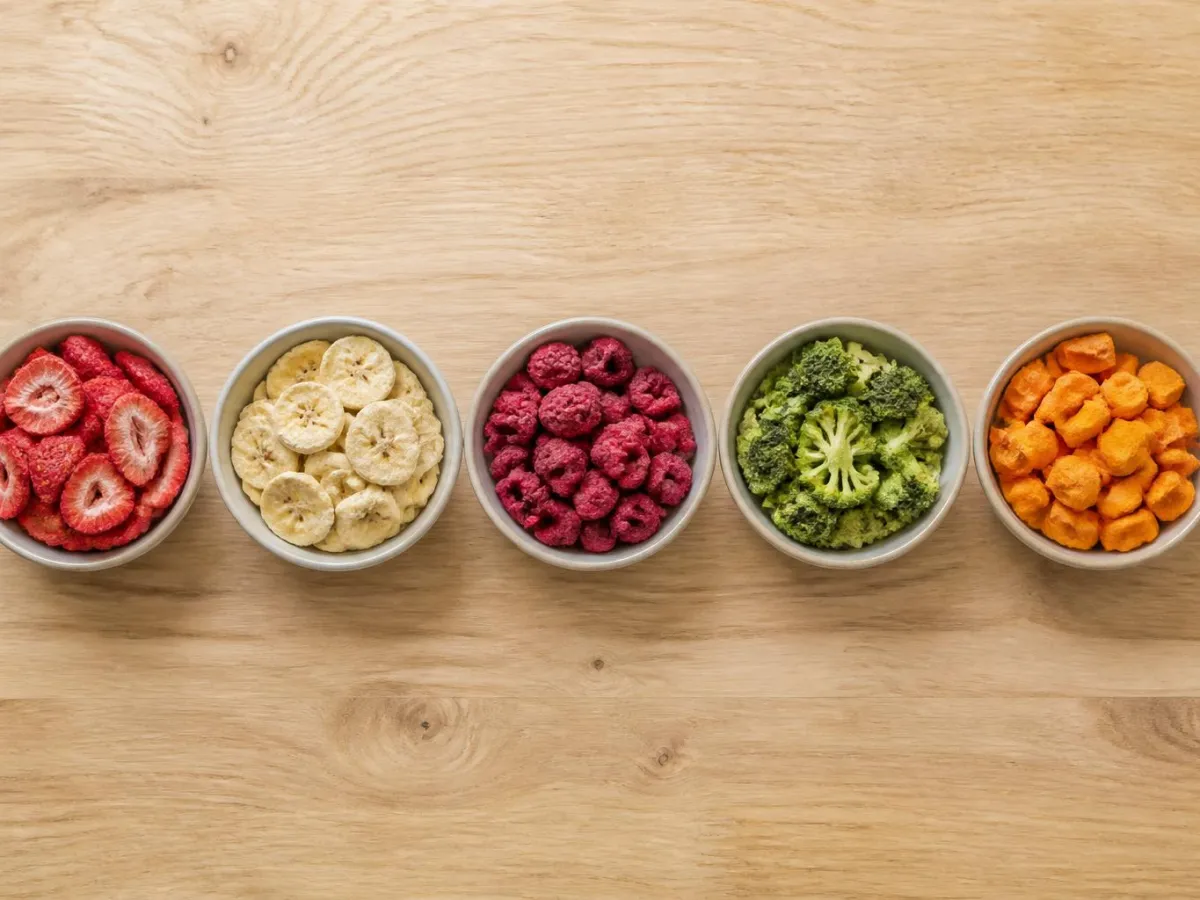
Freeze-dried fruit is fruit with almost all of the water taken out: frozen first, then dried under vacuum so the ice leaves as vapour. A plain pack has one ingredient on the label, and nothing is added or cooked (what freeze-drying is). Two things make it behave differently from a punnet of fruit, and both matter for a baby.
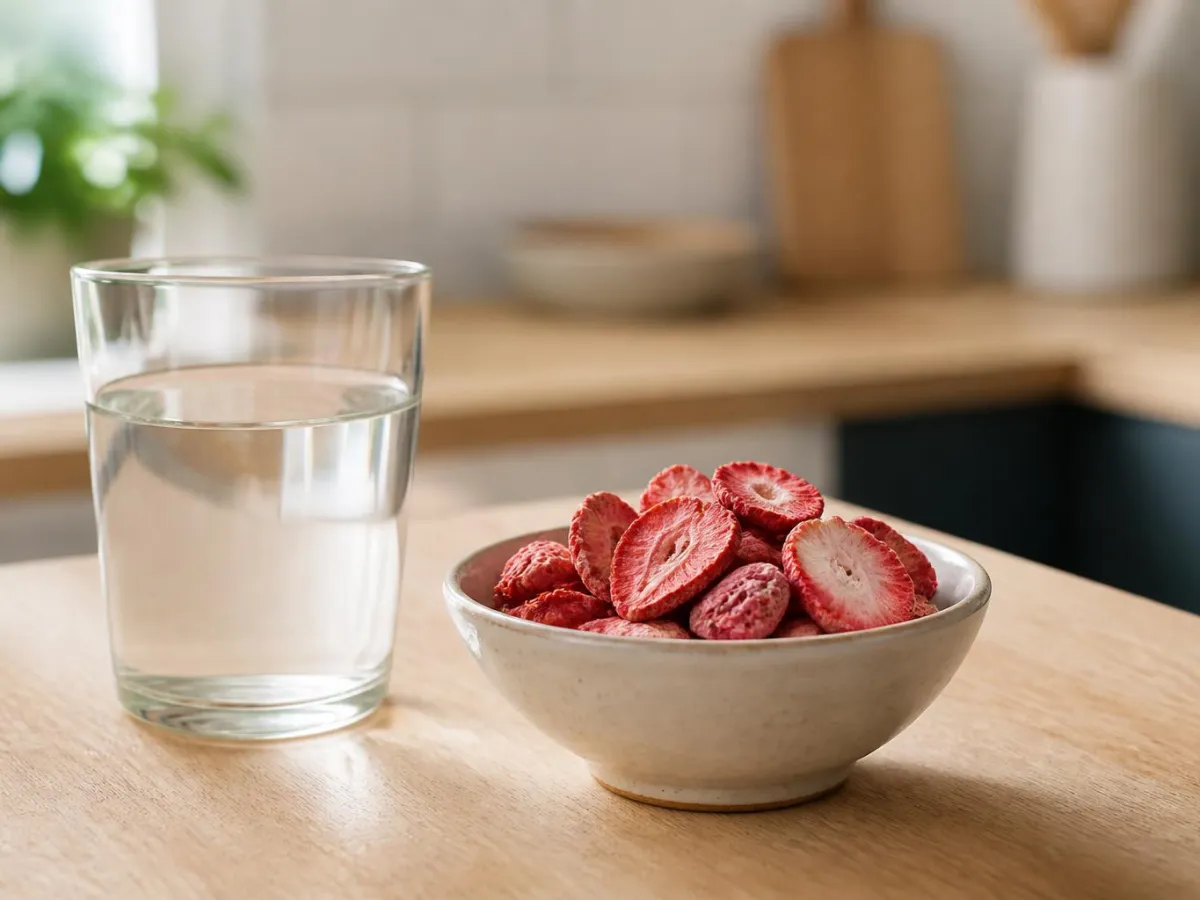
The texture. A slice is a dry, brittle honeycomb. It shatters rather than squashing, and a whole freeze-dried berry is as hard as a boiled sweet until saliva gets into it, which is the opposite of the soft, mashable textures weaning starts with.
The concentration. Strawberries are about 90 per cent water, and freeze-drying takes almost all of it out, which leaves everything else behind in roughly a tenth of the weight: a ratio of about 10:1, so the fruit's own sugars are around ten times as concentrated gram for gram. Around 10g of freeze-dried strawberries is what is left of about 100g of fresh ones, and carries about as much sugar. The fresh to freeze-dried converter does the sums.
Neither makes it unsuitable: they decide the form you serve it in, and how much.
When can babies have freeze-dried fruit?
The NHS says solid foods start at around six months, and lists three signs a baby is ready: they can stay sitting up and hold their head steady, they can co-ordinate their eyes, hands and mouth well enough to pick food up and put it in their mouth themselves, and they can swallow food rather than spitting it back out. Before that, breast milk or first infant formula is all a baby needs.
Fruit does not need to lead: weaning is about building a varied diet alongside milk, and vegetables that are not sweet deserve as much of the early running. Two NHS rules matter here, because both come up when people make fruity baby snacks at home. No honey before one year old, because of the risk of infant botulism, and no whole nuts before five, because of the risk of choking; crushed or ground nuts are fine from six months.
Why crisp freeze-dried fruit is a choking risk for babies
NHS weaning advice tells parents to avoid hard foods such as whole nuts or raw carrot or apple, to cook harder fruit until it is soft, and to cut small round foods like grapes and cherry tomatoes into quarters. A whole freeze-dried blueberry or cherry ticks two of those boxes at once: it is small and round, and it is hard.
The counter-argument is that freeze-dried fruit melts in the mouth. There is something in it: the structure is full of air pockets, so saliva gets in fast and a thin slice can soften within seconds, which is not true of a raisin. It is no guarantee, though. A thick slice or a whole berry takes far longer to give way, melting needs saliva and time that a baby who bites off a fragment does not always allow, and a pack that has absorbed moisture goes chewy rather than crisp (why freeze-dried fruit goes soft).
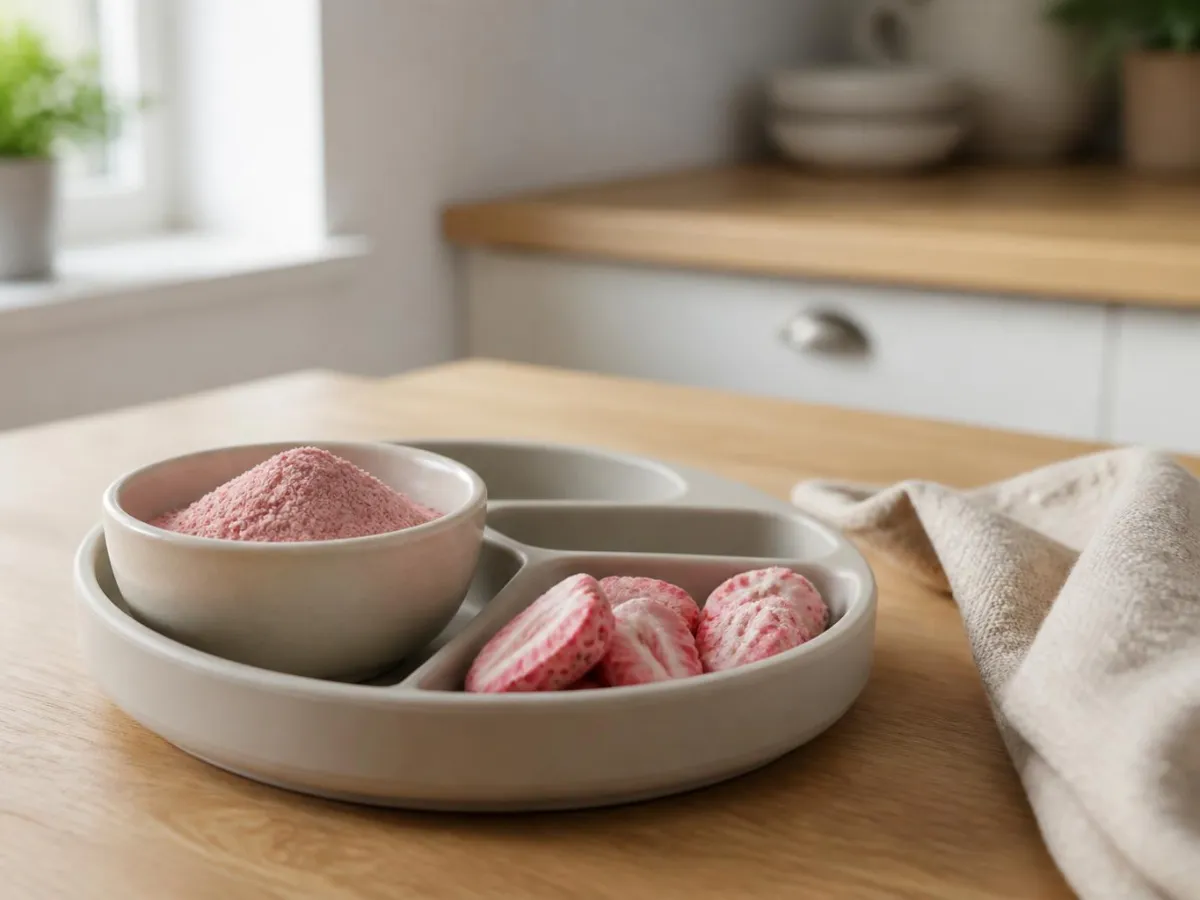
Thin, quick-dissolving pieces are the least risky crisp form, and none of them is the right first texture for a baby. Crush or soften instead.
Gagging is not choking. The NHS describes gagging as a normal, noisy reflex as a baby learns to chew and swallow. Choking is quiet. Always stay with your baby while they eat, keep them sitting upright, and never let a young child eat while walking or being pushed along. A paediatric first aid course is worth doing before you start weaning.
How to serve freeze-dried fruit safely, age by age
| Age | What NHS guidance says about food at this stage | A sensible form of freeze-dried fruit | What to leave out |
|---|---|---|---|
| Under 6 months | Breast milk or first infant formula is all a baby needs | None | All solid food |
| Around 6 months | Smooth purées and soft, mashed food; stay with your baby while they eat | A pinch of powder in purée, plain full-fat yoghurt or baby cereal | Pieces, slices and crisp fragments of any kind |
| 7 to 9 months | Mashed food and soft finger foods; hard foods avoided | Powder, or pieces soaked in milk or water until soft right through | Anything still crisp or firm in the middle |
| 9 to 12 months | Lumpier textures; small round foods cut into quarters | Softened fruit through yoghurt, porridge or mashed banana | Whole berries and thick slices |
| 1 to 4 years | Family food they can manage; hard foods still a risk; no whole nuts before 5 | Softened fruit at mealtimes; thin crisp slices only for a confident chewer, sitting down and supervised | Grazing on crisp pieces all day; whole berries for a child who bolts food |
| 5 years and over | Eating what the family eats | Crisp pieces as a snack, best at the end of a meal | Nothing specific, though the teeth advice applies |
The NHS sets no age for freeze-dried fruit, because it does not mention it. The rows above line up published NHS advice on texture, hard foods and choking with the way freeze-dried fruit behaves. Your health visitor is the person to ask about your own child.
What NHS weaning guidance says about sugar in baby food
The NHS is blunt: your baby does not need sugar, and you should not add sugar or salt to baby food. Plain freeze-dried fruit has none added. What it has is the fruit's own sugar, concentrated by the loss of the water, which is not added sugar in NHS terms but is the reason portions stay small.
| Typical values | Fresh strawberries, 80g | Freeze-dried strawberries, 10g | Freeze-dried strawberries, 5g |
|---|---|---|---|
| Roughly what it is | One adult 5 A Day portion | A small adult handful | A toddler-sized spoonful |
| Energy | about 25 kcal | about 35 kcal | about 18 kcal |
| Total sugars | about 4 to 5g | about 5 to 6g | about 2 to 3g |
These are typical values and ranges from published composition data and product labels. They vary with the variety, the ripeness and the producer, so the label on your own pack is the figure that counts (sugar in freeze-dried fruit).
The NHS counts 30g of dried fruit as one 5 A Day portion, and says a child's portion is roughly what fits in their own palm, which for a toddler is a great deal less than 30g. Fresh, frozen and tinned fruit are the better everyday choices: whether freeze-dried fruit counts as 5 A Day goes through the rules.
Freeze-dried fruit, dried fruit and young children's teeth
NHS advice on feeding young children says dried fruit, such as raisins, should be given with meals rather than as a snack in between, because the sugar it contains can cause tooth decay. Freeze-dried fruit is dried fruit for that purpose. The texture difference is real but limited: a raisin is chewy and presses into the grooves of the back teeth, while a freeze-dried piece shatters and dissolves, but the same concentrated sugars and fruit acids then wash over the teeth. Whether freeze-dried fruit is bad for your teeth has the detail.
What helps is straight NHS dental advice:
- Keep dried fruit, freeze-dried included, to mealtimes rather than between-meal snacks.
- Offer water or plain milk, and keep juice and smoothies to a maximum of 150ml a day, with a meal.
- Brush twice a day from the first tooth, including last thing at night: a smear of fluoride toothpaste under 3, a pea-sized amount from 3 to 6.
- Encourage spitting rather than rinsing, and keep helping your child brush until they are at least seven.
- Take your child to an NHS dentist when their first teeth come through. NHS dental care is free for children.
How to read the label on toddler fruit snacks
The ingredients list, in descending order of weight, tells you more than the front of the pack.
| What the pack says | What it means | Worth knowing |
|---|---|---|
| "Ingredients: strawberries" | 100 per cent fruit, nothing else | This is what you want for a baby or toddler |
| "Apple juice concentrate" | Sugar, used to sweeten | Counted as free sugars in NHS guidance, though it came from fruit |
| "Yoghurt coating" | Sugar and fat around the fruit | Sweeter and stickier than the fruit itself |
| "Rice flour", "maize", "puffs" | A puffed cereal snack with some fruit in it | Check the fruit percentage and the sugars figure |
| "No added sugar" | Nothing sweet was added | The fruit's own sugars are still concentrated |
| "Suitable from 6 months" | A manufacturer's statement | Not NHS advice; the texture judgement is yours |
Shape counts as much as ingredients, and freeze-dried fruit powder sidesteps the texture question altogether. On price, the melt sachets in a British baby aisle and the small pots in the Tesco or Sainsbury's baking aisle both tended to work out dearer per 100g than a larger plain pouch (shelf prices last checked September 2026, and they move): freeze-dried fruit in UK supermarkets covers what is stocked where.
Serving ideas for babies and toddlers
- Pink porridge. Stir a pinch of strawberry or raspberry powder into porridge off the heat. More in freeze-dried fruit in porridge and overnight oats.
- Fruit yoghurt without the sugar. Mix powder into plain full-fat yoghurt, which is the dairy the NHS recommends for under-2s.
- Softened pieces. Cover slices with cool water or milk for two to five minutes until soft right through, then drain and stir into mash or baby rice (rehydrating freeze-dried fruit).
- Unsweetened pancakes and lollies. Fold powder into a plain weaning pancake batter, or freeze it whisked through yoghurt in a small mould. The colour is real fruit, so no food colouring is needed.
Keep all of it to mealtimes, and skip honey until your child is one.
When to ask your health visitor or GP
Ask rather than guess if your baby was premature, has a condition affecting feeding, swallowing or reflux, has additional needs, has had a choking episode, is being introduced to allergenic foods, or if you are worried about growth or very restricted eating. Your health visitor can also explain NHS vitamin drops for babies and young children, and your dentist is the person to ask about teeth.
We cannot give advice about an individual child, and this page has not been checked by a dietitian, nutritionist or doctor. It sets out what the NHS publishes, and where freeze-dried fruit fits against it.
The short version. Start solids at around six months, as the NHS advises. Use plain fruit with one ingredient, crushed to a powder or soaked until soft, and keep whole crisp pieces away from babies and young toddlers. Serve it with a meal, in a portion that fits your child's own palm, and ask your health visitor about anything specific to them.
Freeze-dried fruit for hiking and camping and freeze-dried fruit for pets cover the other situations where the answer changes, and the full range of freeze-dried fruit covers the fruits themselves. Crispberry's own shop is not open yet, so there is nothing for sale on this site today and no prices, stock or delivery times to quote; you can join the list below to hear when that changes.
Good questions, short answers
Can babies eat freeze-dried fruit?
Not as a crisp, dry piece. Hard, brittle food is a choking risk for babies, so freeze-dried fruit is crushed to a powder and stirred into purée, yoghurt or baby cereal, or soaked in milk or water until it is soft right through. In that form, plain freeze-dried fruit with nothing added can be part of a varied weaning diet from around six months, which is when the NHS advises starting solid foods. Follow NHS weaning guidance and ask your health visitor or GP about your own baby.
When can babies have freeze-dried strawberries?
The NHS says to start solid foods at around six months, once a baby can sit up and hold their head steady, co-ordinate their eyes, hands and mouth, and swallow food rather than spit it back out. From that point freeze-dried strawberries can be offered as powder stirred into something soft, or as slices soaked until limp. Whole freeze-dried berries and crisp slices are not suitable for babies at any point in the first year, and the NHS does not publish advice on freeze-dried fruit specifically, so texture judgements are yours and your health visitor's.
Is freeze-dried fruit a choking hazard for toddlers?
It can be. NHS weaning advice is to avoid hard foods such as whole nuts and raw carrot or apple, and to cut small round foods like grapes into quarters, and a whole freeze-dried berry is both small and hard. Thin slices shatter and dissolve quickly in saliva, which is why many families offer them to confident chewers, but a toddler should always be sitting down and supervised while eating, and packs that have gone soft are chewier than fresh ones. If you are unsure, soften the fruit first.
Is freeze-dried fruit bad for toddlers' teeth?
The NHS advises that dried fruit such as raisins is given to toddlers with meals rather than as a between-meal snack, because the sugar it contains can cause tooth decay, and freeze-dried fruit is dried fruit for this purpose. It is crisp rather than sticky, so it does not cling like a raisin, but the fruit sugars and acids are concentrated in the same way. Serve it as part of a meal, offer water afterwards, and brush twice a day with fluoride toothpaste.
How much freeze-dried fruit should a toddler have?
Less than an adult portion. The NHS counts 30g of dried fruit as one 5 A Day portion for an adult, and says a child's portion is roughly the amount that fits in their own palm, which is far smaller. A level teaspoon or two of pieces, or a pinch of powder stirred through food, is a realistic serving for a young child. Fresh, frozen and tinned fruit are better everyday choices, with dried fruit kept to mealtimes.
Are freeze-dried fruit snacks better than raisins for toddlers?
On texture there is an argument: a raisin is chewy, sticky and the right size and shape to be a choking risk, while a freeze-dried piece is brittle and dissolves. On sugar there is little between them once portion size is taken into account, and the NHS advice to give dried fruit at mealtimes applies to both. Check the ingredients either way, because many toddler fruit snacks contain juice concentrate, yoghurt coating or puffed cereal rather than plain fruit.