
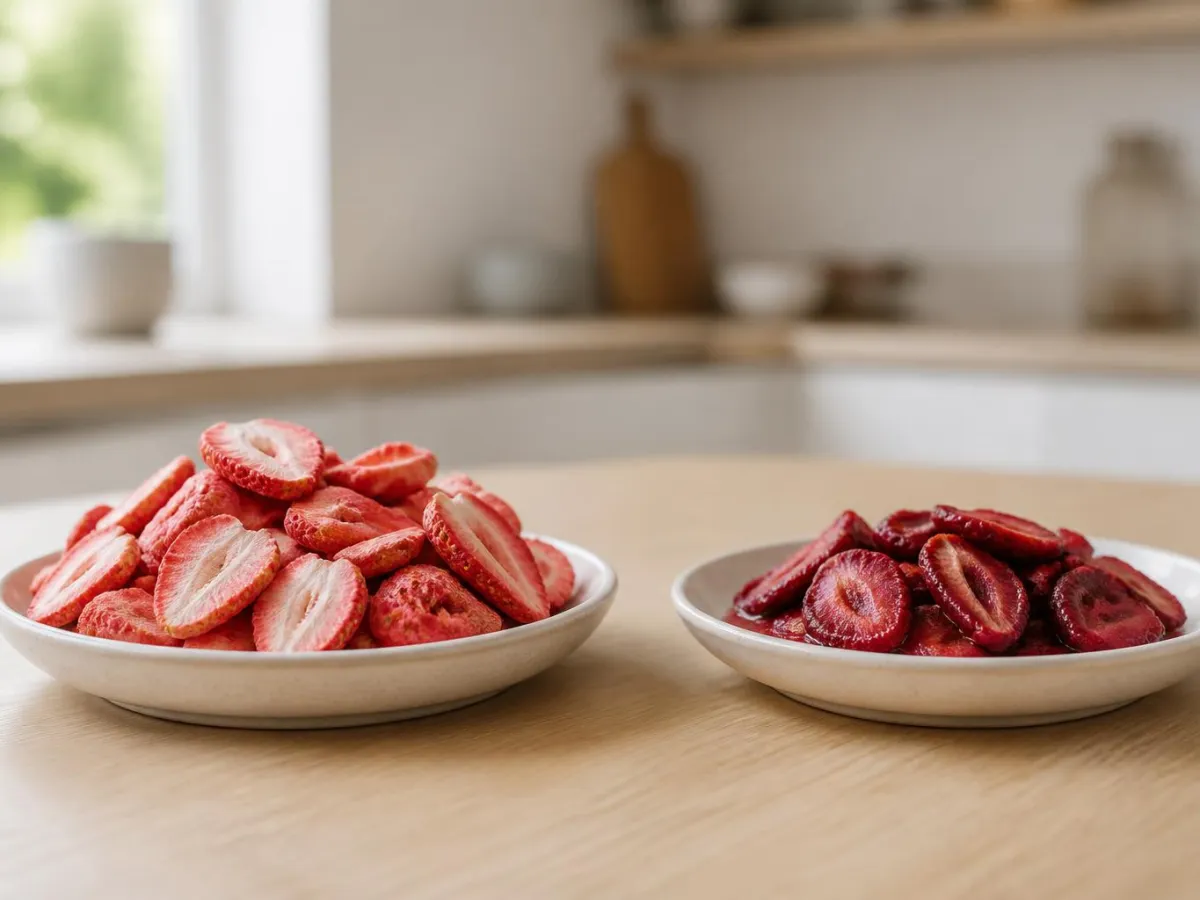
Freeze-dried fruit gone soft
Soft, bendy freeze-dried fruit has taken on moisture from the air. Here is how to dry it out again in a low oven, and how to tell...
Unopened, usually a year or two. Opened, it is your packaging that decides. A quick-reference table, the signs to watch for and how to rescue a soft pack.
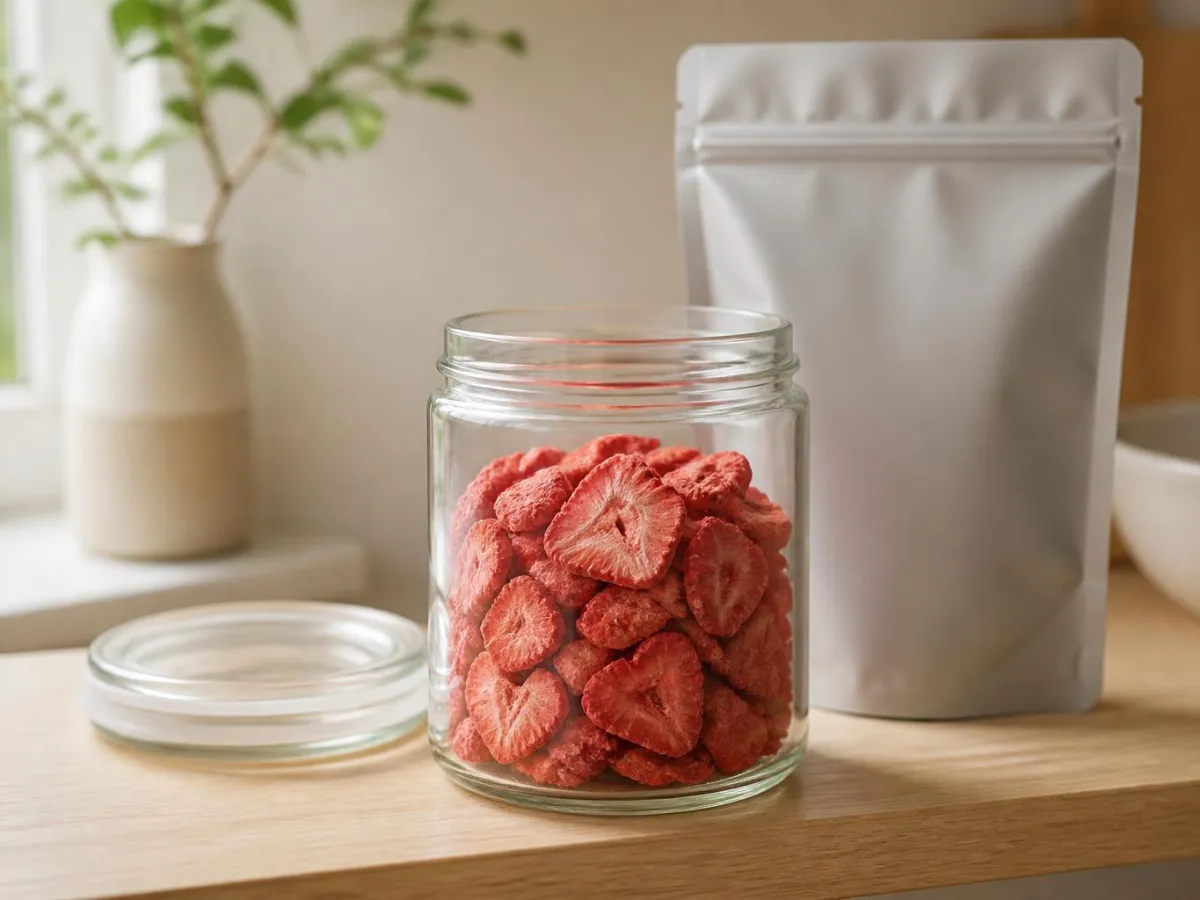
Soft, bendy freeze-dried fruit has taken on moisture from the air. Here is how to dry it out again in a low oven, and how to tell...
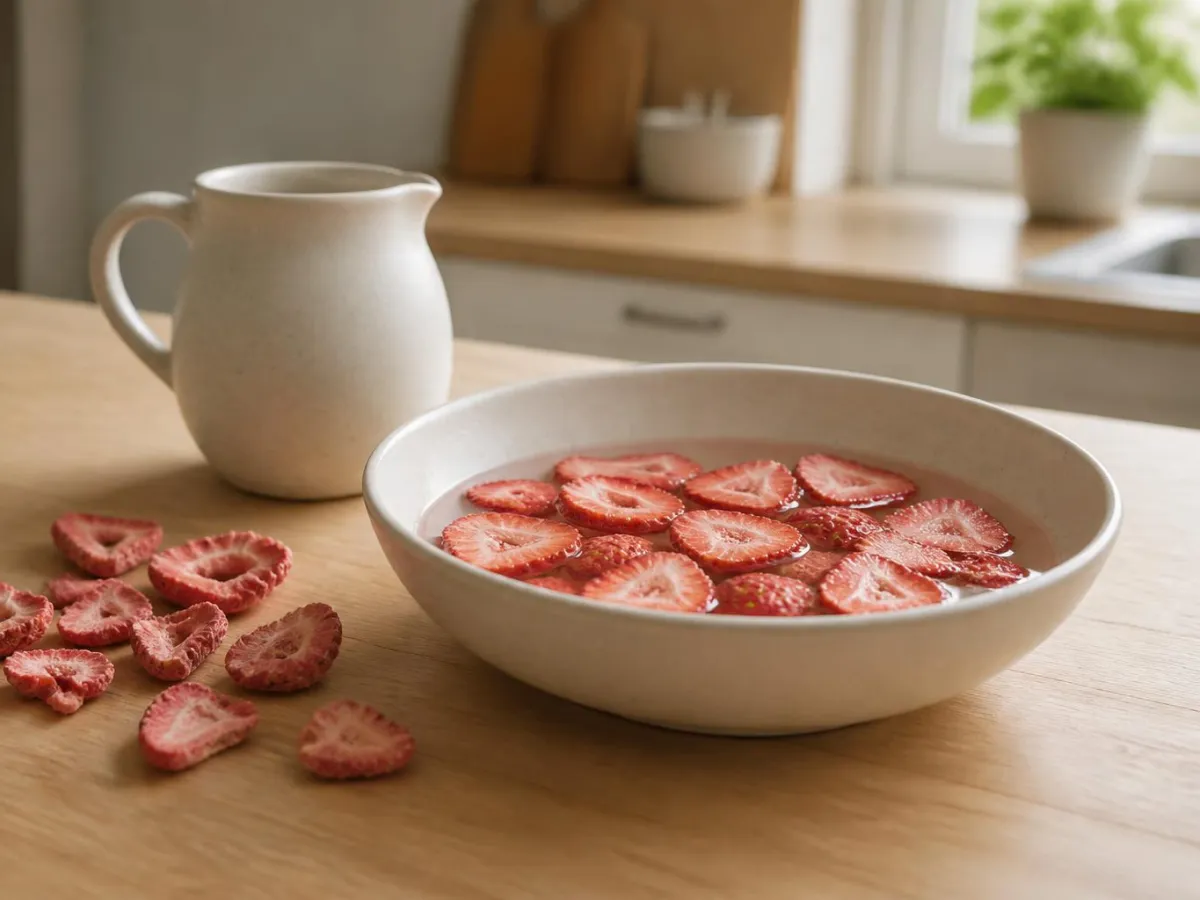
Cover it with water and wait. The ratios and the times, fruit by fruit, and what soaked freeze-dried fruit is actually good for.
An unopened pack of plain freeze-dried fruit usually stays at its best for 12 to 24 months, and the best-before date printed on your pack is the figure to trust over any general rule. Once the pack is open, the clock is set by your packaging rather than by the fruit: tightly resealed in a dry cupboard it stays properly crisp for roughly two to eight weeks, decanted into an airtight clip-top jar often one to three months, and left open in a steamy British kitchen it can go bendy the same day.
Everything below is about quality, not safety. Freeze-dried fruit has only a few per cent of its water left, and microbes need water to grow, so a dry sealed pack does not become dangerous on a particular date. It slowly loses crunch, colour and aroma instead.
| Where the fruit is kept | How long it usually stays properly crisp | What changes first |
|---|---|---|
| Unopened, sealed foil pack, cool dark dry cupboard | Up to the best-before date, commonly 12 to 24 months | Colour and aroma fade very slowly |
| Opened, air squeezed out, zip fully resealed every time, dry cupboard | About 2 to 8 weeks | The snap goes soft; small pieces and crumbs go first |
| Opened in a humid kitchen, bag folded over or clipped loosely | Hours to a few days | Pieces turn bendy and start sticking together |
| Decanted into an airtight clip-top jar, filled full, dry spoon only | About 1 to 3 months, often longer in a dry room | Colour fades if the jar sits in daylight |
| Sealed tin or thick foil pouch with an oxygen absorber, cool and steady | Years; long-term food brands commonly quote decades | Flavour and colour dull long before safety does |
These are general timescales for plain, unsweetened fruit, not measurements from our own kitchen, and they are quality timescales rather than safety ones. Humidity, the type of packaging and how often the pack gets opened move them around far more than the choice of fruit does. Go by the date on your pack, and then by how the fruit looks, smells and snaps.
Freeze-drying leaves the fruit with its original structure intact but hollow, which is exactly why a freeze-dried strawberry snaps like a wafer. That open structure also makes it behave like a sponge for water vapour, and British air, especially in an autumn kitchen with a kettle going, has plenty of vapour to give.
So the useful question is never "how long does freeze-dried fruit last?" in the abstract. It is "how good is the barrier between this fruit and the air in my kitchen?" Ranked from best to worst:
Kitchen tip: the shelf above the kettle and the cupboard next to the oven are the two worst spots in most British kitchens, because they get steam and warmth in turns. A jar in a bedroom wardrobe or a cool hallway cupboard keeps fruit crisper than a jar next to the hob.
Freeze-dried fruit carries a best before date, not a use-by date, and the distinction is set out by the Food Standards Agency: a best-before date is about quality, while a use-by date is about safety. Food past its best before is generally still safe to eat but may not be at its best, and the FSA suggests judging best-before foods with your senses, in the same way you would decide whether a packet of biscuits has gone stale.
That is why manufacturers' dates vary so much between brands for what is essentially the same food. A year, eighteen months and two years are all common, and a tin packed for long-term storage can be dated much further out. None of those dates is wrong; they reflect the packaging, the fruit and how cautious the producer is being.
Once the seal is broken, count in weeks rather than months unless you have decanted it. Three habits make most of the difference:
Keep any desiccant sachet that came in the pack, and leave it in. It is not edible, and it is doing useful work.
No. Do not refrigerate it, and do not freeze it either. Both are humid environments, and the real damage happens when you take a cold pack out into a warm room and moisture in the air condenses on the fruit. Repeat that a few times and you have deliberately dampened the thing you were trying to keep dry.
A cupboard that is cool, dark and dry beats a fridge every time. Steady temperature matters more than low temperature.
| What you find | What it means | What to do |
|---|---|---|
| Crisp, bright, snaps cleanly, smells fruity | In good condition | Eat it, and reseal the pack straight away |
| Bendy, chewy, pieces sticking together | It has taken on moisture: a quality problem | Crisp it in a very low oven, or use it in porridge or baking |
| Powder set into a solid lump | Moisture again; powders go first | Break it up, sieve it, keep it sealed with the desiccant |
| Dull, brownish, tasting flat | Age, warmth or light | Safe if dry and clean, but best used in cooking rather than snacking |
| Visible mould, or an off, fermented or musty smell | Water has got in somewhere | Throw it away, and check how the pack was stored |
The short version: soft is disappointing, mouldy is different. Softness is a texture problem you can work around or reverse. Mould or an off smell means water reached the fruit, and that pack goes in the bin.
Spread the fruit in a single layer on a lined baking tray and put it in the oven at its lowest setting, around 50°C to 60°C, with the door slightly ajar so damp air can escape. Twenty to forty minutes is usually enough. Let it cool completely on the tray before you judge it, because it crisps as it cools, then seal it into an airtight jar immediately, while it is bone dry.
Do not try this at normal baking temperatures. Above roughly 100°C you are cooking the fruit, the sugars start to caramelise, and you end up with something sticky and brown rather than crisp. The full method, including the cases where it is not worth bothering, is in freeze-dried fruit gone soft.
If you would rather not fuss, soft fruit is completely fine stirred into porridge and overnight oats, blended into smoothies, or folded into cake batter when you are baking with freeze-dried fruit. Texture only matters when the fruit is the crunchy bit.
Powders have far more surface area than whole pieces, so they pick up moisture faster and show it sooner, as clumping and then a solid cake in the bottom of the tub. Treat a powder as a shorter-lived thing than slices: a small airtight jar, kept full, opened briefly, with the desiccant sachet left in. A dry teaspoon is non-negotiable. There is more on handling and storing powders in the freeze-dried fruit powder section and on strawberry powder.
Freeze-dried vegetables behave much like fruit but are less sugary and so less inclined to go sticky; freeze-dried peas will happily sit in a jar for months. Anything with added chocolate, yoghurt coating or oil is a different food with a different shelf life, because fat goes rancid in a way plain fruit cannot.
For a camping cupboard, a walking kit or an emergency store, the packaging does all the work. Sealed tins or thick foil pouches with an oxygen absorber, kept somewhere cool with a steady temperature and out of the light, and not opened until you need them. An oxygen absorber only helps inside a genuinely airtight container: drop one into a zip bag and it exhausts itself on the air leaking in, and there is no point adding one to a jar you open every week.
When the tin is finally opened, it becomes an ordinary opened pack, on the ordinary two to eight week crunch clock. That is worth planning for if you are packing for hiking and camping: several small sealed portions beat one large tin you have to open on day one.
Storage advice and portion advice are connected, because a big jar makes it easy to eat far more fruit than you think. Freeze-drying takes out almost all the water and leaves everything else behind, so the finished fruit holds only a few per cent moisture. Berries are roughly 90 per cent water to begin with, which works out at about 10g of freeze-dried fruit from 100g of fresh: a concentration of around ten to one. Weight for weight, that means freeze-dried fruit carries far more sugar and far more calories than the same weight of fresh fruit, so a typical 10g serving is a small handful rather than a bowlful. You can work out the equivalent for other fruit with our fresh to freeze-dried converter.
The NHS position, plainly: a 30g portion of dried fruit counts as one of your 5 A Day, and dried fruit is best enjoyed as part of a meal, as a dessert for example, rather than as a between-meal snack, to reduce the risk of tooth decay. A portion of fresh, frozen or tinned fruit is 80g.
Nutrition figures on freeze-dried fruit vary with the fruit, the variety, the ripeness and the producer, so the label on your pack is the number that counts. There is more detail in the nutrition section, and on freeze-dried fruit and teeth in particular.
Move your opened packs out of the cupboard beside the kettle. Decant anything you will not finish this month into a clip-top jar, filled as full as it will go, with the desiccant sachet from the pouch tucked in. Keep a dedicated dry spoon nearby. Then read the full guide to storing freeze-dried fruit for the detail, rehydrating freeze-dried fruit for when you want it soft on purpose, and freeze-dried strawberries if you are still deciding which pack to buy first.
Our own shop is not open yet, so there is nothing to buy from us on this page. Join the list below and we will let you know when it does open.
If you squeeze the air out and reseal the pack properly every single time, expect roughly two to eight weeks of good crunch, and often longer in an airtight clip-top jar in a dry room. Left open or loosely folded over in a steamy kitchen it can turn bendy within a day. It is not becoming unsafe as it softens; it is absorbing moisture from the air and losing quality.
Not in the way fresh fruit does. Freeze-dried fruit has only a few per cent water left in it, and moulds and bacteria need water to grow, so a dry, sealed pack simply fades slowly in colour, aroma and crunch. It can genuinely spoil if water gets in, from a wet spoon, a split pack or condensation, and then mould is possible and the fruit should be thrown away.
A best-before date is about quality, not safety. The Food Standards Agency says food is generally still safe to eat after its best-before date but may not be at its best, and suggests using your eyes, nose and taste on best-before foods. If a pack has stayed sealed and dry and the fruit looks, smells and tastes normal, it is likely to be fine; if you see mould or it smells off, bin it.
No, and the fridge is one of the worst places for it. Fridge air is humid, and every time you take a cold pack out into a warm kitchen, moisture from the room condenses on the fruit and softens it. A cool, dark, dry cupboard away from the kettle, hob and dishwasher is much better.
Years rather than months, because the two things that age it, moisture and oxygen, have both been taken out of the container. Brands that sell long-term food stores commonly quote decades for sealed, oxygen-free freeze-dried food, which is their claim rather than something we can verify. What is reliable is the principle: the better the barrier and the cooler and steadier the temperature, the longer the quality holds.
It has absorbed water vapour from the air, which is what the airy, open structure of freeze-dried fruit is very good at doing. The usual culprits are a pack left open while you make breakfast, a zip that was not fully closed, a wet spoon, or storage in a humid kitchen. You can usually crisp it up again in a very low oven, and it is perfectly good in porridge, smoothies and baking either way.
Join the list for new guides, easy recipes and a friendly nudge on launch day. One or two emails a month, never more.
We only use your email to send you our newsletter. Unsubscribe any time. See our privacy notice.