Freeze-dried fruit calories: per 100g and per portion
A 10g serving of freeze-dried fruit is usually around 30 to 40 kcal. Here is what the frightening per-100g figure on the pack actually means, fruit by fruit.
On this page
- Freeze-dried fruit calories per 100g and per 10g serving
- Freeze-dried vegetable calories per 100g
- Why freeze-dried fruit calories per 100g look so high
- What a realistic serving of freeze-dried fruit weighs
- Calories in freeze-dried fruit powder
- Why the calories on your pack may differ from these figures
- Freeze-dried fruit, calories and your 5 A Day
- How to keep freeze-dried fruit portions in check
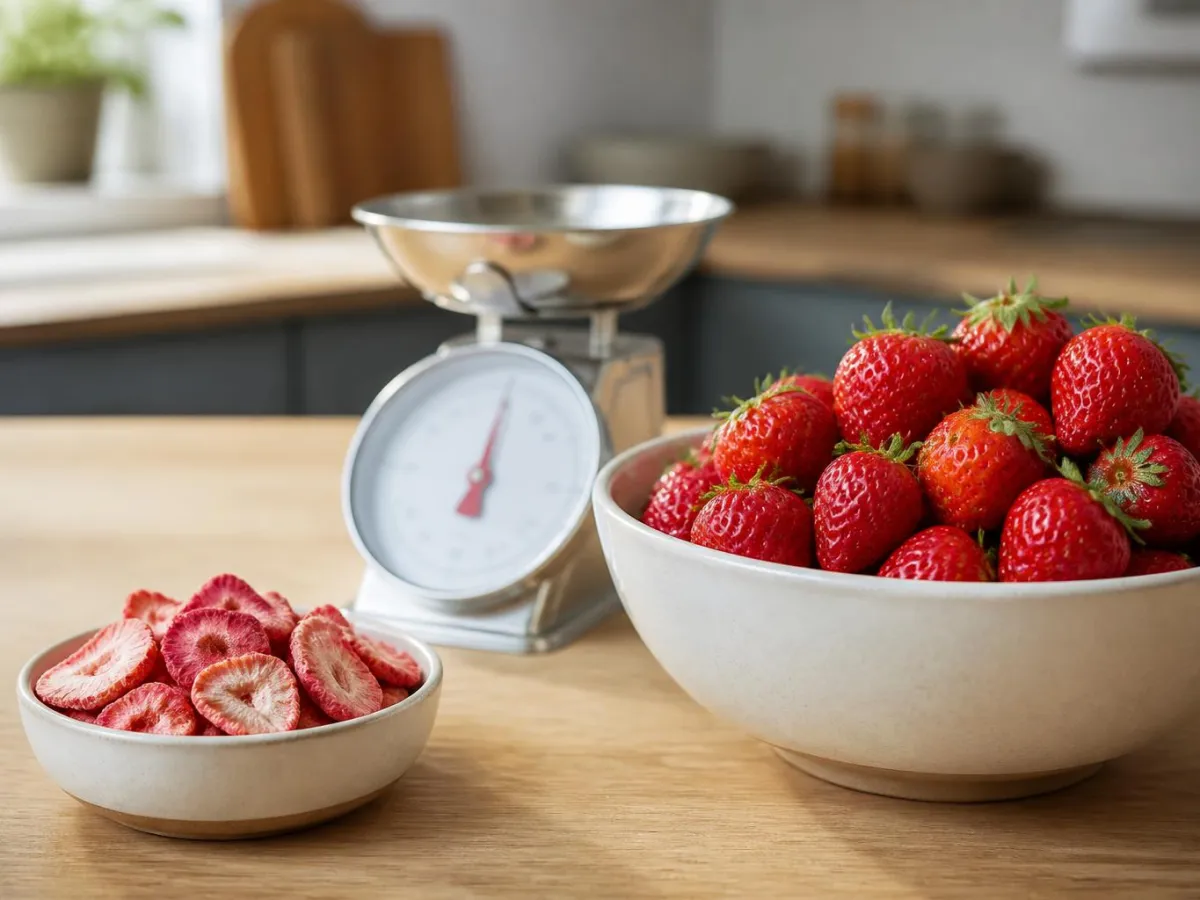
A 10g serving of freeze-dried strawberries contains roughly 35 kcal, and 100g contains roughly 330 to 380 kcal. The per-100g figure looks alarming next to fresh strawberries at about 30 kcal per 100g, but 100g of freeze-dried strawberries is close to a kilogram of fresh fruit, and that is nobody's serving.
Freeze-drying adds nothing. It takes the water out, water has no calories, and so the same energy ends up concentrated into a fraction of the weight: about a tenth for watery berries, nearer a quarter for banana. That single fact explains every number on this page.
Freeze-dried fruit calories per 100g and per 10g serving
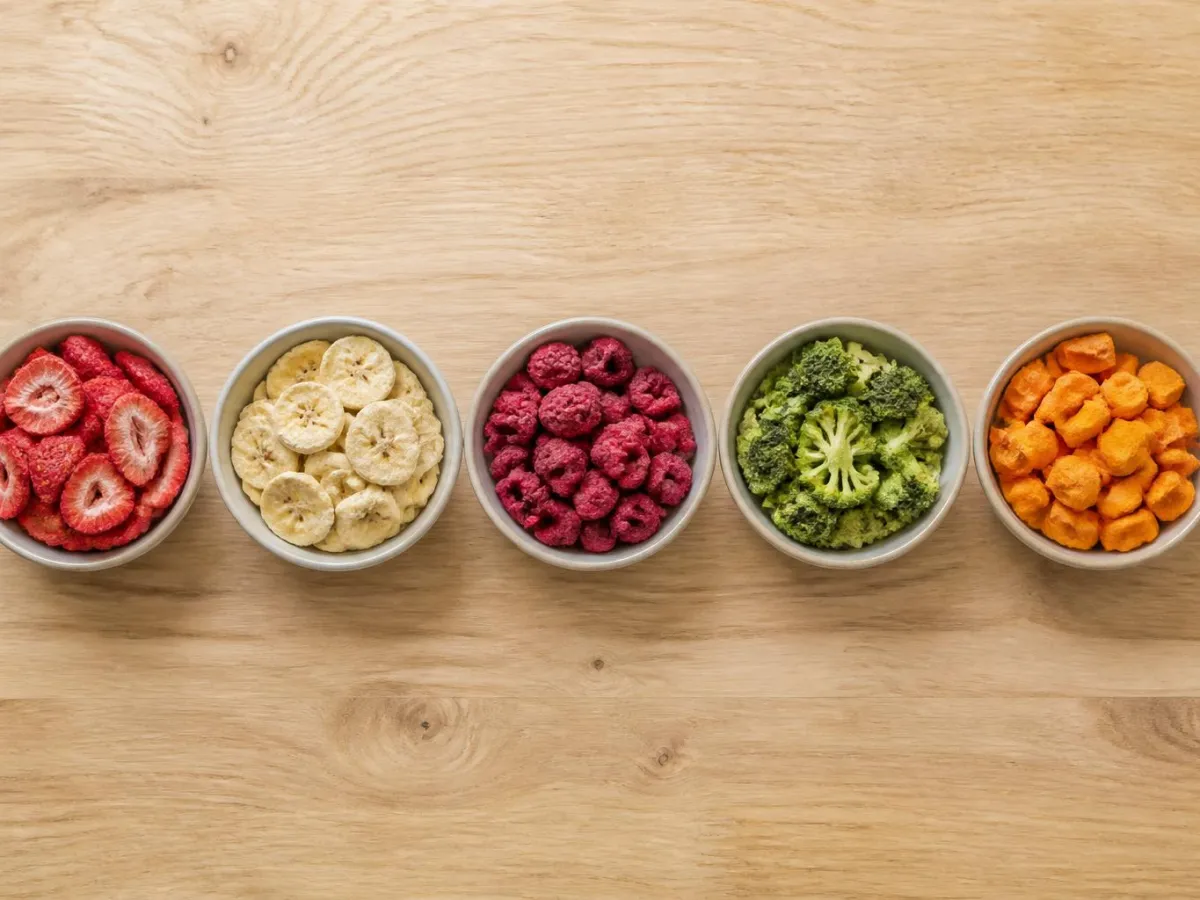
| Freeze-dried fruit | Fresh, per 100g | Freeze-dried, per 100g | Freeze-dried, per 10g serving |
|---|---|---|---|
| Strawberries | about 30 kcal | about 330 to 380 kcal | about 35 kcal |
| Raspberries | about 30 kcal | about 300 to 350 kcal | about 30 to 35 kcal |
| Blueberries | about 55 kcal | about 340 to 390 kcal | about 35 to 40 kcal |
| Blackcurrants | about 30 kcal | about 320 to 370 kcal | about 35 kcal |
| Cherries | about 50 kcal | about 350 to 390 kcal | about 35 to 40 kcal |
| Apple | about 50 kcal | about 350 to 390 kcal | about 35 to 40 kcal |
| Pineapple | about 45 kcal | about 350 to 390 kcal | about 35 to 40 kcal |
| Mango | about 60 kcal | about 350 to 400 kcal | about 35 to 40 kcal |
| Banana | about 90 kcal | about 350 to 400 kcal | about 35 to 40 kcal |
These are typical values and ranges drawn from published UK composition data and from nutrition declarations on plain, unsweetened products. They are not measurements of any particular pack. Products vary with the variety, the ripeness of the fruit and the producer, so the label on your pack is the figure that counts.
Two things worth knowing about the fresh column. Published energy values for fresh berries vary more than you would expect, partly because some sources count the energy in fibre and some do not, which is one reason the freeze-dried figures are given as ranges rather than single numbers. And UK labels give energy twice, in kilojoules and in kilocalories, because both are required; 1 kcal is about 4.2 kJ, so a pack declaring 1,500 kJ is declaring roughly 360 kcal.
Freeze-dried vegetable calories per 100g
Vegetables behave the same way, and because most of them start with less sugar than fruit they finish in a slightly lower band. Sweetcorn is the exception, being starchy to begin with.
| Freeze-dried vegetable | Fresh, per 100g | Freeze-dried, per 100g | Freeze-dried, per 10g serving |
|---|---|---|---|
| Peas | about 70 kcal | about 320 to 370 kcal | about 35 kcal |
| Sweetcorn | about 90 kcal | about 360 to 400 kcal | about 40 kcal |
| Beetroot | about 40 kcal | about 310 to 360 kcal | about 35 kcal |
The pattern across both tables is the striking part: almost everything plain and freeze-dried lands somewhere between 310 and 400 kcal per 100g, whether it started as a strawberry, a pea or a beetroot. Once the water is gone you are left with fruit or vegetable solids, and those solids are mostly sugars and fibre. There is very little room for the total to be anything else.
Why freeze-dried fruit calories per 100g look so high
Fresh strawberries are roughly 90 per cent water. Take that away and 1kg of fruit becomes about 100g of crisp slices, so the ratio is close to ten to one: the same sugar, the same fibre and the same energy in a tenth of the weight. Nothing has been added, and nothing is created by the process, which our guide to what freeze-drying actually does explains in more detail. The accounting has simply changed, because per 100g now means ten times as much actual fruit. Drier fruit shifts the ratio: banana starts at about three quarters water, so it shrinks by nearer four to one, and its per-100g energy climbs less far above the fresh figure.
This is why the per-100g column is the wrong one to judge a portion by, and also why it is the only one manufacturers are required to print. Read it as a property of the food, not as a serving.
If a per-100g figure ever worries you, divide by ten. That gives you the number for a 10g serving, which is much closer to what you are actually about to eat.
What a realistic serving of freeze-dried fruit weighs
| Amount | What that looks like | Typical energy |
|---|---|---|
| 5g | a light scattering over porridge or yoghurt | about 15 to 20 kcal |
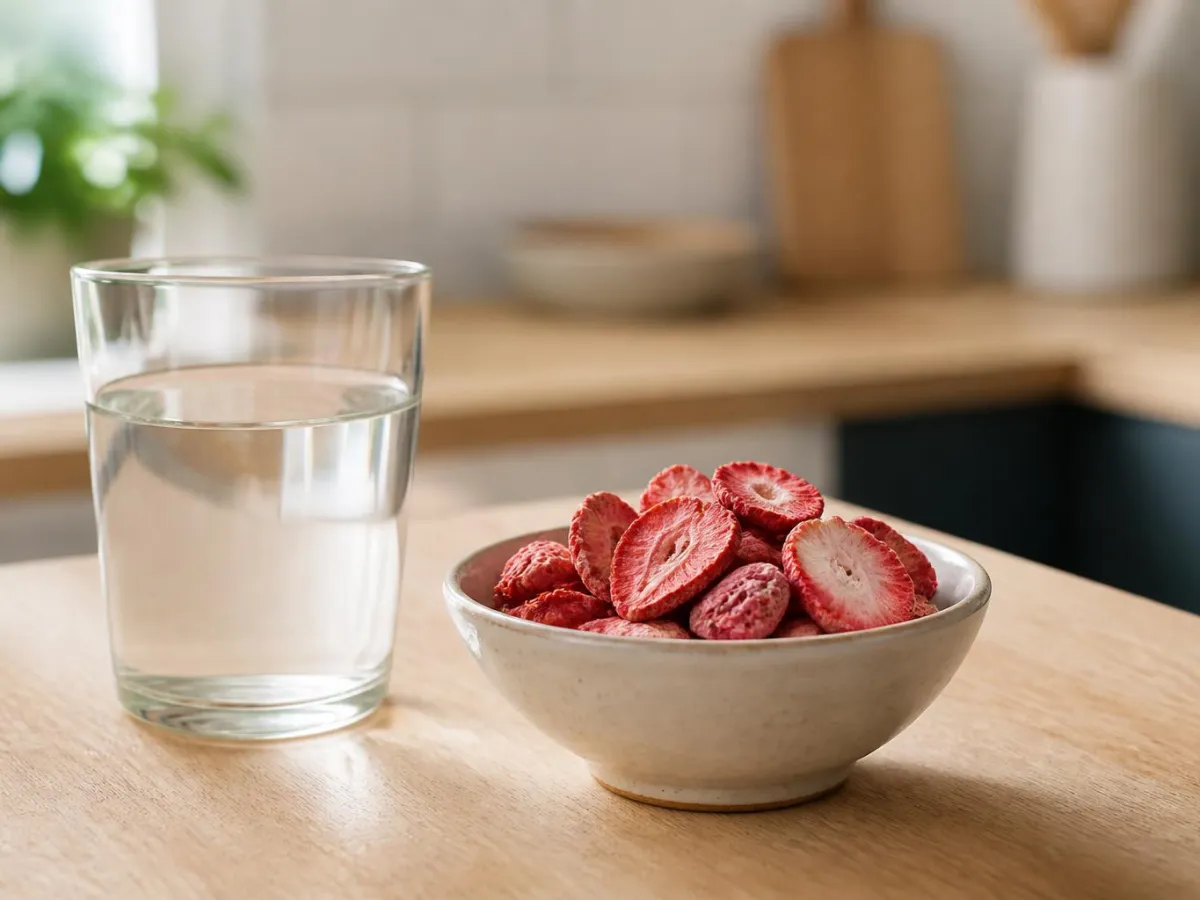
| 10g | a small handful of slices, the usual serving | about 30 to 40 kcal |
| 20g | a generous snack, or a small supermarket pack | about 65 to 80 kcal |
| 30g | one 5 A Day portion of dried fruit (NHS) | about 100 to 120 kcal |
| 100g | roughly a kilogram of fresh berries | about 310 to 400 kcal |
Because only water has been removed, a 10g serving carries roughly the same energy as the fresh fruit it was made from. For strawberries that is around 100g of fresh berries; for banana, which is far less watery to start with, 10g of slices is nearer 40g of fresh fruit. The fresh to freeze-dried converter does the sums for other weights and other fruit.
Traditionally dried fruit such as raisins, sultanas and apricots sits in broadly the same territory per 100g, and some kinds are lower simply because they are only semi-dried and still hold moisture. The meaningful difference is never the per-100g figure. It is the weight you actually eat, and crisp freeze-dried pieces are so light that a satisfying handful weighs very little.
Calories in freeze-dried fruit powder
Powder is the same fruit milled fine, so per 100g it is much the same as the pieces. What changes is how much you use. A level teaspoon of strawberry powder or raspberry powder weighs only a couple of grams, because the stuff is extraordinarily light, so it contributes under 15 kcal to a smoothie, a bowl of porridge or a batch of icing. In energy terms that makes powder one of the lightest ways to get real fruit flavour and colour into something.
Why the calories on your pack may differ from these figures
- The fruit itself. Variety, growing season and ripeness at harvest all move the sugar content, and the sugar content is most of the energy.
- How far it was dried. A product with slightly more residual moisture declares slightly fewer calories per 100g.
- Anything added. Yoghurt-coated, chocolate-coated and sugar-dusted pieces are a different food, often two to three times the energy of plain fruit per 100g, because the coating is fat and added sugar. Plain freeze-dried fruit should list one ingredient.
- Which convention was used. Rounding and the treatment of fibre both nudge a declaration up or down by a few per cent.
UK supermarkets tend to sell freeze-dried fruit in small sachets rather than bags, sometimes as little as 6g, while specialist suppliers sell larger pouches; our guide to freeze-dried fruit in UK supermarkets covers what is usually stocked where (last checked September 2026). Compare energy per 100g between packs, not per serving, because different brands choose different serving sizes.
Crispberry's own shop is not open yet, so this page quotes no Crispberry prices, pack sizes or delivery details. For now, our freeze-dried fruit guides cover what to look for on a label.
Freeze-dried fruit, calories and your 5 A Day
The NHS counts 30g of dried fruit as one of your 5 A Day, and freeze-dried fruit is dried fruit for this purpose. In calories, that portion is about 100 to 120 kcal of berries. The NHS also advises eating dried fruit with meals rather than as a between-meal snack, to reduce the risk of tooth decay, which is worth remembering with fruit this sticky once it softens in the mouth. There is more in our guides to freeze-dried fruit and your 5 A Day and freeze-dried fruit and teeth.
Sugar is the other side of the same coin: all the sugar in plain freeze-dried fruit is the fruit's own, but there is a lot of it by weight. Our page on sugar in freeze-dried fruit sets out typical figures, and the freeze-dried strawberries page covers the full nutrition picture for the most popular fruit.
How to keep freeze-dried fruit portions in check
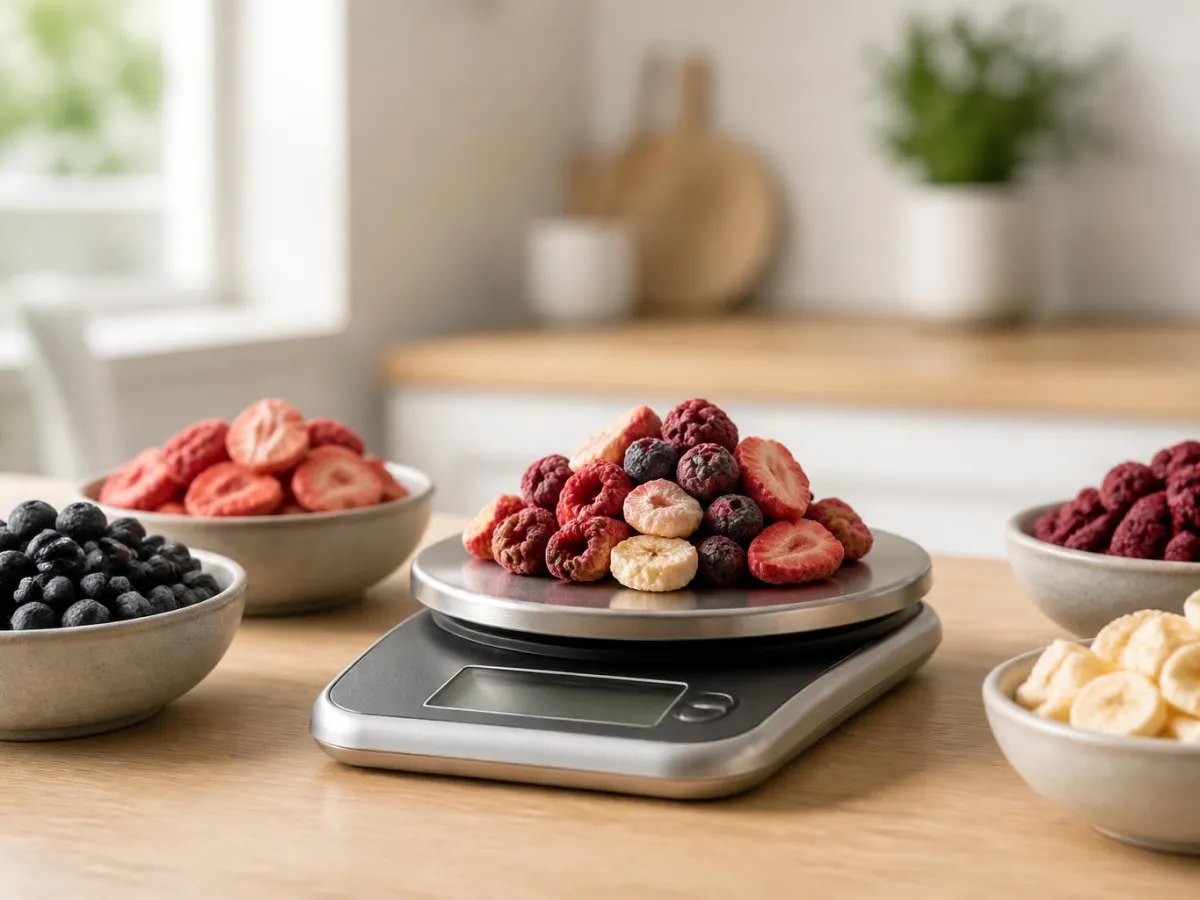
- Weigh a serving once on kitchen scales, look at it, and use that picture afterwards. Ten grams is less than most people guess.
- Decant into a small jar or bowl rather than eating from the bag. The crunch makes grazing effortless.
- Use it as a topping rather than a snack for porridge, yoghurt or overnight oats, which also puts it with a meal.
- Read the ingredients before the calories. A coated product and a plain one are not the same food.
- For babies and toddlers, soften or powder the pieces first, because crisp fragments are a choking risk. See our notes on freeze-dried fruit for babies and toddlers, follow NHS weaning guidance, and ask your health visitor or GP about your own child.
The practical takeaway is short. Judge freeze-dried fruit by the 10g serving, not the 100g bag: that is around 30 to 40 kcal, about the same as the fresh fruit it came from, and the number printed on your own pack is the one to trust.
Good questions, short answers
How many calories are in freeze-dried strawberries?
Typically about 330 to 380 kcal per 100g, which works out at roughly 35 kcal for a 10g serving. The per-100g figure is high because almost all the water has gone and 100g of freeze-dried strawberries is close to a kilogram of fresh fruit. Figures vary between products, so check the label on your pack.
How many calories are in a 10g serving of freeze-dried fruit?
Most plain freeze-dried fruit lands between about 30 and 40 kcal for a 10g serving. Berries sit at the lower end and sweeter fruit such as banana and mango at the higher end. A 10g serving is a small handful of slices or a light scattering over porridge.
Do freeze-dried strawberries have more calories than fresh ones?
Weight for weight, yes, by roughly ten times, because the water has been removed and water has no calories. For the same amount of actual fruit the energy is broadly the same: a 10g serving of freeze-dried strawberries carries about as much energy as the 100g or so of fresh berries it was made from.
How many calories are in freeze-dried fruit powder?
Powder is simply the same fruit milled fine, so per 100g it is much the same as the pieces, usually somewhere between 320 and 390 kcal. In practice you use very little of it. A level teaspoon of fruit powder weighs only a couple of grams, so it adds under 15 kcal to a drink or a bowl of yoghurt.
Is freeze-dried fruit high in calories?
It is energy dense by weight rather than high in calories by portion. A 100g bag holds around 350 kcal, but a normal serving is about 10g and that is roughly 35 kcal. Because the pieces are light and crisp it is easy to eat several servings without noticing, so weighing a portion out is worth doing if you are counting.
How much freeze-dried fruit counts as one of my 5 A Day?
The NHS counts 30g of dried fruit as one 5 A Day portion, and freeze-dried fruit is dried fruit for this purpose. That is roughly 100 to 120 kcal of freeze-dried berries. The NHS also advises eating dried fruit with meals rather than between them, to reduce the risk of tooth decay.