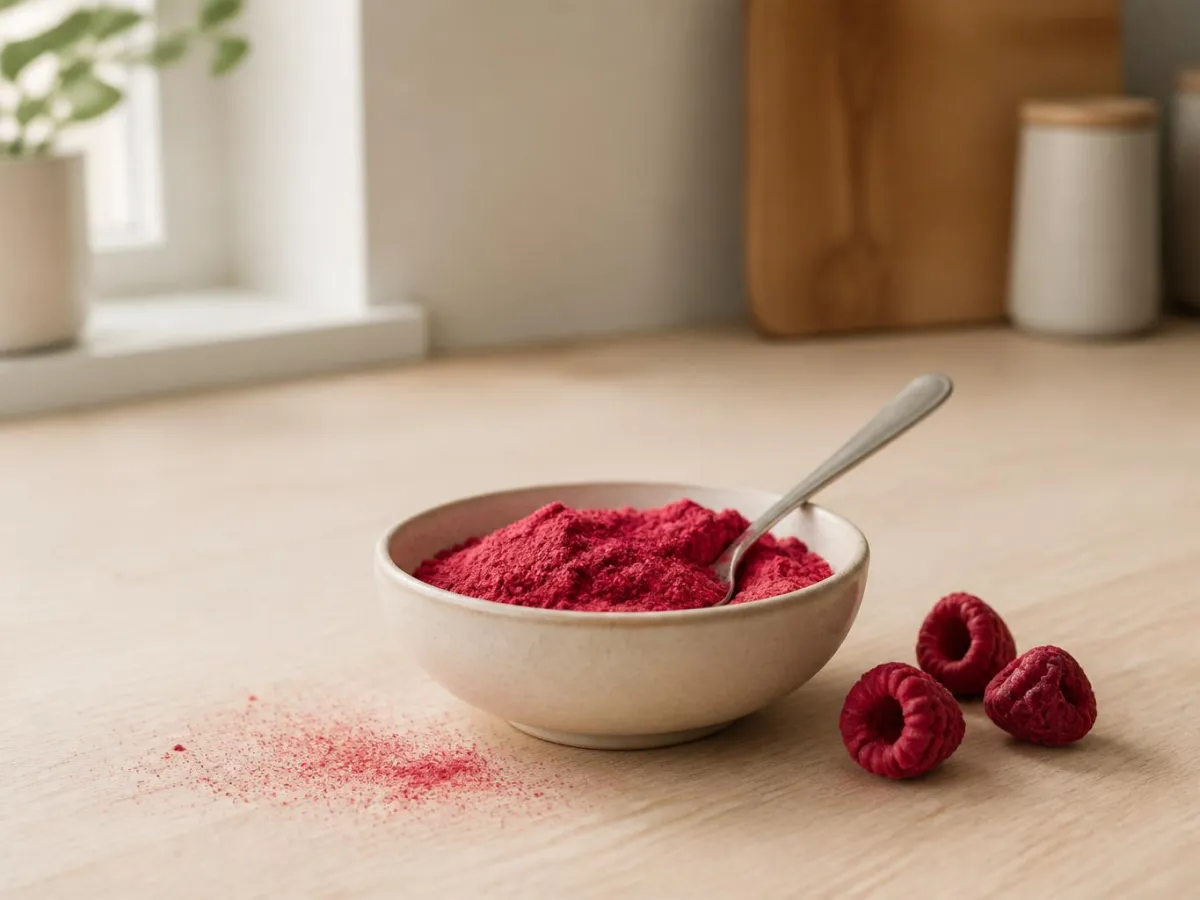
Baking with freeze-dried fruit
Freeze-dried fruit gives bakers flavour and colour without water, which is why it works where fresh fruit fails. Here are the amounts, in grams, and the things that go wrong.
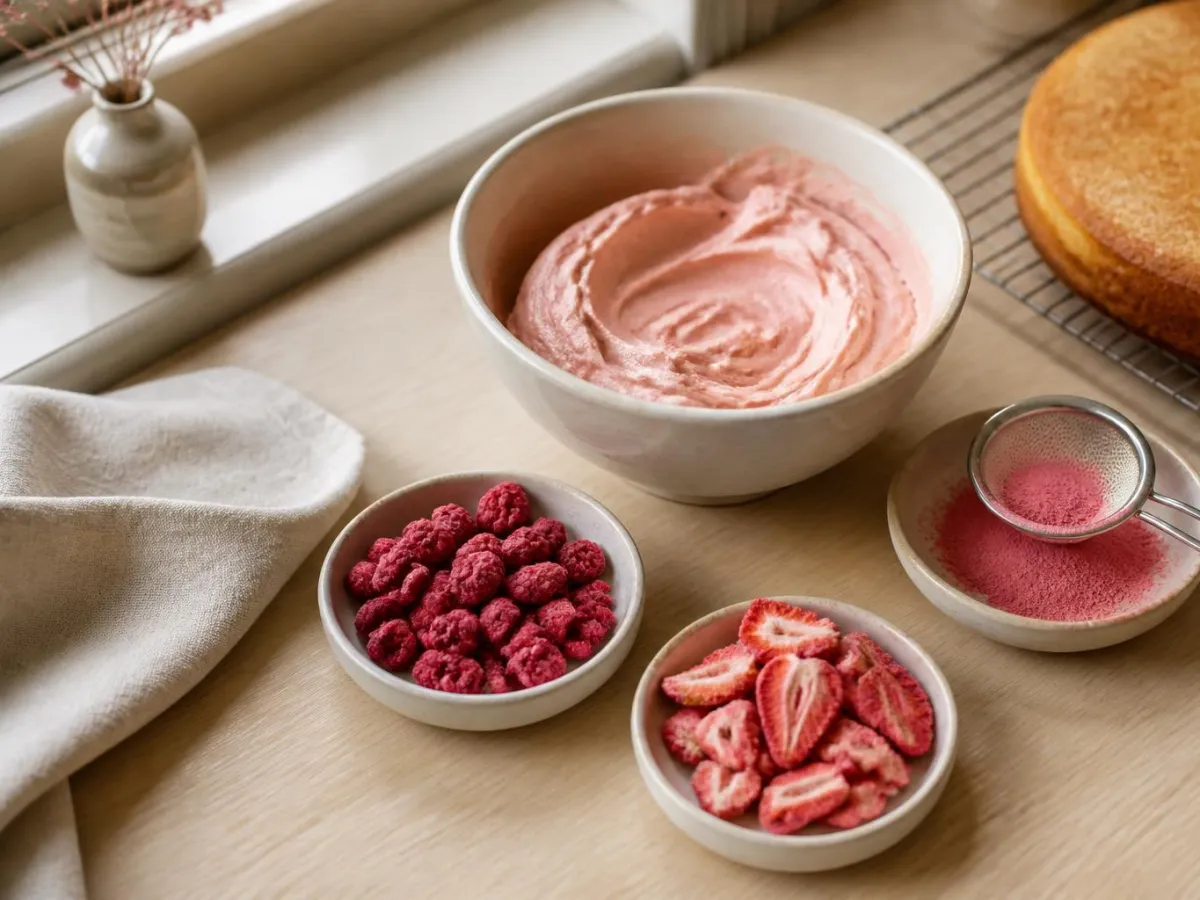
Bake with freeze-dried fruit when you want fruit flavour and colour without fruit water: fold the crisp pieces into a sponge, biscuit dough or melted chocolate at the last moment, or blitz them to a fine powder for buttercream, icing, meringue and macarons. As a starting point, use 15 to 20g of pieces in a 20cm sponge, and 20g of powder per 250g of butter and 500g of icing sugar in buttercream.
The amounts look small because freeze-dried fruit is concentrated fruit. How concentrated depends on how much water the fruit held: 10g of freeze-dried strawberries began life as about 110g of fresh fruit, while 10g of freeze-dried raspberries started as nearer 70g. Either way, weight for weight the dried fruit carries far more sugar and calories than the fresh version, so a little goes a long way in a mixing bowl.
Why freeze-dried fruit works in baking
Fresh berries are roughly 84 to 91 per cent water, depending on the fruit: about 86 per cent for raspberries and about 91 per cent for strawberries. Water is what causes most of the trouble bakers have with fruit, because it thins buttercream, weeps into a sponge, softens a meringue and stops chocolate setting. Freeze-drying takes nearly all of it out, leaving only a few per cent behind, while the flavour compounds, pigments, sugars and fibre stay put, which is why the same berry that ruins an icing works beautifully in it once freeze-dried. That is also where the conversions come from: what is left weighs about a seventh of the fresh fruit for raspberries and about an eleventh for strawberries.
That gives you three things at once:
- Flavour without dilution. A small weight flavours a whole bowl.
- Colour without a bottle. Powder tints buttercream, icing, macaron shells and cream naturally, though see the fading below.
- Structure left alone. The liquid balance does not change, so a set icing stays set and a shortbread stays short.
For the process itself, see our guide to what freeze-drying is and the comparison of freeze-dried and dehydrated fruit, which behave very differently in a bake.
How much freeze-dried fruit to use in baking
| What you are making | Typical amount | Best form | Notes |
|---|---|---|---|
| 20cm sponge or 12 cupcakes | 15 to 20g pieces, or 10 to 15g powder | pieces or powder | pieces fold in last; powder goes in with the flour |
| 12 muffins | 15 to 20g | pieces | expect the colour to soften in the oven |
| Buttercream for 12 cupcakes (250g butter, 500g icing sugar) | 20g, up to 30g for a deeper colour | powder | the classic use, and the easiest place to start |
| Meringue or pavlova (3 egg whites) | 5g | powder | dust over the piped shells; more can soften them |
| Macaron shells (100g ground almonds, 100g icing sugar) | 5 to 8g | powder, sieved | sieve with the dry ingredients so it cannot clump |
| Shortbread (250g plain flour) | 15g | pieces | press into the dough, not on the surface |
| Scones (350g self-raising flour) | 20 to 25g | pieces | swap for the sultanas, weight for weight |
| No-bake cheesecake (300g cream cheese, 200ml double cream) | 15 to 20g | powder | no oven, so the colour stays bright |
| Melted white chocolate (200g) | 15 to 20g | pieces or whole | sharp fruit against very sweet chocolate |
| Glacé or royal icing (200g icing sugar) | 5 to 10g | powder | add liquid a teaspoon at a time afterwards |
These are starting points rather than rules, and they assume plain fruit with nothing added. For other quantities, the fresh to freeze-dried converter does the sums both ways.
Freeze-dried fruit pieces or powder: which to use
| Form | Best for | Not ideal for | Why |
|---|---|---|---|
| Whole berries | decoration, chocolate-dipping, gift bakes | batter | impressive, but they soften unevenly |
| Slices | cake tops, cereal, garnishes | fine icing | pretty, and they hold their shape |
| Pieces or crumb | sponges, muffins, biscuits, scones, bark | smooth icing | fold in last; they spread evenly |
| Powder | buttercream, icing, meringue, macarons, cheesecake | visible fruit texture | even flavour and colour, nothing to bite |
The short version: pieces when you want to see and bite the fruit, powder when you want the whole mixture to taste and look of it. Ready-made freeze-dried raspberry powder and freeze-dried strawberry powder save a step and are ground finer than most home kit manages.
How to make freeze-dried fruit powder at home
- Use a dry, clean spice grinder, a small blender jug or a pestle and mortar. Any moisture in the bowl turns the powder to paste.
- Blitz in short bursts until it looks like icing sugar with flecks in it.
- Sieve it if you want it perfectly smooth, which also catches most of the raspberry and strawberry seeds.
- Grind only what the recipe needs, on the day. Powder draws in moisture from the air faster than whole pieces do, and sets into a solid lump surprisingly quickly.
If the powder has already clumped, sieve it and break the lumps with the back of a spoon first. Clumps in buttercream never fully beat out: they show up as darker specks and a gritty bite.
Freeze-dried raspberries for baking
Raspberry is the baker's default for a reason. It is the sharpest of the common freeze-dried fruits, so it cuts through the sweetness of white chocolate, icing sugar and meringue in a way strawberry cannot, and it gives the strongest natural pink. Pieces and crumb usually cost less per 100g than whole berries, and are the better buy for a mixture.
Two things to plan for: the seeds are small but noticeable, so sieve the powder for a piped icing, and raspberry fades more obviously than most fruit in a hot oven, so if the pink matters put it in the icing rather than the sponge. Our page on freeze-dried raspberries covers forms, storage and what to look for in a pack.
Which freeze-dried fruit suits which bake
- Freeze-dried strawberries are sweeter and gentler: the easy choice for buttercream, sponges and biscuits. The strawberry buttercream recipe is the quickest way to see what the fruit can do.
- Freeze-dried blackcurrants are very sharp and very dark, so they hold colour better than pink fruit and pair well with dark chocolate.
- Freeze-dried cherries suit brownies and almond bakes.
- Freeze-dried blueberries give a lilac tint that turns grey-blue in an alkaline batter, so scatter them over a cooled bake rather than mixing them in.
- Freeze-dried mango and freeze-dried pineapple bring a warm yellow to icing and cheesecake, and freeze-dried banana is mild enough to use generously in loaf cakes.
- Freeze-dried mixed berries are good value in granola, flapjacks and traybakes.
What goes wrong when baking with freeze-dried fruit
The colour fades in the oven. Anthocyanins, the pigments that make berries red and purple, are sensitive to heat and to the pH of the mixture around them, so a batter that looks vividly pink in the bowl can come out beige, dusty pink or grey-lilac. A moderate oven, around 160°C fan rather than 180°C fan, and a pale bake help a little. The reliable answer is to put the colour where there is no heat: buttercream, glacé icing, whipped cream, a no-bake cheesecake filling, or a dusting of powder over the cooled top. Extra bicarbonate of soda pushes berry pigments towards blue and grey, so do not add any.
The powder clumps. Grind fresh, sieve, and store what is left as whole fruit in an airtight jar rather than as loose powder.
The seeds show. Raspberry, strawberry and blackcurrant powders all carry seeds. Sieve for macarons, royal icing and anything piped through a fine nozzle.
The pieces dissolve and streak. Fruit added early to a wet batter rehydrates, bleeds and disappears into pink smears. Fold it in at the very last moment.
The surface scorches. Exposed pieces are thin, sugary and dry, so they catch quickly. Press them into the dough, or scatter them on after baking.
The crunch does not last. A crisp topping takes up moisture from the bake and the air, usually within a day, so decorate shortly before serving. Our page on freeze-dried fruit that has gone soft explains why, and our guide to how long freeze-dried fruit lasts and how to store it covers keeping a pack crisp.
How to adapt a recipe to use freeze-dried fruit
- Decide what you want from the fruit. Flavour and colour throughout means powder; visible fruit and texture means pieces.
- Do not swap it for fresh fruit weight for weight. If a recipe calls for 150g of fresh raspberries, the equivalent is roughly 20g freeze-dried; 150g of fresh strawberries is nearer 14g, because strawberries hold more water. The fresh to freeze-dried converter does it fruit by fruit, which is quicker than guessing.
- If the recipe needs the juice or the bulk, rehydrate first: cover the fruit with just enough cool water, wait two to five minutes and drain. Our guide to rehydrating freeze-dried fruit has timings by fruit.
- Swap, do not add, when using powder in a dry mix. Put the powder in place of a little flour or icing sugar, up to about a tenth of the flour. In buttercream, beat 20g straight in and loosen with milk a teaspoon at a time.
- Expect the mixture to tighten. Powder is thirsty, so a batter that stiffens needs a splash of milk, not more beating.
- Add pieces last, decorations later. Fold in at the end of mixing, and scatter anything you want crisp once the bake is cool.
- Start low. It is easier to add more fruit to the next batch than to rescue an icing that tastes of pot-pourri.
Freeze-dried fruit in baking: sugar, portions and teeth
Because the water has gone, the figures per 100g look dramatic. As typical values, plain freeze-dried berries commonly land somewhere around 330 to 380 kcal per 100g, against roughly 30 to 50 kcal per 100g for the same fruit fresh, most of that carbohydrate being the fruit's own sugars. Those are ranges drawn from published composition data and product labels: figures vary with the fruit, the variety, the ripeness and the producer, so the label on your pack is what counts. Nothing is added to plain freeze-dried fruit, but a cake made with it is still cake.
The NHS counts 30g of dried fruit as one of your 5 A Day, and advises eating dried fruit as part of a meal rather than as a between-meal snack, to reduce the risk of tooth decay. A typical serving of freeze-dried fruit is nearer 10g, and the 15 to 20g in a whole sponge is spread across eight or ten slices, so baking is not where your 5 A Day comes from. There is more in freeze-dried fruit and sugar, freeze-dried fruit and teeth and freeze-dried fruit and 5 A Day.
Baking with children: crisp freeze-dried pieces can be a choking risk for babies and young children, so soften them in a little milk or water, or grind them to a powder and stir it into yoghurt, porridge or a purée rather than handing over the crisp pieces. Follow NHS weaning guidance on textures and foods to avoid, and speak to your health visitor or GP about your own child. There is more in our guide for babies and toddlers.
Where to buy freeze-dried fruit for baking in the UK
Supermarkets stock it in the baking aisle rather than with the fruit, in small pots of roughly 6 to 12g: Tesco and Sainsbury's own-label strawberry and raspberry pieces are the usual suspects, with Aldi and Lidl carrying them on and off. Those pots are fine for decorating a cake and expensive per 100g. Online specialists sell 100g and 250g pouches and a far wider range. Across UK online sellers, freeze-dried strawberries typically work out somewhere around £5 to £11 per 100g, raspberries around £8 to £14 and plain fruit powders around £7 to £10, with bulk packs lower and small sachets much higher (last checked September 2026, and prices change). Our supermarket guide covers who stocks what.
Our own shop is not open yet, so we have nothing to sell you and no prices or delivery to quote. If you would like to know when it opens, join the list below.
If you bake one thing this week, make the buttercream: 20g of powder into 250g of butter and 500g of icing sugar tells you more in five minutes than any amount of reading. Then try 15g of pieces in your usual sponge and see the fading for yourself. For ideas beyond the oven, see what to do with freeze-dried fruit.
Good questions, short answers
Can you use freeze-dried fruit in baking?
Yes, and in several places it works better than fresh fruit, because it carries flavour and colour without adding water. Fold crisp pieces into cake batter, biscuit dough or melted chocolate at the last moment, or blitz the fruit to a fine powder for buttercream, icing, meringue and macaron shells. Recipes that need juice or bulk, such as a compote or a fruit layer, want the fruit rehydrated in water first.
How much freeze-dried raspberry do you put in a cake?
As a starting point, 15 to 20g of freeze-dried raspberry pieces folded into the batter of a 20cm sponge or a dozen muffins, or 10 to 15g of raspberry powder whisked into the dry ingredients if you want an even flavour and colour through the crumb rather than pockets of fruit. Raspberry is sharper than strawberry, so start at the lower end and go up next time.
Do you need to rehydrate freeze-dried fruit before baking?
Not for cakes, biscuits, buttercream, meringue or chocolate, where the fruit can go in dry. Rehydrate it only when the recipe depends on soft, juicy fruit or on its liquid, such as a compote, a sauce or a trifle layer. Cover the fruit with just enough cool water, wait two to five minutes, then drain and use it as you would soft fruit.
Why did my freeze-dried raspberries lose their colour in the oven?
The red and purple pigments in berries, anthocyanins, are sensitive to heat and to the pH of a batter, so a bright pink mixture often bakes to a duller pink, beige or grey-lilac. Nothing has gone wrong and the bake is fine to eat. If you want the colour to show, put the fruit somewhere it is not baked: buttercream, icing, whipped cream, a no-bake cheesecake, or a dusting of powder over the top once the bake has cooled.
Can you use freeze-dried fruit powder instead of flour?
Only a small part of it. Fruit powder has no gluten and behaves like a thirsty, sugary dust, so swapping more than about a tenth of the flour tends to give a dense, dry crumb. Replace a little of the flour rather than adding powder on top of it, and loosen the batter with a splash of milk if it tightens.
Does freeze-dried fruit go soggy in a cake?
Pieces inside a cake take up moisture from the batter and end up soft, which is usually what you want: they behave like small pockets of fruit. If you want crunch, keep the fruit on the outside and add it after baking, and be aware that a crisp topping softens within a day or so once it is stored with the cake.