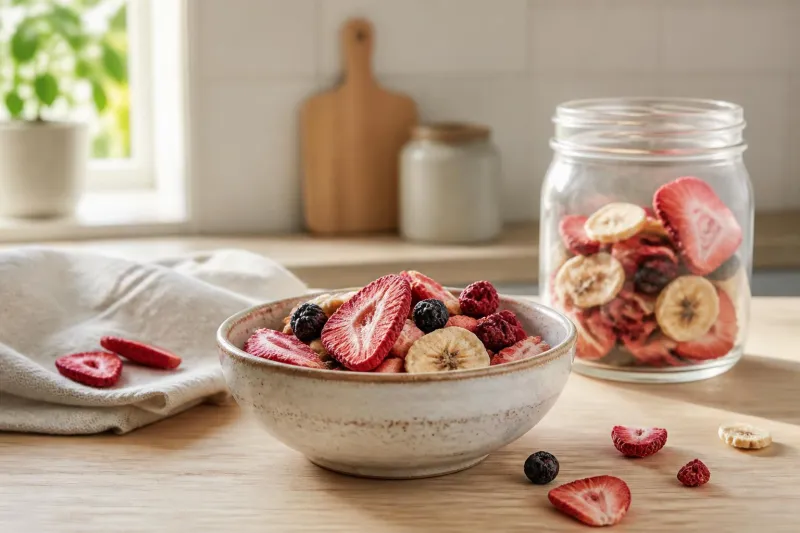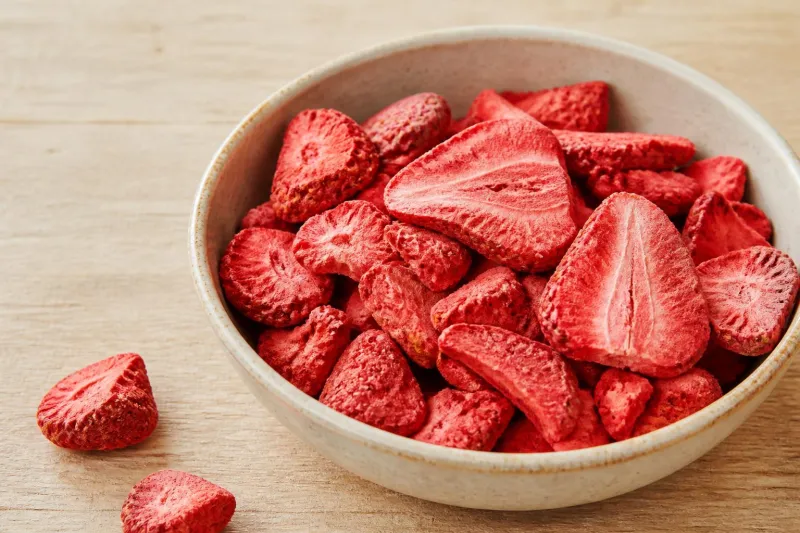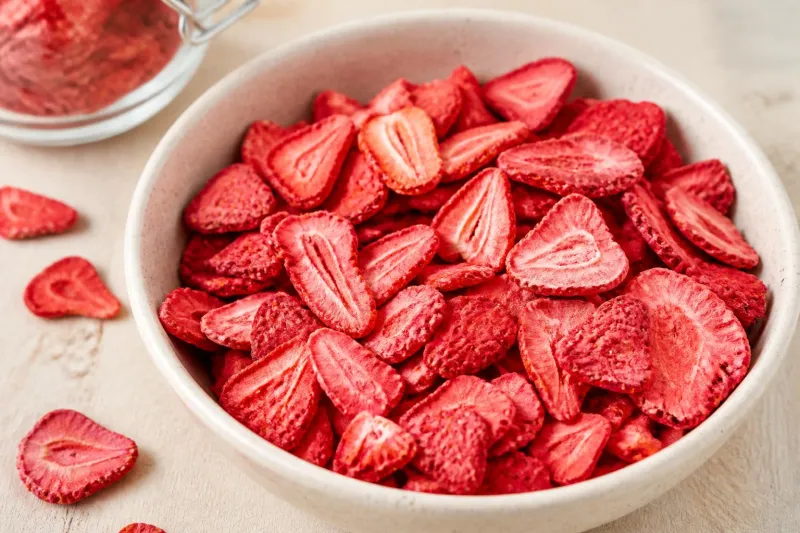
Does freeze-dried fruit count towards 5 A Day?
There is no safe blanket rule that all freeze-dried fruit automatically counts as 5 A Day.

On this page
If you are asking whether freeze-dried fruit counts towards 5 A Day, the careful answer is, sometimes it can, but not every packet should be treated as an automatic yes.
That may sound cautious, but it is the practical UK answer. 5 A Day is based on portions of fruit and vegetables across what we eat over a day or week, not on giving every convenient fruit ingredient a fixed badge by assumption. With freeze-dried fruit, the deciding point is the actual label on the packet, including ingredients, serving information and any claim about what counts as a portion.
What 5 A Day guidance actually says
In the UK, 5 A Day is the familiar public guidance to encourage eating a variety of fruit and vegetables. The broad principle comes through the NHS Eatwell Guide, which looks at overall balance rather than demanding that every individual snack or ingredient achieve a nutrition target on its own (NHS Eatwell Guide).
That distinction matters. People often ask kitchen questions in a very specific way, such as whether one spoonful, one packet or one topping counts. The official guidance is broader than that. It is about patterns of eating, variety and sensible portions, not a running tally attached to every dried crumb of fruit.
There is also a difference between established guidance and interpretation. Established guidance includes the NHS approach to balanced eating and food label reading. Interpretation starts when we try to apply that guidance to a very specific format such as freeze-dried strawberries scattered over porridge, raspberry pieces folded into meringue, or a fruit powder stirred into icing.
For practical home use, we think it helps to keep three points clear.
First, fruit in different forms is still fruit, but form affects how easy it is to eat a lot, how concentrated it becomes, and how the portion should be judged.
Second, dried formats need care because water has been removed. That changes weight, texture and volume. A light handful of freeze-dried slices is not directly comparable with the same visual amount of fresh fruit.
Third, the NHS approach to labels is important here because per 100g and per serving are not the same thing, and readers regularly mix them up (NHS food labels guidance).
So the right starting point is not, “all freeze-dried fruit counts” or “none of it counts”. It is, “what does this product actually say, and how is it intended to be used?”
Can freeze-dried fruit count?
In principle, yes, freeze-dried fruit may count towards 5 A Day. But that is not the same as saying every freeze-dried fruit product definitely does, or that any amount you happen to sprinkle on breakfast should be counted as a full portion.
Freeze-drying removes moisture while keeping the fruit itself in a dry, crisp form. If a packet contains only fruit, with no additions, it is reasonable to see it as a fruit ingredient rather than something unrelated to fruit. That is the basis on which people often assume it can contribute.
Where the caution comes in is portion evidence. A freeze-dried product is much lighter than fresh fruit because the water has been taken out. That means a small weight can represent a larger amount of original fruit, but the exact relationship depends on the fruit, the cut size, and the product. Whole raspberries, sliced strawberries and fruit powder do not behave the same way in a bowl or on a scale.
That is why we avoid giving fixed fresh-to-freeze-dried conversions without pack evidence. It is tempting to say that a certain number of grams always equals one portion, but that would be too neat for real-world packets. Different brands and products may present serving sizes differently, and some may make no 5 A Day claim at all.
So, does freeze dried fruit count as 5 a day? The natural answer is that it can count towards it, where the product and serving information support that use. It is not a blanket rule for every packet and every amount.
A simple kitchen example shows why. If you stir a modest amount of freeze-dried strawberry powder into buttercream for colour and flavour, you are using fruit, but you may not be using enough of it in each slice to treat that serving as a clear fruit portion. By contrast, if a cereal topping portion is specifically labelled by the manufacturer as equivalent to one fruit portion, that is much firmer ground for counting it.
The same caution applies to mixed products. A packet might look fruit-based from the front, but the back may show sugar, starch, oil or flavourings. Once we move away from plain freeze-dried fruit into blends, coatings or snack mixes, assumptions become even less reliable.
For readers comparing formats, our guides to freeze-dried fruit and first steps with freeze-dried fruit information can help with the practical differences between pieces, slices and powders.
Why the label matters more than assumptions
For day-to-day use, the packet is the deciding source. That is not a legal lecture, it is simply the most useful habit.
Start with the ingredients list. If the packet says 100 per cent fruit, that tells you far more than the front-of-pack image. Then look at the nutrition table and check whether the information is given per 100g, per serving, or both. The NHS is very clear that these are different comparison bases, and readers should not treat them as interchangeable (NHS food labels guidance).
Per 100g is useful for comparing products against each other. Per serving is useful only if the serving size is clearly defined and realistic for how the ingredient is actually used.
For freeze-dried fruit, a sensible serving claim would need to make at least three things clear:
- the serving size in grams
- whether the serving is intended to be eaten on its own or used as an ingredient
- whether the manufacturer explicitly states that the serving counts as one portion of fruit
If that information is missing, you do not have enough to make a confident 5 A Day claim in ordinary kitchen planning.
This is especially important because freeze-dried ingredients are often used in small amounts. A tablespoon of berry powder in icing, a scattering of raspberry pieces over cheesecake, or a few strawberry slices on granola may be excellent flavour choices, but they are not automatically a fruit portion just because the source ingredient began as fruit.
When comparing labels, it helps to slow down and keep the bases separate.
Per 100g tells you how concentrated the dry product is. With freeze-dried fruit, that figure will often look intense because you are looking at fruit with the water removed.
Per serving tells you what the manufacturer expects you to eat or use at one time.
Neither figure should be guessed from volume alone. A cup of airy freeze-dried slices can weigh very differently from a cup of denser fruit pieces or powder. This is one of the reasons we prefer weighing in grams when accuracy matters, especially in baking.
If a packet makes a portion claim, use that claim as written. If it does not, do not fill the gap with a homemade conversion chart from the internet.
What else to check besides the fruit itself
Even when the fruit question seems straightforward, the rest of the label still matters.
The first check is the ingredient list. Plain freeze-dried fruit may be just fruit, but some products include added sugar, sweeteners, oils, starches, anti-caking agents or flavourings. That does not automatically make them unsuitable for cooking, but it changes what they are and how you should think about them.
The second check is allergen information. The Food Standards Agency advises consumers to read ingredient and allergen information carefully and not to rely on assumptions about suitability (Food Standards Agency consumer allergy guidance). This matters with fruit ingredients because cross-contamination statements, shared production environments and added ingredients can affect whether a product is appropriate for a particular person.
That point is worth stating plainly. A general assumption such as “it is only fruit, so it must be fine” is unsafe. The actual packet is what matters.
The third check is how the ingredient is meant to be stored after opening. Freeze-dried fruit is valued partly because it is cupboard-friendly before use, but once moisture gets in, texture changes quickly. Crisp fruit can soften, powders can clump, and repeated exposure to steam from the kitchen can shorten the useful life of the opened pack. The Food Standards Agency storage guidance is general rather than product-specific, but the key principle is to follow the product instructions and store food appropriately (Food Standards Agency food storage guidance).
For practical storage habits at home, our guide on how to store freeze-dried fruit covers the cupboard issues readers most often run into, especially moisture and resealing.
Finally, check whether you are buying whole pieces, slices, crushed fruit or powder. These are all useful, but they behave differently in recipes and in portions. A powder disappears into a mixture very easily, which makes it convenient, but also easy to overestimate in your mind as a fruit serving.
Using freeze-dried fruit sensibly in the kitchen
For adult home cooks and bakers, freeze-dried fruit is often most useful as a practical cupboard ingredient, not as a perfect portion calculator.
Its real strengths are convenience, flavour concentration and texture choice. You can keep it on hand for times when fresh fruit is not available, not in season, or simply not ideal for the recipe. It can also help when you want fruit flavour without adding much extra liquid.
That dry texture is exactly why it behaves differently in the kitchen.
In baking, freeze-dried fruit pieces can stay more distinct than fresh fruit in low-moisture mixtures. In buttercream, icing and chocolate work, fruit powder gives flavour and colour without the water that fresh purée would add. In muesli, granola and toppings, crisp slices or pieces can add crunch at first, though they soften once mixed with yoghurt or left on a moist dessert.
Portion-awareness still matters here. If you use freeze-dried fruit as an accent ingredient, think of it as flavour and texture first. If you want it to contribute meaningfully as fruit in your overall day, check the packet and consider the amount actually being eaten, not just the ingredient name.
A few practical kitchen habits help.
Keep opened packs well sealed and dry. If the fruit softens, it may still be usable in some recipes, but it will no longer give the same crisp finish.
Add pieces late where crunch matters. For example, scatter them over porridge or yoghurt just before serving rather than long in advance.
Use powder where you want even distribution. It is often easier than pieces for icings, sponge mixtures and dusting.
Adjust moisture carefully in recipes. Freeze-dried fruit absorbs liquid differently from fresh fruit. If you fold pieces into a batter, they may draw in some moisture during standing. If you add powder to icing or frosting, it can thicken the mixture, so it is sensible to add small amounts and judge the texture as you go.
Treat recipe swaps as experiments unless the recipe was designed for that format. Replacing fresh strawberries with freeze-dried strawberries is not a straight swap because you are changing both moisture and structure.
For readers choosing between formats for baking, we have a guide on picking the right freeze-dried fruit texture for each bake.
One final point is worth keeping in view. Convenience ingredients are easiest to use well when we do not ask them to do every job at once. Freeze-dried fruit can be a very handy part of the cupboard. It can contribute fruit in principle. It can also make baking neater, quicker and less dependent on fresh produce. But whether it counts towards 5 A Day in your own tally depends on the actual product, the actual serving, and the actual label.
That is why our practical answer stays measured. Some freeze-dried fruit may count towards 5 A Day, but the packet decides. Read the ingredients, compare per 100g with per serving properly, and avoid assuming that every sprinkle or spoonful counts as a portion just because it started life as fruit.