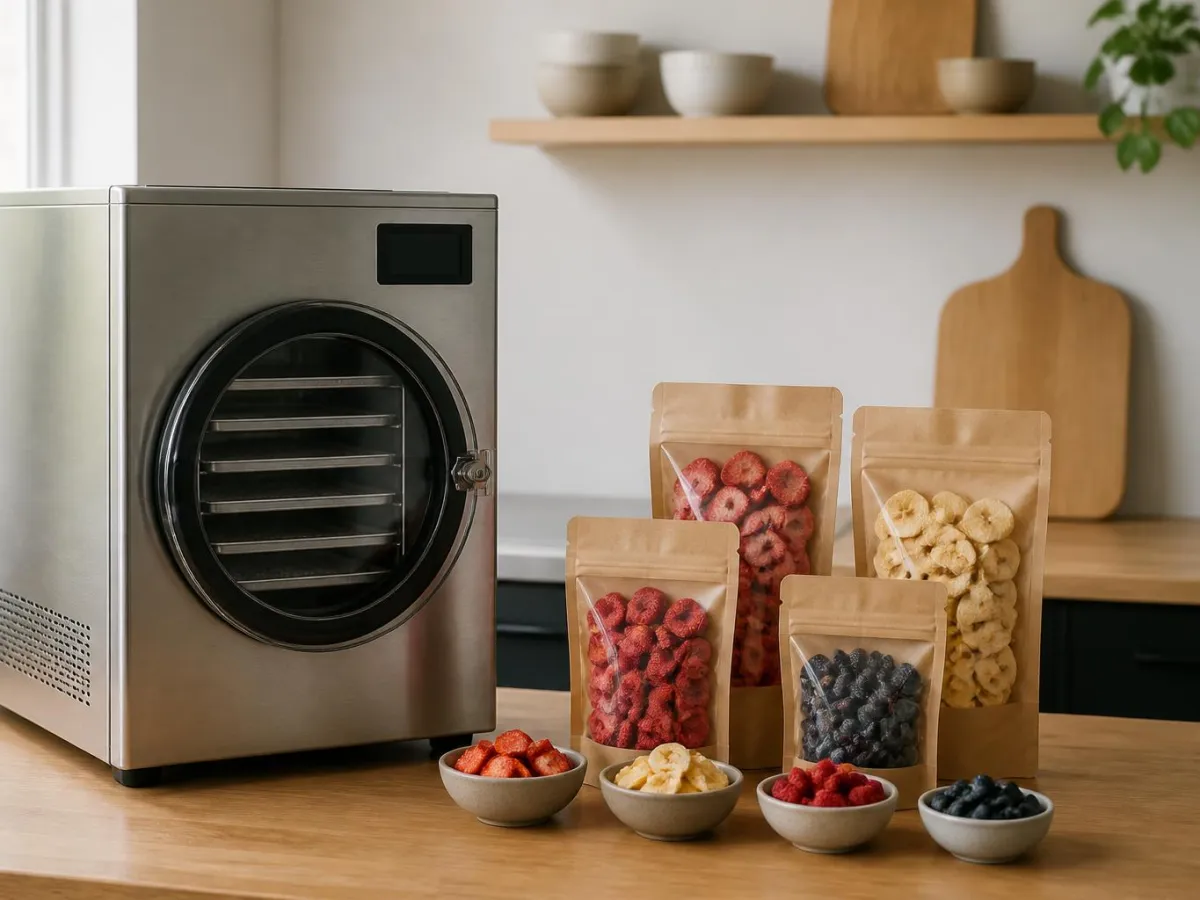
Freeze dryer running costs in the UK
The electricity cost of a freeze-drying cycle is simple arithmetic: kilowatts, hours and your own unit rate. Here is the method, with the sums in pounds and pence.
- kW x hours x p/kWhthe whole calculation
- 18 to 48 hoursthe cycle lengths costed below
- about 24 kWha 24-hour cycle at an average 1kW draw
- Every 3 monthshow often Ofgem resets the price cap
On this page
- The formula for freeze dryer running costs
- Freeze dryer cost per batch at UK electricity unit rates
- How to adjust the figures for your own machine
- What changes the cost of a freeze-drying cycle
- What the electricity works out to per 100g of finished fruit
- How to find your electricity unit rate
- The practical takeaway on freeze dryer running costs
To work out what a freeze dryer costs to run, multiply its average power draw in kilowatts by the length of the cycle in hours to get kilowatt hours, then multiply that by your own electricity unit rate in pence per kWh. A home machine averaging 1kW across a 24-hour cycle uses about 24 kWh, which is roughly £4.80 at 20p per kWh and about £8.40 at 35p.
That is the whole calculation. What follows is the arithmetic laid out so you can plug your own numbers in, and why both variables move about so much.
Why there is no single figure here. Running cost depends on two numbers that are yours and not ours: what your machine actually draws, and what you pay per unit of electricity. Much of what is published on the question is American and quoted in dollars per batch, with neither the kilowatt hours nor the unit rate behind it, so there is nothing to convert. What follows is the method in pence per kWh, with illustrative rates you can swap for your own.
The formula for freeze dryer running costs
Two lines of arithmetic:
- kWh per batch = average power in kW x cycle length in hours
- Cost per batch in pounds = kWh per batch x unit rate in pence per kWh, divided by 100
A worked example, using an illustrative rate of 28p per kWh:
- 1.0 kW x 24 hours = 24 kWh
- 24 kWh x 28p = 672p = £6.72 a batch
Two things stay out of it. Your standing charge is paid daily whether the machine runs or not, so it does not belong in a cost-per-batch figure, and VAT is already inside the unit rate on a domestic bill, so do not add it twice.
Freeze dryer cost per batch at UK electricity unit rates
This assumes an average draw of 1.0 kW, a round number in the middle of the range makers quote for domestic machines. The unit rates are illustrative, chosen to bracket what British households have typically paid rather than to quote a tariff.
| Cycle length | kWh used | At 20p/kWh | At 25p/kWh | At 30p/kWh | At 35p/kWh |
|---|---|---|---|---|---|
| 18 hours | 18 | £3.60 | £4.50 | £5.40 | £6.30 |
| 24 hours | 24 | £4.80 | £6.00 | £7.20 | £8.40 |
| 30 hours | 30 | £6.00 | £7.50 | £9.00 | £10.50 |
| 36 hours | 36 | £7.20 | £9.00 | £10.80 | £12.60 |
| 48 hours | 48 | £9.60 | £12.00 | £14.40 | £16.80 |
The sum is a straight multiplication, so the table scales: if your machine averages 1.3 kW, multiply the money column by 1.3, and if your rate is 27p, take the 25p column and add a tenth.
How to adjust the figures for your own machine
Makers publish an average draw rather than a peak, because the compressor and the shelf heaters switch in and out across a cycle. Published averages for domestic machines sit broadly around 1 kW for the smaller cabinets and rise to roughly 1.5 to 1.7 kW for the largest, so check the plate or the specification sheet for the model in front of you. Some of those specifications are written for 110V American models, but watts are what your meter bills: a 230V unit of the same power simply draws about half the current.
| Average draw | kWh over 24 hours | At 25p/kWh | At 30p/kWh |
|---|---|---|---|
| 0.7 kW | 16.8 | £4.20 | £5.04 |
| 1.0 kW | 24.0 | £6.00 | £7.20 |
| 1.3 kW | 31.2 | £7.80 | £9.36 |
| 1.7 kW | 40.8 | £10.20 | £12.24 |
One honest caveat. Cost-per-batch figures published by machine makers tend to come out lower than their own stated wattage across a full cycle would give at any plausible British electricity price, and they rarely show the kilowatt hours or the unit rate they used. There is no way to reconcile a number whose workings are not published, so treat any headline cost per batch as marketing rather than measurement, and meter your own machine.
What changes the cost of a freeze-drying cycle
How full the trays are. The compressor, pump and chamber run whether the trays are full or nearly empty, so a half-full batch costs almost as much as a full one. Filling the trays is the cheapest saving there is.
How much water is in the food. You are paying to turn ice into vapour and catch it on a condenser, so water content drives cycle length directly. Lower-water foods such as freeze-dried peas and sweetcorn give their moisture up quickly, while watery ones like pineapple and watermelon hold on to it. It shows in the yield as much as the clock: strawberries are roughly 91 per cent water, so they finish at about a tenth of their fresh weight, while freeze-dried banana, at nearer three quarters water, comes out at about a quarter of it. Our fresh to freeze-dried converter has the ratios fruit by fruit.
How thick the pieces are. Thin slices give up their water faster than whole fruit. Slicing strawberries rather than loading them whole shortens the cycle, at the cost of the more impressive whole berry.
Whether you pre-freeze. Food loaded frozen solid from a chest freezer means the machine spends less of the cycle on its own freezing stage, and freezer space is cheaper per hour than freeze dryer time.
Room temperature. Both extremes cost you: a warm room makes the refrigeration work harder to hold the condenser cold, while an unheated garage in midwinter means the shelf heaters run longer. A stable indoor temperature is the easy choice.
Pump type. An oil-sealed rotary vane pump and an oil-free scroll pump do not differ dramatically in the electricity they draw. The difference is elsewhere: the oil pump is cheaper to buy but adds a consumable to change and dispose of, while the oil-free one costs more and removes that chore. Judge them on purchase price and maintenance, not running cost.
Your tariff, and the time of day. A cycle of a day or more straddles peak and off-peak, so an Economy 7 or time-of-use tariff cannot cover a whole batch at the cheap rate. Work out a blended average across the hours the machine will actually run.
What the electricity works out to per 100g of finished fruit
This is the figure you can compare with a shop price. Take the £6.00 batch from the 24-hour, 1kW, 25p row above and divide it by the finished weight. Berries come out at roughly a tenth of what went in, so the fresh fruit column follows from the finished one.
| Finished weight per batch | Roughly, fresh fruit in | Electricity per 100g finished |
|---|---|---|
| 150g | about 1.5kg | £4.00 |
| 250g | about 2.5kg | £2.40 |
| 400g | about 4kg | £1.50 |
| 600g | about 6kg | £1.00 |
Across UK specialist retailers, plain freeze-dried berries have generally worked out at roughly £8 to £14 per 100g (last checked September 2026; prices change constantly). On electricity alone, then, a well-filled home batch looks cheap. The comparison is knowingly incomplete: it leaves out the fruit, the machine, pump oil, packaging, freezer time and your labour. Whether a home freeze dryer is worth it puts those back in, and the home freeze dryer hub covers buying.
A note on what comes out of the machine. Freeze-dried fruit is concentrated: only the water leaves, so gram for gram the finished fruit carries several times the sugar and calories of the fresh fruit it came from. Plain freeze-dried berries typically land somewhere around 330 to 380 kcal per 100g, against roughly 30 to 60 kcal for the same weight fresh. Those are typical ranges only and they vary by fruit and by brand, so the pack label is the figure that counts. A helping is small: around 10g is a normal serving, and the NHS counts 30g of dried fruit as one of your 5 A Day and advises eating it with meals rather than between them, which is better for teeth.
How to find your electricity unit rate
Look at your latest bill or your supplier's app for the figure in pence per kWh. That is the only number that makes these sums true for you.
We have deliberately not printed a current rate. Ofgem resets the price cap every three months, and the capped level varies by region, meter type and whether you pay by direct debit, standard credit or prepayment. The cap limits the unit rate and the standing charge rather than your total bill, and it does not apply to fixed deals. It covers Great Britain, not Northern Ireland, which has its own regulator. Any figure printed here would be wrong for some readers today and for everybody within a quarter.
Two ways to get a real number rather than an estimate:
- Read your meter or in-home display before and after a cycle and take the difference in kWh, running as little else as you can in that window.
- Use a plug-in energy monitor, which sits between plug and socket and totals the kWh. Check the manual first: some makers specify a dedicated circuit, and a monitor or extension lead rated below the machine is not worth the risk.
The practical takeaway on freeze dryer running costs
Write your unit rate on a sticky note and stick it to the machine. Meter one real cycle with something you dry often, so the kWh figure is yours rather than a maker's average. After that, cost per batch is a ten-second sum, and the only lever worth pulling is filling the trays properly.
If you would rather skip the machine altogether, what freeze-drying is explains what you are paying a commercial dryer to do, freeze-drying compared with dehydrating covers the much cheaper machine that does a different job, and where to buy freeze-dried fruit in UK supermarkets covers what is on the shelves. The Crispberry shop is not open, so there is nothing to buy here: these pages are guidance only.
Good questions, short answers
How much does it cost to run a freeze dryer in the UK?
Multiply the machine's average power draw in kilowatts by the length of the cycle in hours, then multiply by your own electricity unit rate in pence per kWh. A machine averaging 1kW over a 24-hour cycle uses about 24 kWh, which comes to roughly £4.80 at 20p per kWh and about £8.40 at 35p. Use the rate printed on your own bill, because unit rates differ by region, tariff and payment method.
Does a freeze dryer use a lot of electricity?
Per hour, no more than a small fan heater. The issue is the length of the cycle: most foods take somewhere between about 18 and 48 hours, so the machine draws power continuously for a day or more. That turns a modest hourly draw into tens of kilowatt hours per batch.
How many kWh does a freeze dryer use per batch?
For a home machine averaging around 1kW, a 24-hour cycle is about 24 kWh and a 36-hour cycle about 36 kWh. Manufacturer figures for average draw run from about 1kW on smaller units to about 1.7kW on the largest domestic ones, so the same 24-hour cycle could be anywhere from about 24 kWh to about 41 kWh. A plug-in energy monitor is the only way to know your own number.
Is it cheaper to freeze dry at home or buy freeze-dried fruit?
On electricity alone, home freeze-drying is usually cheaper per 100g than buying, but electricity is the smallest part of the cost. The machine itself runs into thousands of pounds, and you also pay for the fresh fruit, pump oil, packaging and your own time. Whether it adds up depends almost entirely on how many batches you run over the machine's life.
Can you run a freeze dryer on Economy 7 or an off-peak tariff?
Only partly. A cycle lasting 24 hours or more will span both the cheap overnight window and the expensive daytime one, so you cannot put a whole batch on the off-peak rate. If you are on a time-of-use tariff, work out a blended average rate across the hours the machine will actually be running and use that figure in the sums.
Does the energy price cap tell me what my freeze dryer costs to run?
Not directly. Ofgem sets the cap every three months and it limits the unit rate and the standing charge rather than the size of your bill, and the capped level varies by region, meter type and how you pay. It also applies to standard variable tariffs in Great Britain, not to fixed deals. The figure you need is the pence per kWh on your latest bill.