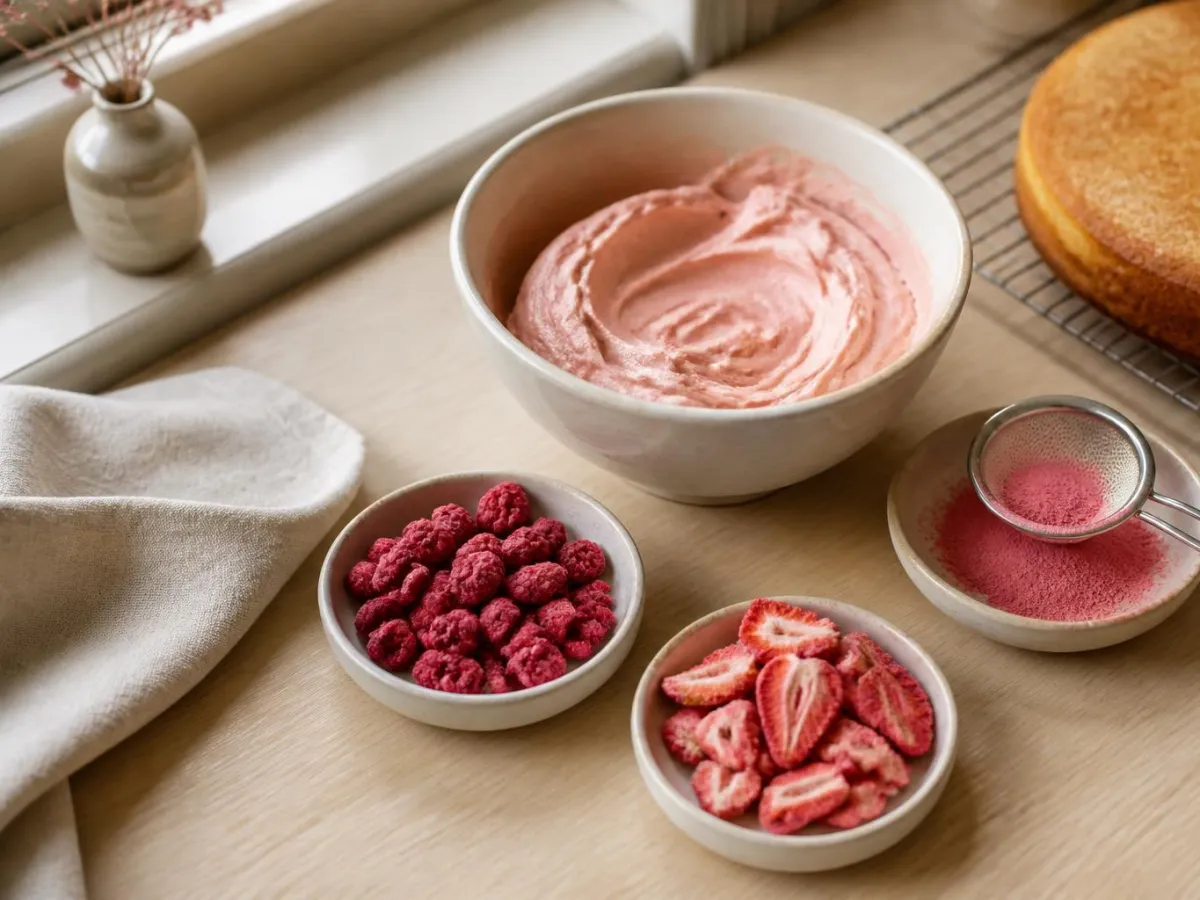
Freeze-dried raspberry powder
Sharper than strawberry, so you need less of it. What raspberry powder does in icing, meringue, chocolate and drinks, with quantities in grams.
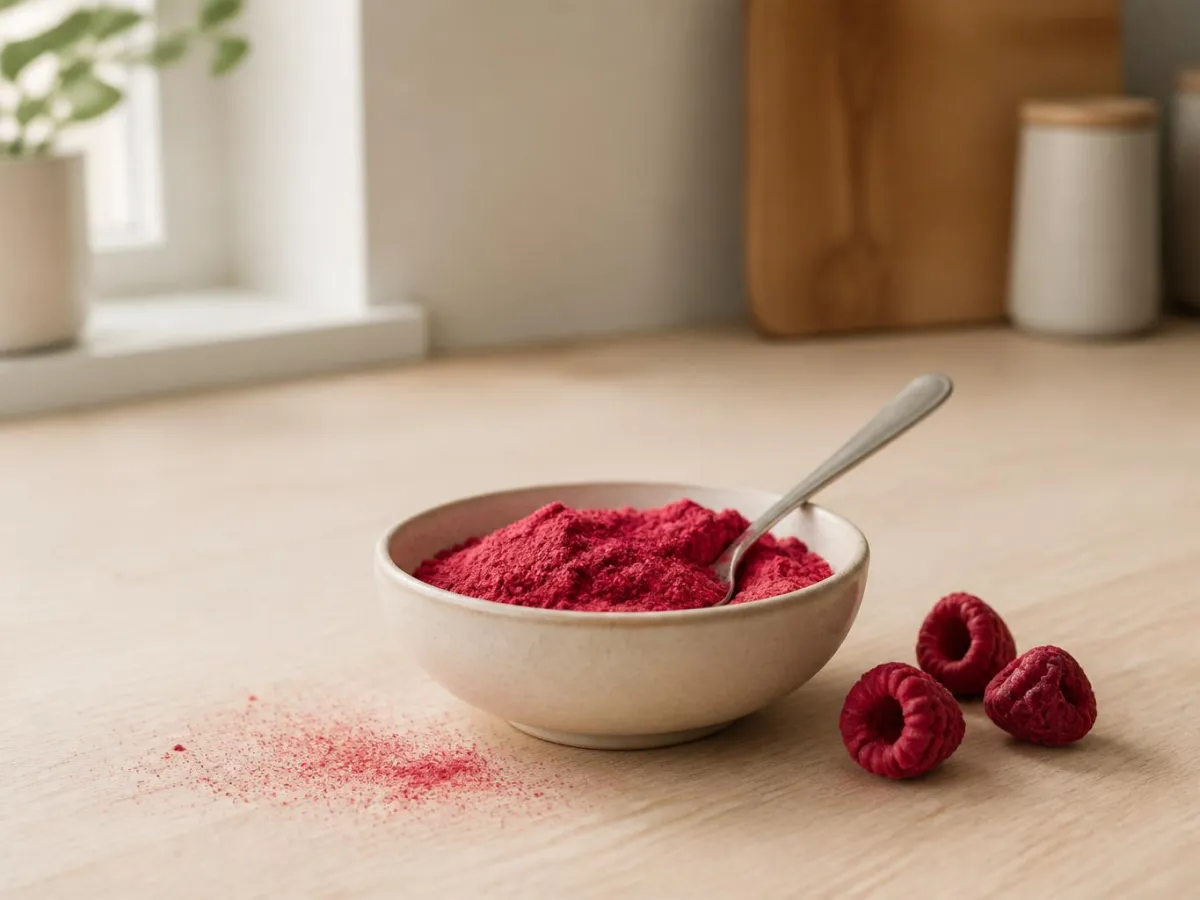
- 10 to 15gper 250g butter for buttercream
- about 7:1fresh raspberries to freeze-dried, by weight
- Sharper than strawberryso use less of it
- 30gone 5 A Day portion of dried fruit (NHS)
On this page
- What freeze-dried raspberry powder is
- Why raspberry powder suits sweet mixtures
- How much freeze-dried raspberry powder to use
- Raspberry powder compared with strawberry powder
- Raspberry seeds, and how to sieve the powder
- How to make freeze-dried raspberry powder at home
- Freeze-dried raspberry powder nutrition: typical values
- Raspberry powder for babies and toddlers
- Where to buy freeze-dried raspberry powder in the UK
- How to store freeze-dried raspberry powder
Freeze-dried raspberry powder is raspberries with the water taken out and the fruit milled fine, so it carries sharp raspberry flavour and a deep pink colour into mixtures that fresh fruit would ruin. For buttercream, start with 10 to 15g of powder per 250g of butter; for meringue, macarons and white chocolate you need less again, because raspberry is tarter than the sweeter fruit powders and carries further.
What freeze-dried raspberry powder is
A plain powder has one ingredient on the label: raspberries. The colour is a proper crimson-pink rather than a pastel, and the flavour is tart and perfumed, with none of the cooked, jammy note you get from a coulis or a jam.
Watch out for two different products sharing a shelf. Plain fruit powder is milled fruit and nothing else. Raspberry-flavoured drink powders, smoothie mixes and dessert mixes usually contain sugar, maltodextrin, added colour and flavouring. Turn the pack over: the ingredients list settles it in a second.
You will also see powders described as seedless or sieved, and others that are simply the whole berry milled, seeds included. Both are useful, and which you want depends on the job.
Why raspberry powder suits sweet mixtures
Two reasons, and neither is to do with looks.
The first is sharpness. Butter, icing sugar, white chocolate and meringue are all sweet, and sweetness on sweetness tastes flat. Raspberries are among the more acidic soft fruits, so a raspberry buttercream tastes of fruit where a sweeter powder can taste mainly of pink. That contrast is also why you can often cut a little sugar elsewhere in the recipe once the powder is in.
The second is water. Fresh raspberries are roughly 86 per cent water. Freeze-drying takes nearly all of it out and leaves about 3 per cent moisture behind, which works out at about 7 to 1 by weight: roughly 70g of fresh raspberries becomes about 10g of powder. Everything else in the fruit is concentrated by that same factor of about seven, which is why a heaped teaspoon is a real portion of fruit rather than a garnish, and why the sugar and energy per 100g look so much higher than they do on a punnet. Add a purée to buttercream and it splits; add it to meringue and it weeps; add it to melted chocolate and it seizes. Powder gives you the fruit and leaves the water behind, so textures behave exactly as they should. As a bonus, the colour comes from the fruit, so there is no bottle of dye involved. For the whole berries and the crumble, see freeze-dried raspberries, and for the arithmetic behind other fruits see what freeze-drying actually does.
How much freeze-dried raspberry powder to use
| Use | Raspberry powder | How to add it |
|---|---|---|
| Buttercream | 10 to 15g per 250g butter | Beat in at the end, then rest for ten minutes |
| Cream cheese frosting | 8 to 12g per 250g | Add before the icing sugar is fully in |
| Whipped cream | 5 to 8g per 300ml | Whisk in with the sugar |
| Meringue and pavlova | 4 to 8g per 100g egg white | Fold or ripple in at the very end |
| Macaron shells | 5 to 8g per 100g ground almonds | Sift with the icing sugar |
| White chocolate | 5 to 10g per 100g | Stir in off the heat |
| Ganache | 5 to 8g per 200g chocolate | Whisk into the warm cream first |
| Cheesecake filling | 15 to 25g per 500g | Blend until there are no streaks |
| Sponge or shortbread | 10 to 20g per 250g flour | Expect the colour to fade in the oven |
| Yoghurt or porridge | 3 to 5g per bowl | A heaped teaspoon, stirred and left a minute |
| Milkshake or smoothie | 5 to 10g per glass | Blend rather than stir |
| Lemonade, cocktails, fizz | 2 to 4g per glass | Slake with a little liquid first |
| Dusting truffles or doughnuts | 1 to 2g | Mix with icing sugar so it does not clump |
These are starting points rather than rules. Raspberries vary in sharpness with variety and season, and producers mill to different finenesses, so taste and adjust. If a recipe gives a quantity for freeze-dried strawberry powder, start with about two-thirds of it. There are more ideas in our guide to baking with freeze-dried fruit, and the method transfers straight onto our strawberry buttercream recipe if you swap the fruit.
Raspberry powder compared with strawberry powder
| Compared | Raspberry powder | Strawberry powder |
|---|---|---|
| Flavour | Sharp, tart, perfumed | Sweeter, softer, jammier |
| Colour in icing | Deep pink to crimson | Pale to mid pink |
| Seeds | Hard, noticeable, worth sieving | Tiny, rarely a problem |
| Starting amount in 250g buttercream | 10 to 15g | 15 to 20g |
| Best with | White chocolate, cream cheese, meringue, gin | Vanilla, milk, shortbread, cream |
| Typical UK price per 100g | about £7 to £10 | about £7 to £9 |
The price bands are indicative ranges for third-party UK specialist online retailers, last checked September 2026, and they move constantly, so treat them as a rough guide rather than today's figure. Organic and named-origin lines sit above them, and small baking tubs cost far more per gram than a 100g pouch. For a fuller picture of what is sold where, see where to buy freeze-dried fruit.
Raspberry seeds, and how to sieve the powder
Raspberry seeds are hard, and freeze-drying does not soften them. Milled whole-berry powder therefore contains seed fragments, which show as darker specks and feel faintly gritty. In porridge, granola, smoothies and sponge, nobody minds. In a smooth ganache, a macaron shell or icing piped through a fine nozzle, they matter.
To sieve, tip the powder into a fine sieve or tea strainer over a bowl and work it through with the back of a spoon. Keep the coarse fragments left in the sieve for breakfast rather than binning them. Grind a little more than the recipe needs, because some weight stays behind as seed.
How to make freeze-dried raspberry powder at home
Put freeze-dried raspberries or raspberry crumble into a completely dry blender, spice grinder or pestle and mortar and work in short bursts. Everything must be bone dry, including the spoon and the jar you are storing it in. Let the dust settle for a few seconds before you lift the lid, or you will lose a fair bit of it to the kitchen.
Nothing but crunch is lost in the grinding, so 20g of berries gives you roughly 20g of powder. Whether it saves money depends on the shop, because crumble and pieces are not always cheaper per 100g than ready-milled powder. What it does give you is freshness and control: you grind what you need, choose how fine it goes, and decide whether to sieve. If you are working the other way round and want to know what a weight of fresh raspberries becomes once freeze-dried, our fresh to freeze-dried converter does the arithmetic.
Freeze-dried raspberry powder nutrition: typical values
Powder is the same fruit as the whole berry, so nothing has been added or taken away but water. What changes is how easy it is to eat a lot of it. Because freeze-drying removes about 86 per cent of the weight, the figures per 100g are roughly seven times the fresh ones, so weight for weight freeze-dried raspberry carries far more sugar and far more energy than fresh fruit. A typical serving is about 10g, and the right-hand column is the one to read.
| Typical values | Fresh raspberries, per 100g | Raspberry powder, per 100g | Per 10g serving |
|---|---|---|---|
| Energy | about 30 to 55 kcal | about 310 to 380 kcal | about 31 to 38 kcal |
| Carbohydrate | about 5 to 12g | about 40 to 80g | about 4 to 8g |
| of which sugars | about 4 to 6g | about 28 to 42g | about 3 to 4g |
| Fibre | about 2.5 to 7g | about 18 to 45g | about 2 to 4g |
| Protein | about 1 to 1.5g | about 7 to 10g | about 1g |
| Fat | under 1g | about 2 to 6g | under 1g |
These are typical ranges rather than figures for any particular product, and the ranges are broad partly because published values for fresh raspberries differ between data sources, especially for fibre and energy. They also shift with variety, ripeness, how finely the fruit is milled and whether the seeds have been sieved out, since the seeds carry much of the fibre and most of the small amount of fat. Products vary, so the label on your own pack is the only figure that counts. In a plain powder all the sugar is the fruit's own; none is added. There is more in our note on sugar in freeze-dried fruit and on calories in freeze-dried fruit.
On portions, the NHS counts 30g of dried fruit as one of your 5 A Day, and it advises eating dried fruit as part of a meal rather than as a between-meal snack, to reduce the risk of tooth decay. That applies to powder stirred into yoghurt or porridge just as much as to whole berries: see does freeze-dried fruit count towards 5 A Day and freeze-dried fruit and teeth.
Raspberry powder for babies and toddlers
Powder avoids the main problem with freeze-dried fruit for small children, which is that crisp whole pieces are a choking risk. Stirred into yoghurt, porridge or a fruit purée it softens straight away. Keep the amount small, because it is concentrated, and follow NHS weaning guidance on when and how to introduce new foods. For individual advice, speak to your health visitor or GP. Our page freeze-dried fruit for babies and toddlers goes through this in more detail.
Where to buy freeze-dried raspberry powder in the UK
Almost all of the choice is online, from wholefood shops and specialist baking suppliers selling 100g and larger pouches. Supermarkets have generally been a poor bet for plain powder: the big chains have stocked very little freeze-dried fruit of any kind, and where it turns up it is usually a small home-baking sachet of pieces rather than powder, which you can of course grind yourself. Ranges change from season to season, so our guide to freeze-dried fruit in UK supermarkets has the picture as we last checked it.
Whatever you buy, compare the price per 100g rather than the price on the front of the pack, and check that the ingredients say raspberries and nothing else.
The Crispberry shop is not open yet, so we have no prices, stock or delivery to quote, and nothing on this page is an offer to sell. You can join the list to hear from us when that changes. In the meantime, more about Crispberry and our editorial policy explain who writes these pages and how.
How to store freeze-dried raspberry powder
Powder has far more surface area than whole fruit, so it takes up moisture from the air much faster. Keep it in a small airtight jar rather than a half-empty big one, use a dry spoon, and close the lid between spoonfuls. Cool, dark and dry beats the shelf above the hob or the windowsill. If a desiccant sachet came in the pack, leave it in.
If it has set into lumps, break them up with a fork or push it through a sieve; it is still fine to use, provided it has been kept clean and shows no sign of mould. Our guide to storing freeze-dried fruit covers packaging and shelf life, and freeze-dried fruit that has gone soft explains what to do when the crunch has gone from the whole berries too.
If you keep one fruit powder in the cupboard, raspberry earns the space: 10 to 15g per 250g of butter, sieved when the finish needs to be smooth, added at the end and given ten minutes to bloom.
Good questions, short answers
What is freeze-dried raspberry powder?
It is freeze-dried raspberries milled to a fine powder, and a plain one contains nothing but fruit. Because all the water has gone, it carries sharp raspberry flavour and a deep pink colour into icing, meringue and chocolate without loosening them. It is not the same thing as a raspberry-flavoured drink or dessert mix, which usually contains sugar, colour and flavouring, so read the ingredients list.
How much freeze-dried raspberry powder do I put in buttercream?
Start with 10 to 15g of powder per 250g of butter, beat it in at the end and leave it to stand for ten minutes, because both the flavour and the colour deepen as the powder takes up moisture. Taste before adding more. Raspberry is sharper than strawberry, so you generally need about two-thirds as much.
How do I get the seeds out of freeze-dried raspberry powder?
Push the powder through a fine sieve or a tea strainer and keep the coarse fragments left behind for porridge or granola. Raspberry seeds are hard and do not soften, so sieving is worth it for macaron shells, smooth ganache and anything piped through a fine nozzle. Grind a little more than you need, since some weight is lost as seed fragments.
Can I make freeze-dried raspberry powder at home?
Yes. Blitz freeze-dried raspberries or raspberry crumble in a completely dry blender, spice grinder or pestle and mortar in short bursts, then sieve if you want it seed-free. Nothing is lost but the crunch, so 20g of berries gives you roughly 20g of powder. Make small amounts, because home-ground powder clumps quickly.
Does raspberry powder keep its colour when baked?
The colour is vivid in anything unbaked, such as buttercream, cheesecake, cream and milkshakes, and it fades in the oven. Sponges, shortbread and macaron shells come out a softer, browner pink than the raw mixture, so either accept the muted shade or put the powder in the filling and the topping instead.
Where can I buy freeze-dried raspberry powder in the UK?
Mostly online, from wholefood and specialist baking retailers selling 100g pouches; UK supermarkets rarely carry plain fruit powder, although small sachets of freeze-dried raspberry pieces do appear in the home-baking aisle. Plain raspberry powder has typically sat at roughly £7 to £10 per 100g, last checked September 2026, with organic lines above that. Prices and stock change, so compare the price per 100g.