Is freeze-dried fruit ultra-processed?
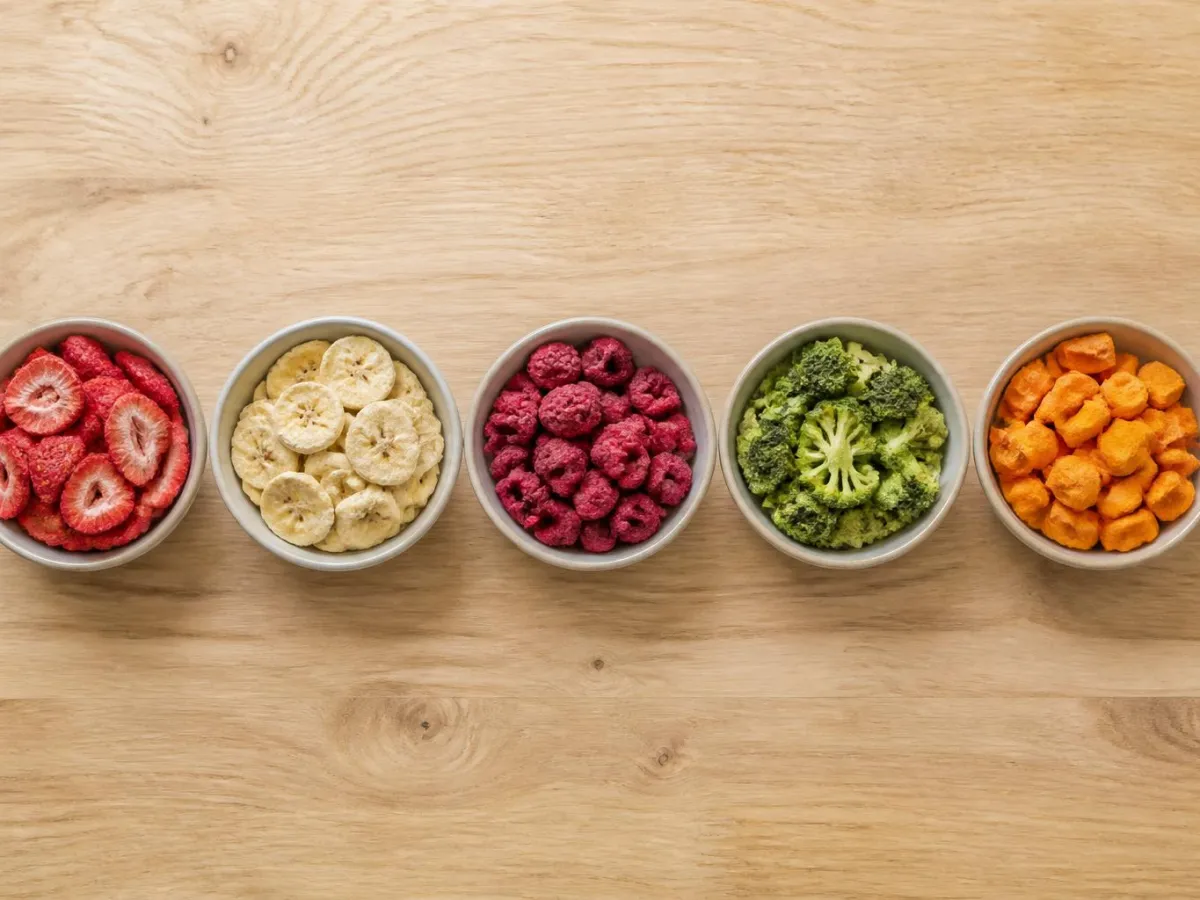
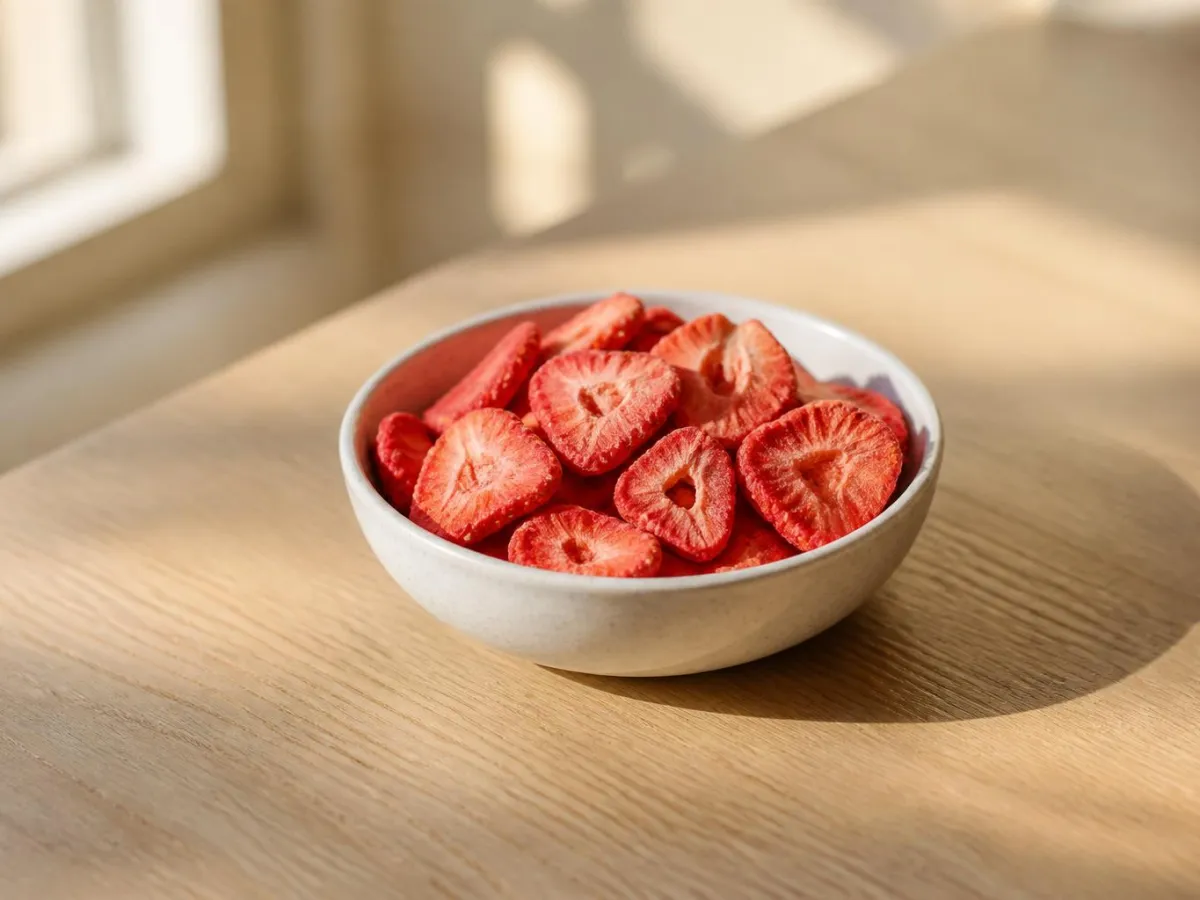
Plain freeze-dried fruit is fruit with the water removed and nothing added, which puts it in NOVA group 1. Coated and sweetened versions are a different matter.
- Group 1where NOVA puts plain freeze-dried fruit
- 4groups in the NOVA classification
- about 10ga typical serving
- 30gone 5 A Day portion of dried fruit (NHS)
On this page
- What the NOVA classification actually is
- Why plain freeze-dried fruit sits in NOVA group 1
- Which freeze-dried products are ultra-processed
- How to check a pack of freeze-dried fruit in a UK shop
- Why the NOVA classification is debated
- Freeze-dried fruit is concentrated, so portions stay small
- The short answer on freeze-dried fruit and UPF
Plain freeze-dried fruit is not ultra-processed. Under the NOVA classification, the research system that gave us the term, it sits in group 1, unprocessed or minimally processed foods, because drying is one of the minimal processes NOVA names and nothing is added to the fruit.
What changes the answer is everything added around the fruit. Chocolate-coated freeze-dried strawberries, yoghurt-coated fruit pieces and the freeze-dried sweets sold in corner shops are ultra-processed, and it is the coating or the sweet that makes them so, not the freeze-drying.
What the NOVA classification actually is
NOVA came out of research led by Carlos Monteiro at the University of São Paulo and was set out for a general audience in a 2019 paper in Public Health Nutrition. It sorts foods by how much and what kind of industrial processing they have been through, rather than by their nutrients. There are four groups.
| Group | What NOVA means by it | Familiar UK examples |
|---|---|---|
| 1 | Unprocessed or minimally processed. Nothing added. Allowed processes include drying, freezing, grinding, boiling, pasteurising and vacuum packing | Fresh and frozen fruit and vegetables, plain oats, milk, dried pasta, plain nuts, eggs |
| 2 | Processed culinary ingredients, used to cook with rather than eaten alone | Sugar, salt, butter, vegetable oil, vinegar |
| 3 | Processed foods. A group 1 food with a group 2 ingredient added, usually two or three ingredients in total | Tinned fruit in syrup, salted nuts, plain bread, cheese, tinned beans |
| 4 | Ultra-processed. Industrial formulations, often with a long ingredients list including additives you would not keep in a kitchen cupboard, such as emulsifiers, flavourings, colours, sweeteners and thickeners | Sweets, crisps, flavoured yoghurts, most packaged biscuits, mass-produced breads, many breakfast cereals |
Drying appears in that group 1 list by name, alongside crushing, grinding, freezing and pasteurising. That is the whole reason plain freeze-dried fruit lands where it does.
Why plain freeze-dried fruit sits in NOVA group 1
Freeze-drying is a physical process, not a recipe. The fruit is frozen solid, then held under very low pressure so the ice turns straight to vapour without melting, which is why the pieces keep their shape and go crisp instead of chewy. Nothing is added and nothing is substituted. How freeze-drying works goes through the stages in detail.
The label is the giveaway. A bag of plain freeze-dried strawberries has an ingredients list of one word: strawberries. A fruit powder has the same list, because milling is grinding, which is also a group 1 process. On NOVA's own terms that is a minimally processed food, in the same bracket as a bag of frozen peas.
It is worth being clear that this is not a loophole or a marketing argument. It is the same logic that puts air-dried apricots and sultanas in group 1 too. Freeze-dried and dehydrated fruit differ in texture, colour and how quickly they soften, not in their processing category.
Which freeze-dried products are ultra-processed
Freeze-dried fruit is an ingredient as well as a snack, and it turns up inside plenty of products that are ultra-processed. Where a product sits depends on the ingredients list, not on the freeze-drying.
| Product | What the ingredients list tends to say | NOVA group |
|---|---|---|
| Freeze-dried strawberry or raspberry slices | Strawberries. Raspberries. One item | 1 |
| Freeze-dried mixed berries, no added sugar | A list of fruits and nothing else | 1 |
| Freeze-dried fruit powder | The fruit, milled | 1 |
| Freeze-dried peas or sweetcorn, plain | Peas. Sweetcorn | 1 |
| Freeze-dried fruit with added sugar or fruit juice concentrate | Fruit, sugar or concentrate | 3 |
| Fruit crisps fried or tumbled in oil and sugar | Fruit, oil, sugar | 3, or 4 if flavourings and additives appear too |
| Chocolate-coated freeze-dried berries | Fruit, then a chocolate coating with emulsifier and flavouring | 4 |
| Yoghurt-coated or coconut-coated fruit pieces | Fruit, then a coating with fats, sugar, emulsifiers, sometimes flavourings | 4 |
| Freeze-dried sweets and "space sweets" | Whatever was in the sweet: glucose syrup, sugar, acids, colours, flavourings | 4 |
| Breakfast cereal, bar or instant porridge containing freeze-dried fruit pieces | A long list, of which the fruit is a small part | 4 |
The freeze-dried sweets that have spread through UK corner shops and market stalls are a useful test of the idea. Freeze-drying a chewy fruit sweet makes it crunchy and startling. It does not make it fruit. The sweet was ultra-processed before it went into the machine, and it still is.
How to check a pack of freeze-dried fruit in a UK shop
Turn the pack over and read the ingredients list, not the front. Plain fruit has a list as long as the fruits in the bag. Anything else is on that list by law.
Two bits of British labelling help you here. First, a claim of "with no added sugars" is only permitted where no sugars or sweetening ingredients have been added, and where sugars are naturally present the label should also carry the words "contains naturally occurring sugars". Second, coatings must be declared, so a chocolate or yoghurt coating cannot hide.
UK availability tends to split along the same line. Plain sachets of freeze-dried strawberries and raspberries have generally turned up in supermarket baking aisles, while coated and chocolate-covered lines have been easier to find in health food shops. Ranges, prices and own-label lines change constantly, so treat any of that as a starting point and check for yourself (last checked September 2026). Where to buy freeze-dried fruit in UK supermarkets covers what British shops tend to stock.
Why the NOVA classification is debated
NOVA is a research tool, not a rule of British food law, and UK expert bodies treat it with care.
The Scientific Advisory Committee on Nutrition reviewed the evidence in its 2023 position statement on processed foods and health. It reported that systematic reviews consistently find higher ultra-processed food consumption associated with a range of adverse health outcomes, but also set out real limitations: the studies are almost entirely observational, so confounding factors such as energy intake, body weight, smoking and socioeconomic status may not be fully accounted for; ultra-processed foods are hard to identify reliably in UK dietary survey data; and the classification of some foods does not match existing UK dietary advice. SACN also noted that the ultra-processed category contains many foods high in fat, salt and sugar that UK advice already tells us to cut down on, so some of the association may already be covered by current recommendations.
The British Nutrition Foundation takes a similar line, arguing that the lack of an agreed definition makes UPF a poor tool for telling healthier products from less healthy ones. Neither the Eatwell Guide nor NHS advice uses the category at all.
None of that makes the question pointless. It means the useful move is to look at what is actually in a pack, which is the same advice that leads you to plain fruit anyway.
Freeze-dried fruit is concentrated, so portions stay small
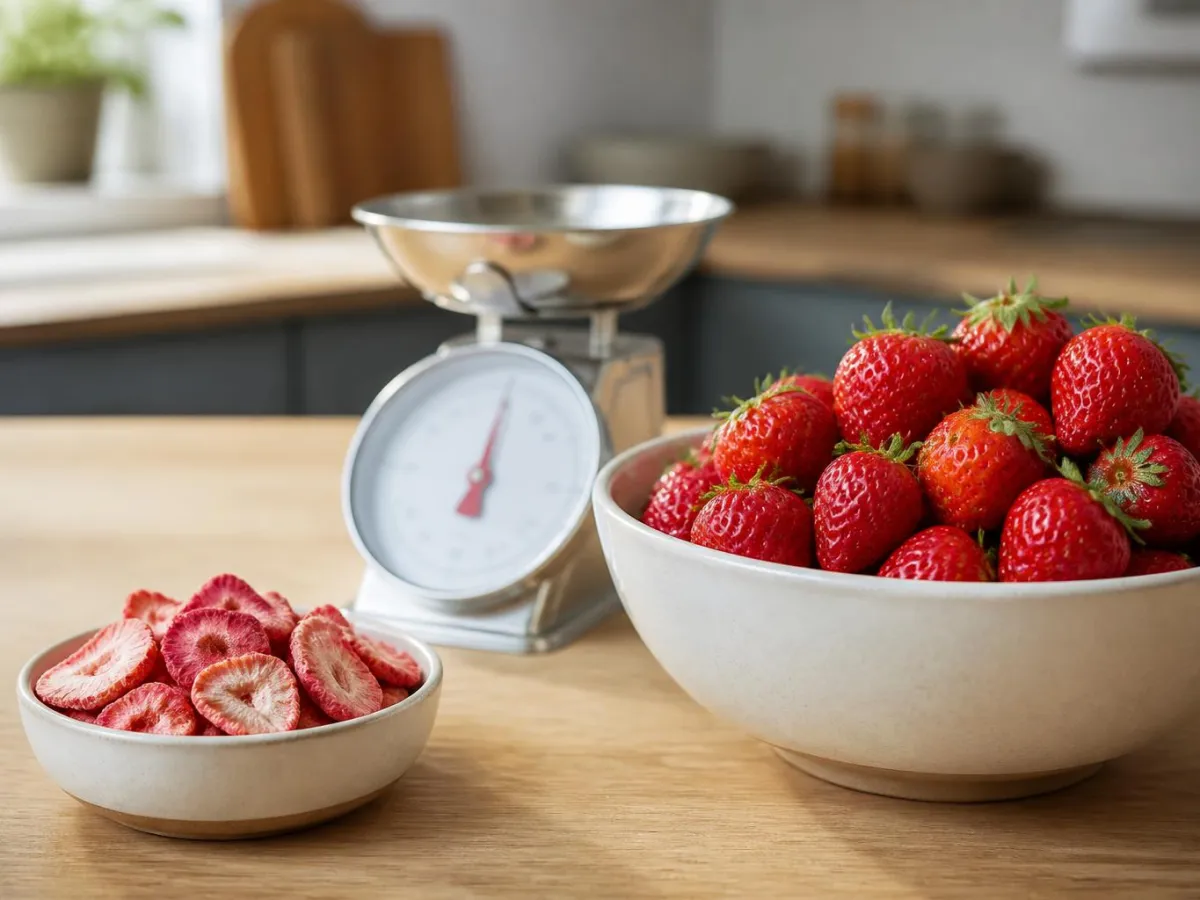
Whatever NOVA says, one thing matters more for how you eat it: freeze-dried fruit is concentrated. About 91 per cent of a strawberry is water, and freeze-drying takes nearly all of it out while leaving the rest behind, so the ratio works out at roughly 11 to 1: about 11kg of fresh strawberries for every 1kg of freeze-dried fruit. Weight for weight, freeze-dried fruit therefore has far more sugar and far more energy than fresh fruit. Our fresh to freeze-dried converter gives the ratio for each fruit, because each one starts with a different amount of water.
| Typical values, strawberries | Fresh, per 100g | Freeze-dried, per 100g | Freeze-dried, per 10g serving |
|---|---|---|---|
| Energy | about 30 kcal | about 300 to 380 kcal | about 30 to 38 kcal |
| Carbohydrate | about 6g | about 60 to 80g | about 6 to 8g |
| of which sugars | about 6g | about 50 to 70g | about 5 to 7g |
| Fibre | about 2g | about 15 to 25g | about 2g |
These are typical ranges, not figures for any one pack. They vary with the fruit, the variety, the growing season and the producer, so the label on your own pack is the figure that applies to what you are eating. A typical serving of freeze-dried fruit is about 10g, which is why the per-100g column looks alarming and the per-serving column does not. Our page on calories in freeze-dried fruit works through the same arithmetic fruit by fruit.
The NHS counts 30g of dried fruit as one of your 5 A Day, and advises eating dried fruit with meals rather than between them, to reduce the risk of tooth decay. That applies to freeze-dried fruit as much as to sultanas. There is more in our notes on freeze-dried fruit and your 5 A Day, sugar in freeze-dried fruit and freeze-dried fruit and teeth.
For babies and young children, crisp freeze-dried pieces can be a choking risk. Soften them in a little liquid or crush them to a powder first, follow NHS weaning guidance, and ask your health visitor or GP about your own child. See freeze-dried fruit for babies and toddlers.
The short answer on freeze-dried fruit and UPF
Judge the pack, not the process. If the ingredients list names only fruit, you have a minimally processed food that happens to be crunchy. If it names a coating, a syrup or a flavouring, you have a confection with fruit in it, which may be perfectly nice but is a different thing. And because the water has gone, keep the serving to about 10g and eat it with a meal rather than between meals.
Crispberry's own shop is not open yet, so nothing is for sale here and there are no prices to quote. Until then, our freeze-dried fruit guides and the nutrition section are the useful part, and you can join the launch list to hear when the shop opens.
Good questions, short answers
Is freeze-dried fruit ultra-processed?
Plain freeze-dried fruit is not ultra-processed. Under the NOVA classification it sits in group 1, unprocessed or minimally processed foods, because drying is one of the minimal processes NOVA lists and nothing is added to the fruit. Products built around freeze-dried fruit are different: chocolate-coated berries, yoghurt-coated pieces and freeze-dried sweets are ultra-processed because of what has been added to them.
What is the difference between processed and ultra-processed food?
In the NOVA system, a processed food is a group 1 food with salt, sugar or fat added to it, like tinned fruit in syrup or salted nuts, and usually has only two or three ingredients. An ultra-processed food is an industrial formulation that typically includes ingredients you would not keep at home, such as emulsifiers, flavourings, colours or sweeteners. Freeze-drying on its own does not move a fruit into either category.
Is freeze-dried fruit less processed than ordinary dried fruit?
Not in NOVA terms. Both plain freeze-dried and plain air-dried fruit are fruit with the water taken out, and NOVA treats both as minimally processed. The difference worth checking is that some dried fruit, such as sweetened cranberries, has sugar or fruit juice concentrate added, which moves it into NOVA group 3, so read the ingredients list rather than the description on the front.
Does freeze-dried fruit have added sugar?
Plain freeze-dried fruit has no added sugar; all the sugar in it is the fruit's own, concentrated because the water has gone. In Great Britain a pack may only say 'with no added sugars' if nothing sweetening has been added, and where sugars occur naturally the label should also carry the words 'contains naturally occurring sugars'. Sweetened, infused and coated products will list the sugar in the ingredients.
Does the NHS class freeze-dried fruit as one of your 5 A Day?
The NHS counts 30g of dried fruit as one of your 5 A Day, and freeze-dried fruit is dried fruit. Because the sugars are concentrated, the NHS advises eating dried fruit with meals rather than as a between-meal snack, to reduce the risk of tooth decay. A typical serving of freeze-dried fruit is smaller than that, about 10g.
Do UK dietary guidelines use the term ultra-processed food?
No. The Eatwell Guide and NHS advice are built around nutrients and food groups, not processing categories. The Scientific Advisory Committee on Nutrition looked at the evidence in its 2023 position statement and found that the studies are almost all observational, that identifying ultra-processed foods in UK dietary survey data is difficult, and that some NOVA classifications do not match existing UK advice.