Freeze-dried beetroot powder
Pure beetroot, milled fine. The strongest natural pink in the cupboard, plus an earthy note that savoury cooking welcomes, with quantities to start from.
- about 8:1fresh beetroot to powder, by weight
- 5g per 250gstarting point for buttercream
- Magenta pinkthe colour it gives, from the vegetable
- Brightest unbakedthe pigment fades with heat
On this page
- What freeze-dried beetroot powder is
- What freeze-dried beetroot powder tastes like
- How much freeze-dried beetroot powder to use
- Freeze-dried beetroot powder as natural food colouring
- How to use beetroot powder in savoury cooking
- Freeze-dried beetroot powder nutrition: typical values
- How to store freeze-dried beetroot powder
- Where to buy freeze-dried beetroot powder in the UK
- Beetroot powder for babies, toddlers and dogs
- Where to start with a first pack of beetroot powder
Freeze-dried beetroot powder is beetroot with almost all of its water removed and then milled fine, and it is bought mainly for one thing: a deep magenta pink in icing, doughs and dips without opening a bottle of food dye. Start at about 5g per 250g of buttercream, keep the colour anywhere the oven cannot reach it, and expect a hot oven to fade the pink towards brown.
What freeze-dried beetroot powder is
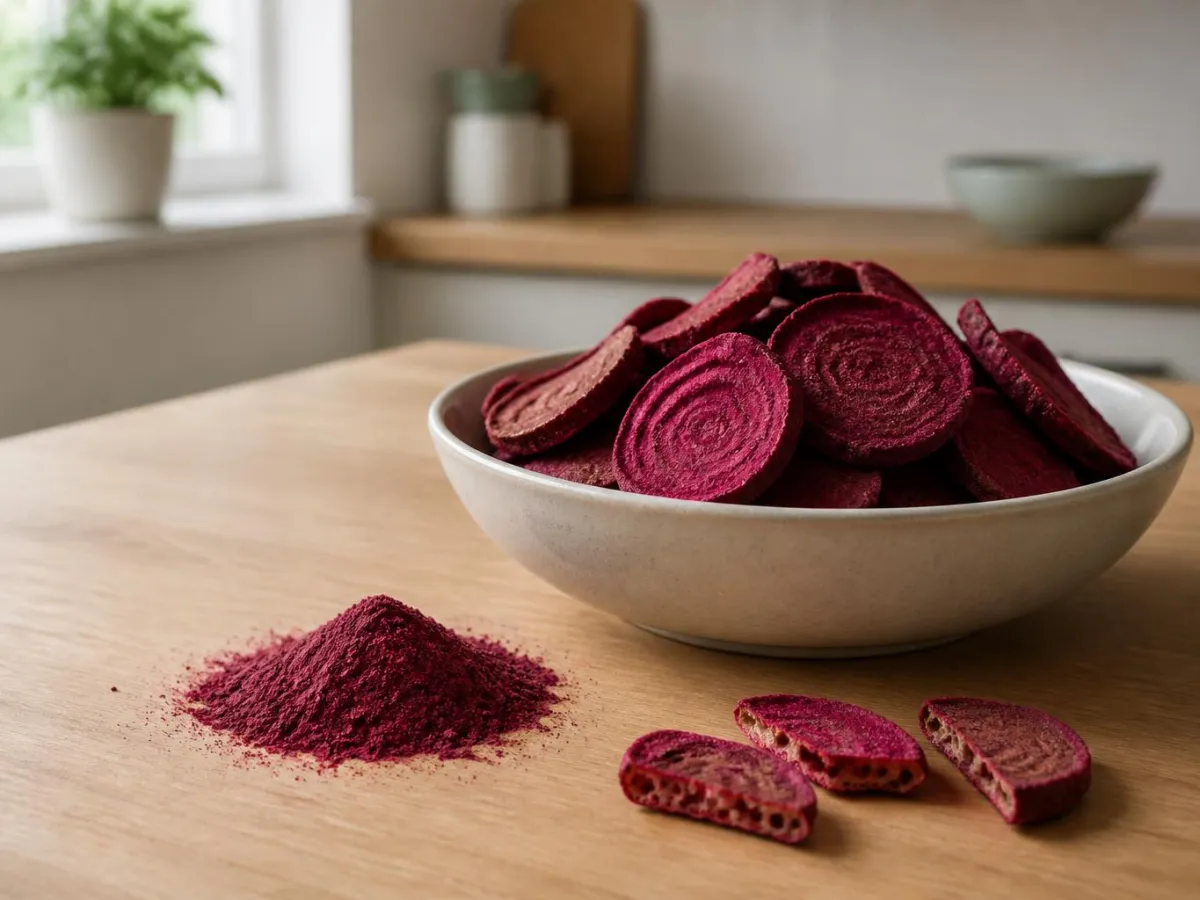
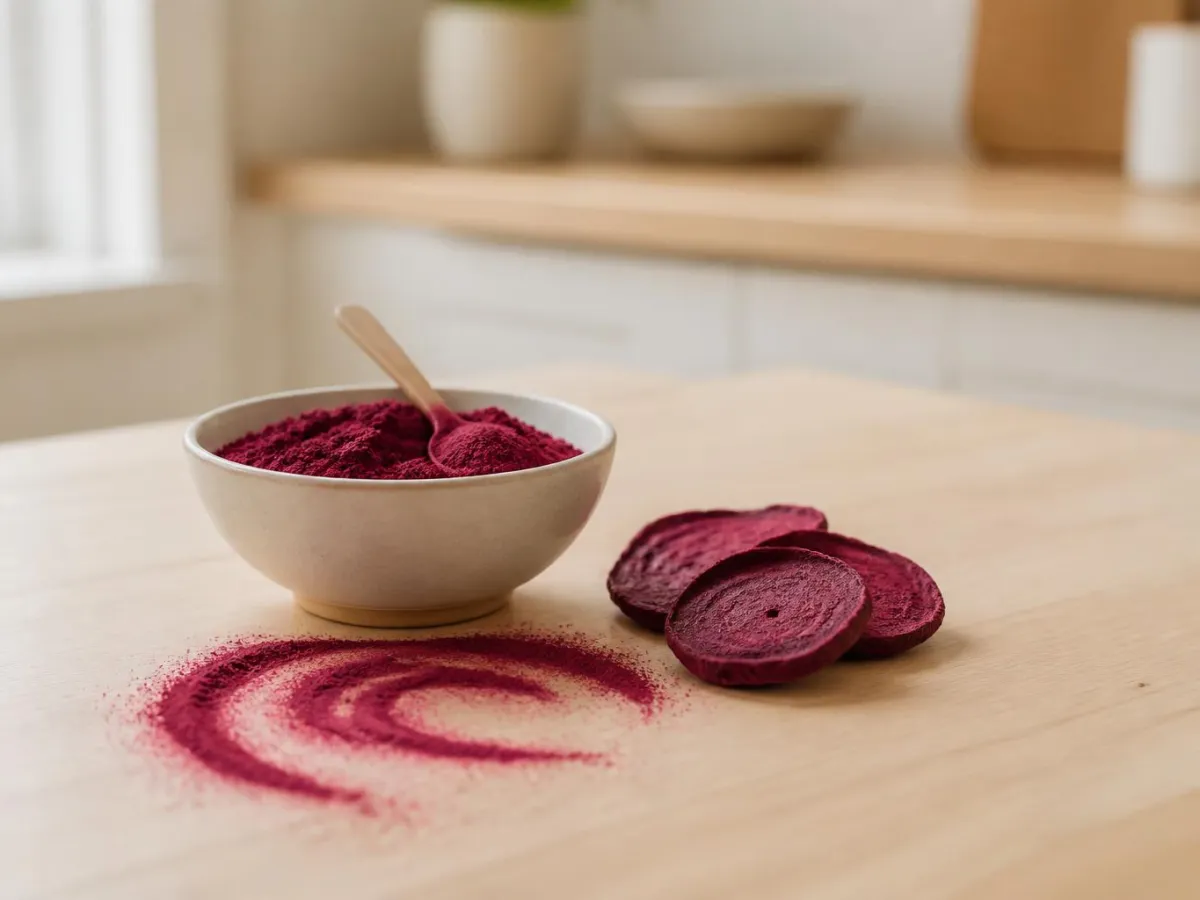
Beetroot is frozen and then dried under vacuum, so the ice leaves as vapour and the vegetable is never cooked dry; what freeze-drying is explains the process. It is usually blanched or cooked first, which sets the colour, and milling the crisp result gives a fine powder that in a plain product is the whole vegetable and nothing else: the ingredients list should read "beetroot" and stop.
Fresh beetroot is roughly 88 per cent water, so the ratio is about eight to one by weight: 80g of prepared beetroot becomes about 10g of powder. For pieces to snack on and rehydrate, see freeze-dried beetroot. Beetroot juice powder and supplement scoops are different products.
What freeze-dried beetroot powder tastes like
Sweet first, earthy second, which is the opposite way round from boiled beetroot. Drying concentrates the sugar already there, so a spoonful smells faintly of soil and tastes mostly sweet, with a mineral, damp-garden note underneath. At 5g per 250g of icing the vanilla still leads and the powder is doing colour work; at 15g the beetroot makes itself known. That earthiness is why it suits goat's cheese, dill, caraway and dark chocolate, and why it is more at home in savoury cooking than any berry powder.
How much freeze-dried beetroot powder to use
| Use | How much | Colour to expect |
|---|---|---|
| Buttercream or cream cheese icing | 5 to 10g per 250g | Vivid magenta pink |
| Royal or glace icing | 3 to 5g per 250g icing sugar | Clear, bright pink |
| Sponge or cupcake batter | 15 to 25g per 500g mix | Muted brown-pink once baked |
| Fresh pasta dough | 15 to 25g per 500g flour | Warm pink |
| Soup, dhal or stew | 5 to 10g per litre | Deep red-pink broth |
| Hummus and dips | 5 to 10g per 400g | Bright magenta |
Treat these as starting points: crops, producers and milling all differ. Beat it into icing at the end and rest the bowl ten minutes, because the colour deepens as the powder takes up moisture. A level teaspoon of fine powder is only about 2 to 3g, so weigh it when colour matters.
Beetroot powder does not dissolve; it is vegetable solids in suspension. Slake it to a paste with a teaspoon of warm water or lemon juice before it goes into icing or batter, and you will avoid speckles. It stains hands and wooden spoons.
Freeze-dried beetroot powder as natural food colouring
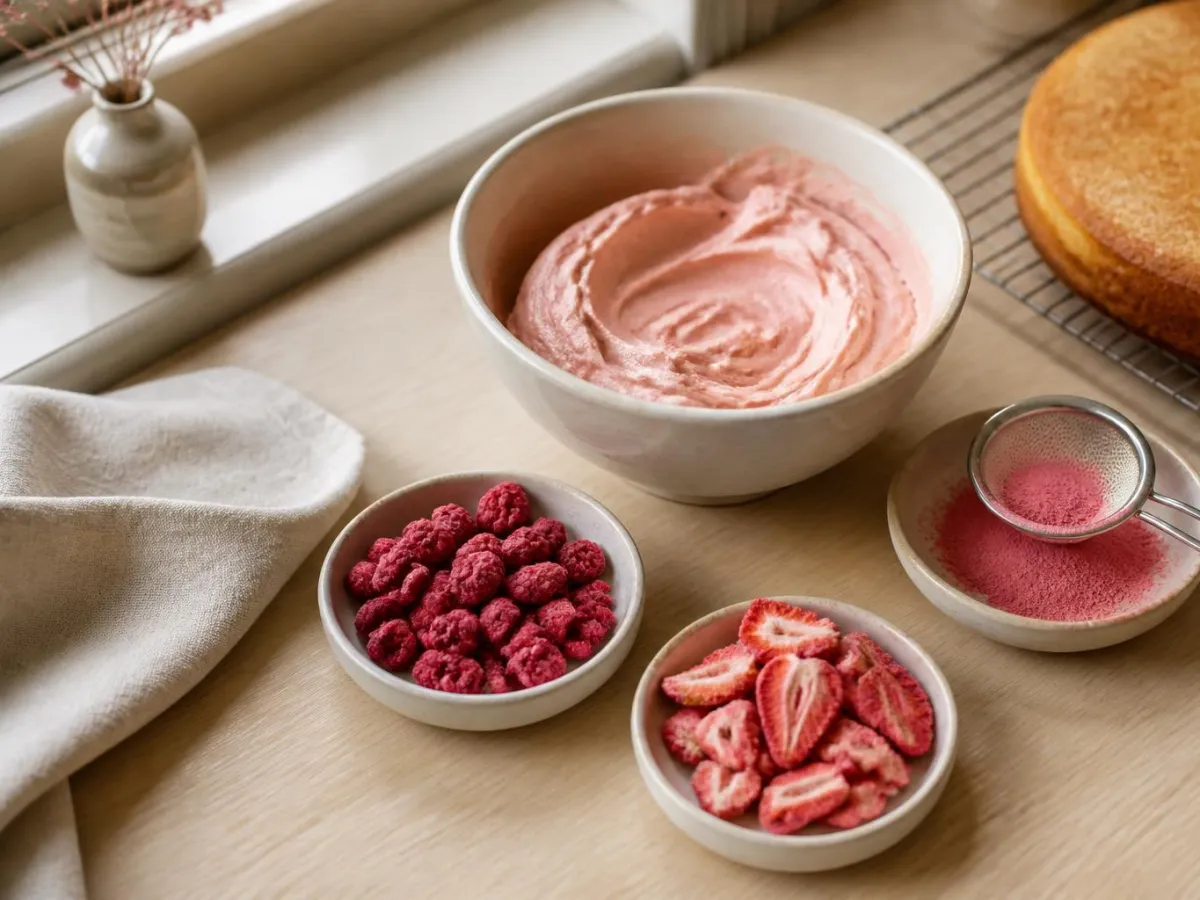
Beetroot's pigment is betanin, one of the betalains, a different family from the anthocyanins in freeze-dried raspberry powder and strawberry powder, so you get a stronger, bluer pink from less powder and less fruit flavour with it. Heat dulls it: betanin breaks down with heat, so the longer and hotter the bake, the more magenta you lose. Alkali shifts it: bicarbonate of soda pushes the colour towards blue-violet and then yellow-brown, while lemon juice or buttermilk pulls it back to pink.
| Where the colour goes | Heat it meets | Colour you get |
|---|---|---|
| Buttercream, royal icing, cheesecake | None | Deep magenta, the best it gets |
| White chocolate and ganache | Melted off the heat | Clean pink, no seizing |
| Macaron and meringue shells | 140 to 150C fan, short | Softer pink, still convincing |
| Fresh pasta | 2 to 3 minutes boiling | Warm pink, some colour in the water |
| Sponges and cupcakes | 180C fan, 20 to 25 minutes | Muted brown-pink |
| Bread and long bakes | 200C fan or above | Beige to brown |
So colour what the oven never sees: the buttercream, the filling, the drip. Baking with freeze-dried fruit covers the technique and the fruit powder guide compares the powders. Red velvet is the awkward case: those recipes contain bicarbonate of soda, so beetroot gives a brick red-brown rather than postbox red, and the frosting is where the colour should go.
A labelling note: a plain vegetable powder is named on the ingredients list as beetroot, while the same pigment sold as an additive is E162 on the Food Standards Agency's approved list.
How to use beetroot powder in savoury cooking
- Soups. Whisk 5 to 10g into a litre near the end for a borscht-coloured broth; colour that has simmered for an hour will have faded.
- Dhal, stews and chilli. A teaspoon adds red-brown depth without the wetness of grated beetroot.
- Hummus and dips. The most reliable trick of the lot: magenta hummus, nothing in it but chickpeas and beetroot.
- Bread, flatbreads and gnocchi. Sift 10 to 20g in with every 500g of flour; the crumb stays pink as the crust browns.
Freeze-dried beetroot powder nutrition: typical values
Because the water has gone, everything left is concentrated: weight for weight the powder has far more sugar and far more calories than fresh beetroot, though nothing is added. A typical serving of freeze-dried fruit or vegetable is about 10g, and powder is used in less, by the teaspoon.
| Typical values | Powder, per 100g | Powder, per 5g |
|---|---|---|
| Energy | about 300 to 380 kcal | about 15 to 19 kcal |
| Carbohydrate | about 60 to 78g | about 3 to 4g |
| of which sugars | about 50 to 68g | about 3g |
| Fibre | about 15 to 22g | about 1g |
| Protein | about 10 to 18g | about 0.5 to 0.9g |
| Fat | about 1g | trace |
These are typical ranges, worked from published composition data for fresh beetroot and the water that drying removes. Products vary, so the label on your pack is what counts.
The NHS counts 30g of dried fruit as one of your 5 A Day and advises eating dried fruit with a meal rather than between meals, to reduce the risk of tooth decay. Beetroot is a vegetable, and a teaspoon of powder is a flavouring rather than a portion: see sugar in freeze-dried fruit and freeze-dried fruit and teeth.
Beetroot powders and capsules are often sold with promises about blood pressure or stamina. Beetroot has no authorised health claim on the Great Britain nutrition and health claims register, so we do not make claims like that. Harmlessly, the NHS lists beetroot among foods that can turn your urine pink.
How to store freeze-dried beetroot powder
Powder takes up moisture from the air faster than pieces do and clumps sooner. Keep it in a small airtight jar rather than a big half-empty one, use a bone-dry spoon, leave any desiccant sachet in, and store it cool, dark and dry, because light and warmth cost you colour as surely as heat does. Lumps can be forked apart or sieved. How to store freeze-dried fruit and fruit that has gone soft go further.
Where to buy freeze-dried beetroot powder in the UK
Supermarkets are not really the place. The big chains tend to carry cooked vacuum-packed beetroot, pickled beetroot and root vegetable crisps rather than the freeze-dried kind, and what beetroot powder does reach a British supermarket shelf is usually in the sports aisle rather than the baking one. Ranges change, so check before making a special trip. It is mostly an online buy from UK wholefood shops and baking suppliers: where to buy freeze-dried fruit and freeze-dried fruit in UK supermarkets set out who stocks what.
Treat any figure as a snapshot: plain freeze-dried beetroot and beetroot powder from UK online health food shops have typically sat in the region of £5 to £9 per 100g, below the berry powders (last checked September 2026). Compare price per 100g, not pack price. Crispberry's own shop is not open, and nothing on this page is an offer to sell, so we have no prices, stock or delivery times of our own to quote; you can join the launch list if you would like to hear when that changes. About Crispberry and our editorial policy explain who writes these pages and how.
Beetroot powder for babies, toddlers and dogs
Powder does not carry the choking risk that small crisp pieces do, which is part of why it suits small children: stir a pinch into porridge, yoghurt or a purée rather than adding it to a bottle, and soften or grind crisp pieces first. Follow NHS weaning guidance on textures and supervision, and speak to your health visitor or GP about your own child; a pink nappy after beetroot is harmless. Freeze-dried fruit for babies and toddlers covers weaning.
For dogs, plain beetroot is not on the toxic list, but this is a human ingredient rather than a dog food, so tiny and occasional is the rule. Keep grapes, raisins, sultanas and currants well away, all toxic to dogs: a dried grape is simply a raisin. Check with your vet first, and see freeze-dried fruit and pets.
Where to start with a first pack of beetroot powder
Spend your first pack on buttercream: slake 5g with a teaspoon of lemon juice, beat it into 250g of icing, wait ten minutes and look before adding more. Then use the rest on hummus, pasta dough or soup, keep the colour away from long bakes, and store the jar airtight in the dark.
Good questions, short answers
What is freeze-dried beetroot powder used for?
Two jobs, mostly. It colours: a teaspoon or two turns buttercream, royal icing, cheesecake, pasta dough or hummus a deep magenta pink without any food dye. And it flavours savoury cooking, where its earthy sweetness suits soups, dhal, risotto, bread and spice rubs. Because it is dry, it adds colour without loosening a mixture the way fresh beetroot or beetroot juice would.
How much beetroot powder do I need for pink icing?
Start with about 5g of powder per 250g of finished buttercream, mix, then leave it for ten minutes, because the colour deepens as the powder takes up moisture. Go to 8 or 10g for a stronger pink, but taste as you go: past roughly 10g per 250g the earthy note starts to show through the sugar.
Does beetroot powder lose its colour when baked?
Yes, partly. Beetroot's pigment is betanin, which is heat-sensitive, so a sponge that has spent 25 minutes in a 180C fan oven comes out a muted brown-pink rather than magenta. The colour is at its brightest in things that are never baked, such as buttercream, icing, cheesecake and milkshakes, so put the strongest colour in the filling or topping.
Does beetroot powder make cake taste earthy?
At small amounts, barely. Drying concentrates beetroot's natural sweetness, so the earthiness sits behind the sugar, and lemon juice, vanilla, cocoa or a berry powder covers what is left. It becomes noticeable when you push the quantity up to chase a deeper colour, which is the usual reason people taste beetroot in a cake they did not mean to.
Is freeze-dried beetroot powder the same as beetroot juice powder?
No. Plain freeze-dried beetroot powder is the whole vegetable, milled, and its ingredients list says beetroot and nothing else. Beetroot juice powder is made from the juice and is often spray-dried onto a carrier such as maltodextrin, and supplement-style beetroot products may be blends with other ingredients. They behave differently in baking, so read the ingredients before you buy.
Can you colour pasta dough with beetroot powder?
Yes, and it is one of the better uses, because the dough is cooked only briefly. Sift 15 to 25g of powder in with every 500g of flour and hold back a little of the liquid, since the powder is dry. Expect a warm pink rather than scarlet, and some colour to leach into the cooking water.