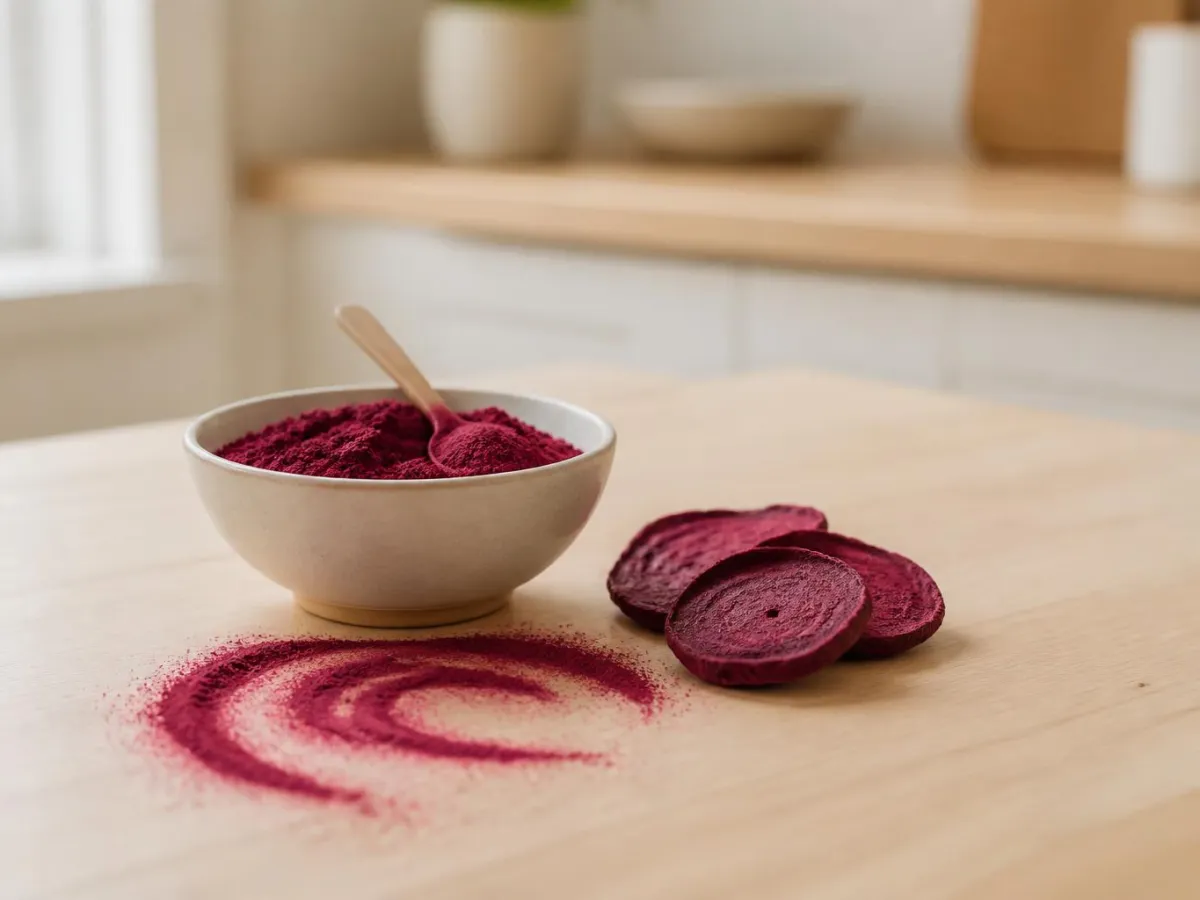
Freeze-dried beetroot
Deep magenta, crisp and concentrated. How to use freeze-dried beetroot for natural colour, snacking and cooking, and what is actually in it.
- about 8:1fresh beetroot to freeze-dried, by weight
- about 88%water in fresh beetroot, nearly all removed
- 3 to 15 minto rehydrate in hot water
- Natural pinkcolour for icing and bakes
On this page
- What freeze-dried beetroot is like
- How to use freeze-dried beetroot
- For natural pink and red colour
- As a crisp snack
- In everyday cooking
- How to rehydrate freeze-dried beetroot
- Freeze-dried beetroot nutrition: typical values
- Where to buy freeze-dried beetroot in the UK
- How to store freeze-dried beetroot
- Freeze-dried beetroot for babies, toddlers and pets
- The short version
Freeze-dried beetroot is beetroot with almost all of its water removed at low temperature and low pressure, leaving crisp, deep magenta pieces, slices or powder that keep for months in a cupboard. It is used for three things: natural pink and red colour in icing, cheesecake and bakes; a crunchy snack or salad topping straight from the pack; and a store-cupboard vegetable that rehydrates in minutes into soups, stews and grain dishes. Fresh beetroot is about 88 per cent water, so the ratio is roughly eight to one by weight: 80g of prepared fresh beetroot comes out as about 10g freeze-dried.
What freeze-dried beetroot is like
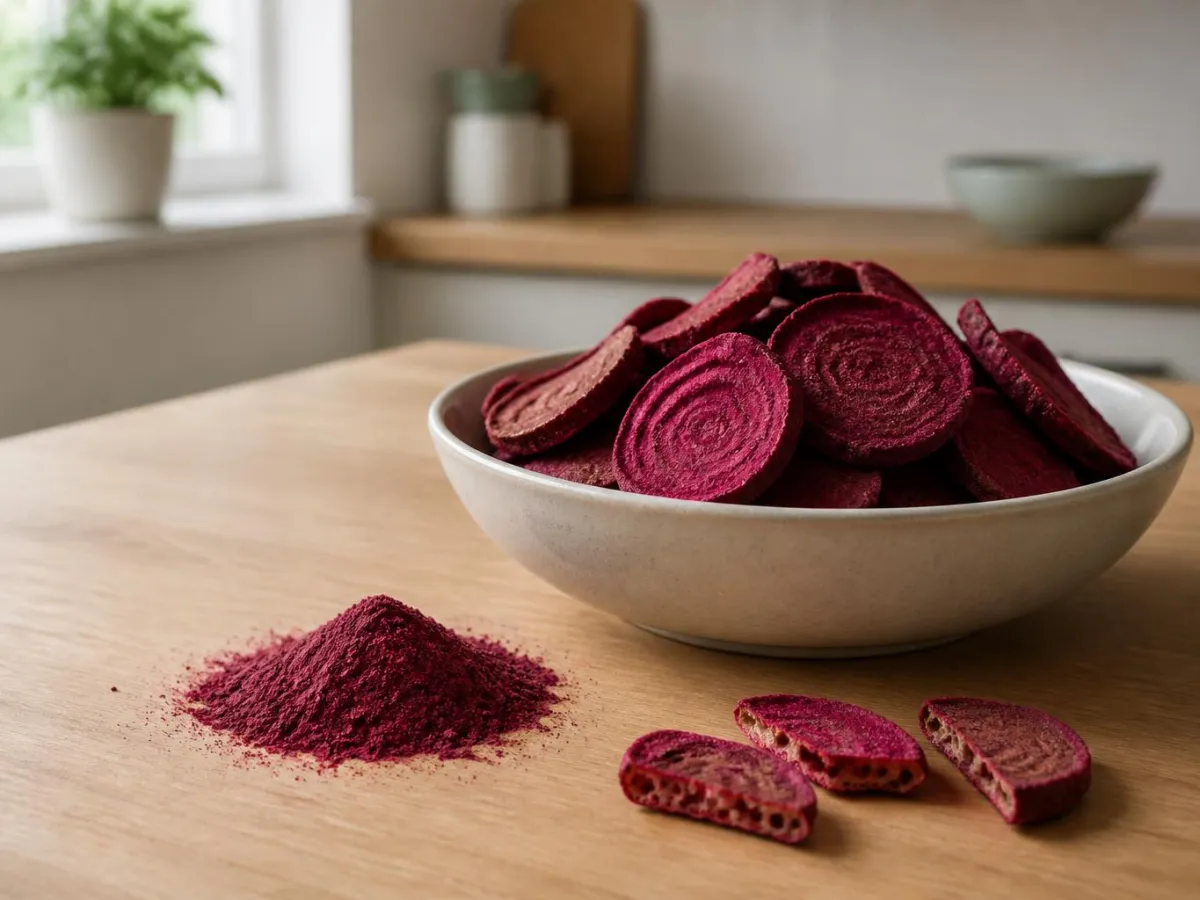
It is light, brittle and an almost unreasonable colour, somewhere between magenta and dark cherry. Dry, it snaps rather than bends, and it tastes sweet first and earthy second, which is the opposite way round from boiled beetroot. Most producers blanch or cook beetroot before drying it, which sets the colour and softens the raw edge. The drying itself happens frozen and under vacuum, which is what keeps the structure open and the colour bright; our guide to what freeze-drying is sets out how that works.
You will usually see it in four forms:
- Dice or cubes, the workhorse for soups, stews and grain dishes.
- Thin slices, crisp enough to snack on and the prettiest garnish.
- Pieces or crumble, small fragments for scattering and for grinding.
- Powder, the same vegetable milled fine. There is more on that in our guide to beetroot powder.
Two things it is not. It is not the same as air-dried or dehydrated beetroot, which is dried with warm air and comes out leathery and darker; our page on freeze-dried versus dehydrated explains why. And it is not the beetroot crisps in the snack aisle, which are usually fried or baked root vegetable slices, often with oil and salt.
How to use freeze-dried beetroot
| Use | Typical amount | Method |
|---|---|---|
| Buttercream or cream cheese icing | 10 to 20g powder per 250g | Beat in at the end, rest 10 minutes |
| Cake, biscuit or pasta dough | 15 to 25g powder per 500g mix | Sift in dry; expect the colour to soften in the oven |
| Soup, stew or dhal | 10 to 15g pieces per 500ml | Add 10 minutes before the end, with a splash more liquid |
| Risotto, couscous or pilaf | 10g pieces per portion | Stir in dry with the hot stock |
| Hummus or dip | 5 to 10g powder per 400g | Blend in; the pink deepens as it hydrates |
| Salad or soup topping | about 5g slices | Scatter dry for crunch |
| Milkshake or smoothie | 1 to 2 teaspoons powder | Blend rather than stir |
These are sensible starting points rather than fixed rules. Beetroot varies in sweetness and colour strength, so taste and adjust.
For natural pink and red colour
Colour is the usual reason for reaching for it in baking. Beetroot's pigment gives a genuine pink without a bottle of food dye, and because the powder brings no water with it, buttercream stays firm and meringue stays stable. The pigment is fussy about two things: heat and alkalinity. It holds beautifully in anything unbaked, fades towards brown-pink in the oven, and goes duller still next to bicarbonate of soda. A squeeze of lemon juice in the mix helps, and so does putting the colour in the filling or topping rather than the sponge.
As a crisp snack
Slices and dice are pleasantly sweet and crunchy from the pack, in the same way freeze-dried peas are. They are good on salads, soups and grain bowls, and they weigh almost nothing in a rucksack.
In everyday cooking
Add pieces dry to anything wet and simmering. They take up the liquid, keep their colour and save you peeling, boiling and staining a chopping board.
How to rehydrate freeze-dried beetroot
| Form | Liquid | Time | What you get |
|---|---|---|---|
| Dice or cubes | Hot water, twice their volume | 10 to 15 minutes | Tender, close to cooked beetroot |
| Thin slices | Hot water to cover | 3 to 5 minutes | Soft slices for salads |
| Pieces in a pan | The dish's own liquid | About 10 minutes simmering | No draining needed |
| Any form, cold water | Cold water to cover | 20 to 30 minutes | Same result, gentler on colour |
Drain well before adding rehydrated beetroot to anything you want to stay pale, and keep the soaking liquid if you are making soup, because a good deal of colour goes into it. Our guide to rehydrating freeze-dried food covers the awkward cases, and the fresh to freeze-dried converter does the sums for other quantities.
Freeze-dried beetroot nutrition: typical values
Because the water has gone, everything else is concentrated. Weight for weight, freeze-dried beetroot has far more sugar and calories than fresh beetroot, and 100g of it is a very large amount, roughly 800g of fresh. A typical serving is about 10g.
| Typical values | Fresh beetroot, per 100g | Freeze-dried, per 100g | Freeze-dried, per 10g serving |
|---|---|---|---|
| Energy | about 35 to 50 kcal | about 300 to 380 kcal | about 30 to 38 kcal |
| Carbohydrate | about 8 to 10g | about 60 to 78g | about 6 to 8g |
| of which sugars | about 7 to 9g | about 50 to 68g | about 5 to 7g |
| Fibre | about 2 to 3g | about 15 to 22g | about 2g |
| Protein | about 1.5 to 2.5g | about 10 to 18g | about 1 to 2g |
| Fat | under 1g | about 1g | trace |
These are typical ranges, worked from published composition data for fresh beetroot and the weight of water that freeze-drying removes. They vary with the variety, the growing season, whether the beetroot was cooked first and who made it, so the label on your pack is what counts. In a plain product the only sugar is the beetroot's own; nothing is added.
Beetroot is a vegetable, and NHS vegetable portions are based on 80g of fresh weight, which is in the region of 10g freeze-dried. The NHS counts 30g of dried fruit as one of your 5 A Day and advises eating dried fruit as part of a meal rather than as a between-meal snack, to reduce the risk of tooth decay. Beetroot is sweet and sticky once it softens, so that with-meals habit is a sensible one to borrow. There is more in our pages on 5 A Day and freeze-dried fruit and freeze-dried fruit and your teeth.
You will see beetroot powders and capsules sold with promises about blood pressure, stamina or nitric oxide. Beetroot has no authorised health claim on the Great Britain nutrition and health claims register, which means claims like that should not be made for it here, and we do not make them. Beetroot can also turn urine or stools pink for a day or so in some people, which is harmless.
Where to buy freeze-dried beetroot in the UK
British supermarkets are not really the place. The big chains tend to stock cooked vacuum-packed beetroot, pickled beetroot in jars and mixed root vegetable crisps rather than the freeze-dried kind, so plain freeze-dried beetroot is mostly an online buy from UK health food shops, baking suppliers and camping-food specialists. Ranges change, so check before making a special trip. Our supermarket guide sets out what is usually on the shelves.
Prices move, so treat any figure as a snapshot: plain freeze-dried beetroot pieces from UK online health food shops have typically sat somewhere in the region of £5 to £9 per 100g, with plain beetroot powder in a similar bracket (last checked September 2026). Compare price per 100g rather than pack price, and read the ingredients: it should say beetroot and nothing else.
Crispberry's own shop is not open. Nothing is for sale here, so we have no prices, stock levels or delivery times of our own to quote; join the launch list if you would like to know when that changes.
How to store freeze-dried beetroot
Keep the pack sealed in a cool, dark, dry cupboard, squeeze the air out after opening and reseal it tightly, or decant into an airtight jar. Moisture is the enemy: damp air is what turns crisp pieces bendy and powder lumpy. If yours has gone soft it is still fine for cooking, it has simply lost its crunch.
Freeze-dried beetroot for babies, toddlers and pets
Crisp, hard pieces are a choking risk for babies and young children, so soften them in warm water or milk until they are properly soft, or grind them to a powder and stir it into a purée or yoghurt. Follow NHS weaning guidance on textures and supervision, and speak to your health visitor or GP about your own child. Our page on freeze-dried fruit for babies and toddlers goes through this properly.
For dogs, plain beetroot is not on the toxic list, but portions should be tiny and occasional, and the fruits to keep well away are grapes, raisins, sultanas and currants, which are toxic to dogs. Remember that a dried grape is a raisin, so anything raisin-based is out. Check with your vet before adding anything new to your pet's food, and see our notes on freeze-dried fruit and pets.
The short version
Buy pieces if you want to snack, top and cook with it, and powder if what you are really after is colour. Work on roughly eight to one against fresh, keep servings around 10g because it is concentrated, put the colour somewhere the oven cannot reach it, and store the pack airtight.
Good questions, short answers
What is freeze-dried beetroot used for?
Three things mainly: natural pink and red colour in icing, cheesecake and bakes; a crunchy snack or salad topping straight from the pack; and a store-cupboard vegetable that rehydrates in minutes into soups, stews, risotto and couscous. Because it contains almost no water, it can colour and flavour mixtures that fresh beetroot would make wet.
Does freeze-dried beetroot taste earthy?
Yes, but less so than boiled beetroot. Drying concentrates the natural sweetness, so the earthy note sits behind the sugar rather than in front of it. In icing and bakes a little lemon juice, vanilla or cocoa covers it almost completely.
How much freeze-dried beetroot equals one fresh beetroot?
Fresh beetroot is about 88 per cent water, so the ratio is roughly eight to one by weight. A medium beetroot of about 80g prepared weight comes out at roughly 10g freeze-dried, which is also about a level tablespoon of pieces.
Can you eat freeze-dried beetroot as a snack?
Yes. Thin slices and dice are crisp and sweet straight from the pack and make a good salad or soup topping. It is concentrated, so a typical serving is about 10g. Offer it softened or powdered to babies and young children, because crisp pieces are a choking risk.
Is freeze-dried beetroot the same as beetroot powder?
It is the same food in a different form: plain beetroot powder is freeze-dried beetroot milled fine. Pieces are for snacking, rehydrating and cooking; powder is for colour and flavour in icing, batters, dips and drinks. Check the ingredients list, because some powders on sale are juice powders or supplement blends with other ingredients added.
Does beetroot colour survive baking?
Only partly. Beetroot's pigment is heat-sensitive and fades towards brown-pink in the oven, and alkaline ingredients such as bicarbonate of soda dull it further. In unbaked things, such as buttercream, cheesecake, icing and milkshakes, the colour stays vivid.