Freeze-dried berries
Most UK mixed berry packs are built around strawberry, with raspberry and blueberry alongside. How the common berries differ, and when one fruit beats a mix.
- Strawberry-ledwhat most UK berry mixes are built around
- 5 to 11 to 1fresh fruit to freeze-dried, by berry
- about 10ga typical serving
- 30gone 5 A Day portion of dried fruit (NHS)
On this page
- What goes into a freeze-dried mixed berry pack
- Why freeze-dried mixed berries cost less per 100g than single berries
- What freeze-dried berries cost in the UK
- Freeze-dried berries compared: flavour, sharpness and fresh fruit ratio
- How to use freeze-dried berries
- In porridge and overnight oats
- In granola and cereal
- In smoothies
- In baking
- When a single freeze-dried fruit beats a berry mix
- Freeze-dried berries nutrition: typical values
- Where to buy freeze-dried berries in the UK
- How to store freeze-dried berries
- Freeze-dried berries for babies, toddlers and dogs
- Which freeze-dried berries to buy first
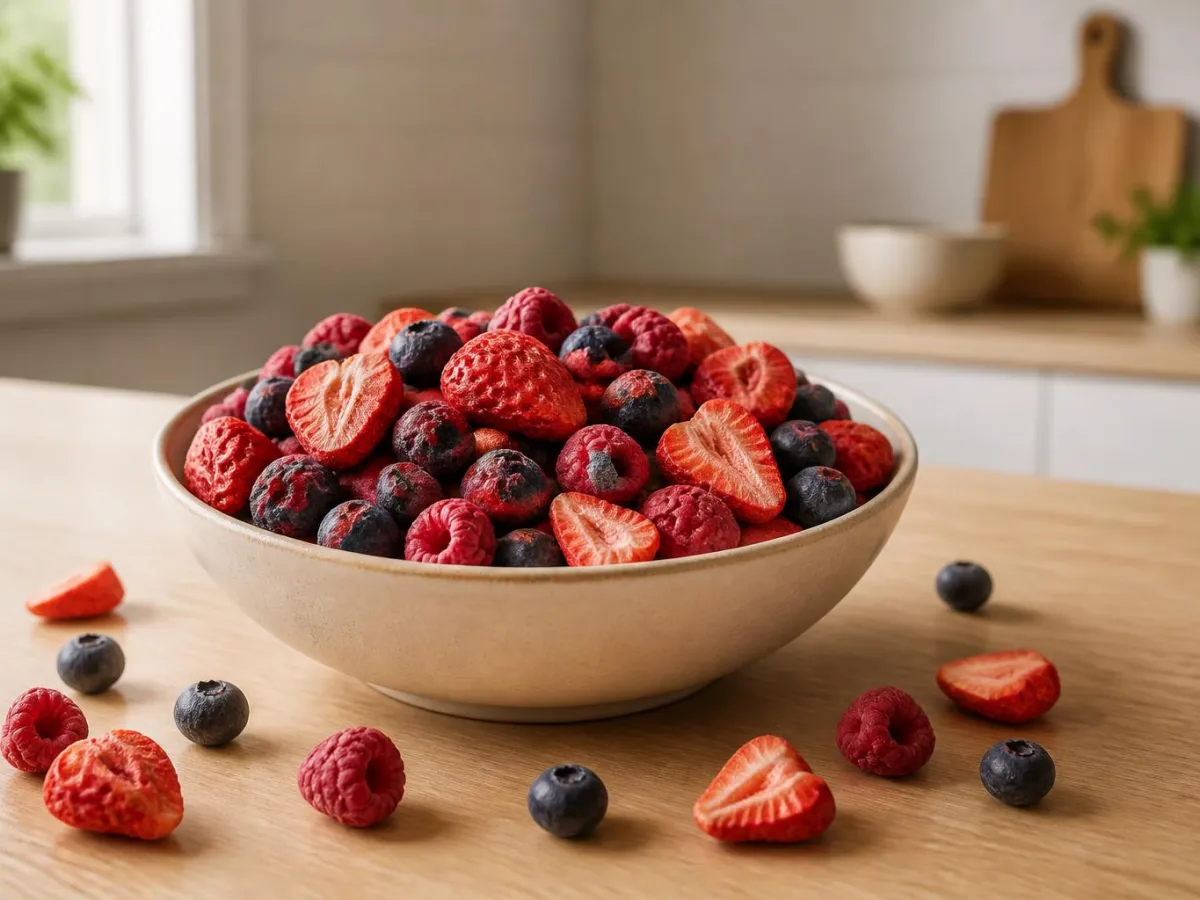
Freeze-dried berries are berries that have been frozen solid and then dried under vacuum, so almost all the water leaves as vapour and the fruit is left crisp, brightly coloured and nothing but fruit. A mixed berry pack sold in the UK is usually built around strawberry, with raspberry and blueberry alongside, and often a smaller amount of blackcurrant, blackberry or cherry to sharpen it.
A mix is the cheapest way into freeze-dried fruit, and for porridge, granola and smoothies it is the sensible choice. For baking, icing and decorating, a single fruit is almost always better.
What goes into a freeze-dried mixed berry pack
There is no legal recipe for a berry mix, so blends vary by producer. The UK pattern is fairly consistent:
- Strawberry — usually the largest share, as slices or pieces. Sweet, familiar, and the cheapest berry to supply at scale.
- Raspberry — whole hollow berries or crumble. The sharp, perfumed note in the pack.
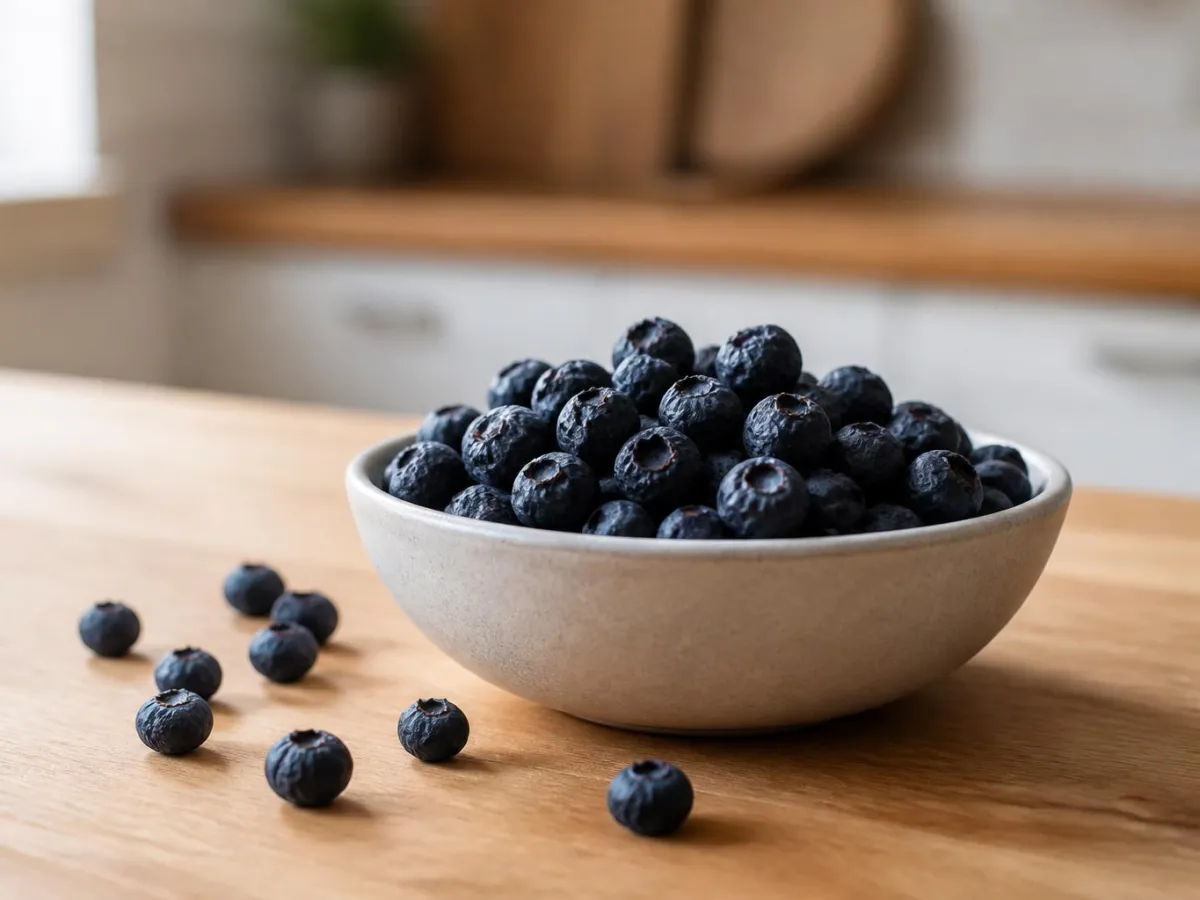
- Blueberry — whole, and noticeably chewier than the rest. Mild, slightly winey.
- Blackcurrant — very tart, almost black, and the berry that gives a blend its edge.
- Blackberry or cherry — less common, added for depth rather than volume.
Ingredients are listed by weight, so read the order. A pack called "mixed red and purple berries" with strawberry named first is a strawberry pack with highlights, and should be priced like one. The best labels declare percentages.
If the ingredients list anything other than fruit — sugar, fruit juice concentrate, rice flour, an anti-caking agent — you are holding a snack product rather than a plain ingredient. Neither is wrong, but only one of them behaves predictably in a cake.
Why freeze-dried mixed berries cost less per 100g than single berries
- The cheap berry does the heavy lifting. Strawberries are grown in enormous volume and cost far less per tonne than raspberries or blueberries, so a strawberry-led blend lands below what a raspberry-only bag can ever cost.
- Mixes absorb the offcuts. Whole berries are the premium line, because keeping fragile fruit intact through picking, freezing, drying and packing creates waste. The berries that break are perfectly good fruit that cannot be sold as whole, and a mix is where they go.
- Cosmetic variation stops mattering. A batch that is uneven in size or shade will not pass as a single-fruit pack, but nobody inspects a mix for uniformity.
The saving is modest, and it is a saving against the expensive berries rather than against everything: plain strawberry slices are often the cheapest freeze-dried fruit in the shop.
What freeze-dried berries cost in the UK
| Pack | Typical UK price per 100g |
|---|---|
| Strawberry slices or pieces | about £6 to £8 |
| Whole strawberries | about £7 to £9 |
| Raspberry pieces | about £8 to £10 |
| Whole raspberries | about £8 to £11 |
| Blueberries | about £9 to £12 |
| Mixed berries | about £7 to £8 |
Ranges typically seen across UK online wholefood shops and specialist suppliers, last checked September 2026. Prices move with the harvest and the size of bag, and small sachets can cost more than twice as much per gram as a 100g pack, so compare per 100g.
Our own shop is not open yet — nothing is for sale on this site today. It opens in a few months, and you can join the list to be told when.
Freeze-dried berries compared: flavour, sharpness and fresh fruit ratio
| Berry | Water when fresh | Usual flavour note | Sharpness | Fresh to freeze-dried | Suits |
|---|---|---|---|---|---|
| Strawberry | about 91% | Jammy and sweet | Low | about 11 to 1 | Snacking, cereal, icing, cake tops |
| Raspberry | about 86% | Perfumed and tart | High | about 7 to 1 | Baking, buttercream, chocolate |
| Blueberry | about 84% | Mild, faintly winey, chewy | Low to medium | about 6 to 1 | Porridge, muffins, granola |
| Blackberry | about 88% | Deep and slightly earthy | Medium | about 8 to 1 | Compote, crumble, yoghurt |
| Blackcurrant | about 80% | Intensely tart | Very high | about 5 to 1 | Cutting through sweetness, sorbet |
| Cherry | about 82% | Rich, with an almond edge | Medium | about 5.5 to 1 | Dark chocolate, granola, heavy bakes |
The ratio falls straight out of the water column: a berry that is 84 per cent water leaves about a sixth of its weight behind, so it takes roughly six parts fresh to make one part dried, while a strawberry at 91 per cent takes about eleven. Ratios are therefore estimates from typical water content, and the flavour notes are how these berries are generally described; varieties differ. The fresh to freeze-dried converter does the sums either way for 18 fruits and vegetables. The sharpness column is the one that decides a pack: a mostly-strawberry mix reads as sweet, while blackcurrant turns the whole thing tart.
How to use freeze-dried berries
Straight from the pack they are crisp, which is why walkers pack them and why they suit hiking and camping. In the kitchen:
In porridge and overnight oats
Scatter about 10g over hot porridge and stir; the berries soften within a minute or two and streak the oats pink. In overnight oats, stir them in before the fridge and they rehydrate on the milk. See freeze-dried fruit in porridge and overnight oats.
In granola and cereal
The best single use for a mix, because you want variety and do not need precision. Add the berries after the granola has cooled rather than baking them in, or the colour dulls. More in freeze-dried fruit in cereal and granola.
In smoothies
Berries go into the blender dry: no thawing, no soggy freezer bag. The flavour is concentrated, so around 15g stands in for a decent handful of fresh.
In baking
A mix works when you want fruit flecks and do not mind which fruit. Fold pieces through batter at the last moment, or press them into shortbread dough before baking. Where colour or flavour must be exact, use one fruit — see baking with freeze-dried fruit.
When a single freeze-dried fruit beats a berry mix
- Colour. Buttercream, meringue and macaron shells need one clean colour; a mix gives a muddy mauve. Use freeze-dried strawberries, freeze-dried raspberries or a milled raspberry powder.
- Precision. If a recipe calls for 20g of raspberry, a mix cannot give it to you.
- Even rehydration. A thin blackcurrant collapses in under a minute while a whole strawberry takes five, so a soaked mix ends up part mush, part crunch. See rehydrating freeze-dried fruit.
- Decorating. Matching slices along a cake look deliberate. Assorted berries look assorted.
- Sharpness on purpose. For tartness against sweetness, reach for freeze-dried blackcurrants or freeze-dried cherries rather than hoping the mix has enough.
- Fussy eaters. Children who happily eat freeze-dried blueberries will pick the blackcurrants out one by one.
Freeze-dried berries nutrition: typical values
Berries are mostly water when fresh, and freeze-drying takes the water away and leaves everything else, so figures per 100g look startling. Depending on the blend, 100g of freeze-dried berries began as roughly 600g to a kilogram of fresh fruit.
| Typical values | Fresh berries, per 100g | Freeze-dried, per 100g | Freeze-dried, per 10g serving |
|---|---|---|---|
| Energy | about 30 to 50 kcal | about 320 to 390 kcal | about 32 to 39 kcal |
| Carbohydrate | about 5 to 10g | about 60 to 80g | about 6 to 8g |
| of which sugars | about 4 to 10g | about 40 to 65g | about 4 to 7g |
| Fibre | about 2 to 4g | about 10 to 25g | about 1 to 3g |
| Protein | under 2g | about 4 to 8g | under 1g |
| Fat | under 1g | about 1 to 4g | under 1g |
These are typical ranges from published composition data and product labels, given as ranges because a blend's figures depend on which berries are in it and in what proportion. Products vary, and the label on your pack is what counts. In a plain pack all the sugar is the fruit's own; nothing is added.
The concentration is the point to hold on to. Weight for weight, freeze-dried berries carry far more sugar and far more energy than fresh ones, simply because the water has gone. A typical serving is about 10g.
On portions, the NHS counts 30g of dried fruit as one of your 5 A Day, and advises eating dried fruit with meals rather than between them, to reduce the risk of tooth decay. There is more in our notes on freeze-dried fruit and 5 A Day and freeze-dried fruit and teeth.
Where to buy freeze-dried berries in the UK
Online wholefood shops and specialist baking suppliers are the dependable source for 100g bags and upwards, and they are where mixes are easiest to find. Supermarket stock is patchy: when freeze-dried fruit turns up in Tesco, Sainsbury's, Waitrose, Aldi or Lidl it is usually a small snack sachet in the baby, free-from or home baking aisle rather than a loose ingredient pack, and a mix is less common than plain strawberry. Availability last checked September 2026; our guide to freeze-dried fruit in UK supermarkets goes aisle by aisle.
How to store freeze-dried berries
Moisture is the only real enemy. Keep the pack sealed in a cool, dark, dry cupboard, and once open squeeze the air out and reseal, or tip the berries into an airtight jar. Mixes soften a little faster than single fruits, because the thinner pieces draw in moisture first. Freeze-dried fruit that has gone soft is still usable in porridge, smoothies and baking, and our guide to storing freeze-dried fruit has the detail.
Freeze-dried berries for babies, toddlers and dogs
Crisp freeze-dried pieces are a choking risk for babies and young children. Soften them in a little water or milk first, or crush them to a powder and stir them into yoghurt or porridge. Follow NHS weaning guidance on introducing new foods, and speak to your health visitor or GP about your own child. Our page on freeze-dried fruit for babies and toddlers covers it properly.
For dogs, the important point is what must never go in the bowl: grapes, raisins, sultanas and currants are toxic to dogs, and a raisin is simply a dried grape. In Britain "currants" on a dried fruit label means dried grapes, not blackcurrants, which is an easy and dangerous thing to muddle. Stick to very small amounts of plain fruit with nothing added, check with your vet before giving your dog anything new, and read freeze-dried fruit for pets first.
Which freeze-dried berries to buy first
Buying one bag to find out whether you like freeze-dried fruit? Buy a berry mix and put it on your porridge. If you already know the job — pink buttercream, a raspberry sponge, a decorated cake — skip the mix and buy the single fruit, because a mix gives you neither a clean colour nor an exact weight. Either way, compare the price per 100g and start with a 10g serving: this is fruit with the water taken out, and it goes further than it looks.
Good questions, short answers
What are freeze-dried berries?
They are ordinary berries that have been frozen solid and then dried under vacuum, so the ice turns straight to vapour and almost all the water leaves. What remains is crisp, keeps its colour and shape, and is nothing but fruit. No sugar or preservative needs to be added to a plain pack.
What berries are in a freeze-dried mixed berry pack?
Most UK mixes are built around strawberry slices or pieces, with raspberry and blueberry alongside, and sometimes a smaller amount of blackcurrant, blackberry or cherry. There is no set recipe, so blends differ by producer. Ingredients are listed in order of weight, so whichever berry is named first is the one you are mostly buying.
Are freeze-dried mixed berries cheaper than single fruits?
Usually they cost less per 100g than raspberries or blueberries bought on their own, because the bulk of a mix is cheaper strawberry and because mixes can use pieces and broken fruit rather than perfect whole berries. They are not always cheaper than plain strawberry slices. Compare the price per 100g rather than the price on the front of the pack.
Do freeze-dried berries need rehydrating?
No. They are ready to eat straight from the pack and many people prefer the crunch. If you want soft fruit, cover them with just enough cool water and wait a few minutes. A mix softens unevenly, because a thin blackcurrant gives in within a minute while a whole strawberry can take five.
Do freeze-dried berries count towards your 5 A Day?
The NHS counts a 30g portion of dried fruit as one of your 5 A Day, and advises eating dried fruit with meals rather than as a between-meal snack to reduce the risk of tooth decay. A 30g helping of freeze-dried berries is a lot of fruit by volume, so most people are eating well under a full portion at a time.
Where can I buy freeze-dried berries in the UK?
Online wholefood shops and specialist baking suppliers are the reliable source for 100g and larger ingredient bags. Supermarket availability is patchy and tends to be small snack sachets in the baby, free-from or home baking aisles rather than loose ingredient packs. Our own shop is not open yet, so we have no prices, stock or delivery times to quote; you can join the list to hear when it opens.