Freeze-dried blueberries
Whole, crisp and rattling in the pack. How to use freeze-dried blueberries, what is typically in them and how to pick a good pack in the UK.
- about 6:1fresh fruit to freeze-dried, by weight
- Whole berries, powdercommon forms
- 5 to 10 minto soften in water
- 30gone 5 A Day portion of dried fruit (NHS)
On this page
- What freeze-dried blueberries taste like
- Freeze-dried blueberries vs fresh, frozen and dried blueberries
- How to use freeze-dried blueberries
- Muffins, cakes and pancakes
- Porridge, overnight oats and cereal
- Smoothies, trail mix and lunchboxes
- How much to use instead of fresh blueberries
- How to rehydrate freeze-dried blueberries
- Freeze-dried blueberry nutrition, typical values
- How to choose a pack of freeze-dried blueberries
- Where to buy freeze-dried blueberries in the UK
- How to store freeze-dried blueberries
- Freeze-dried blueberries for babies and toddlers
- Can dogs eat freeze-dried blueberries?
- The practical takeaway
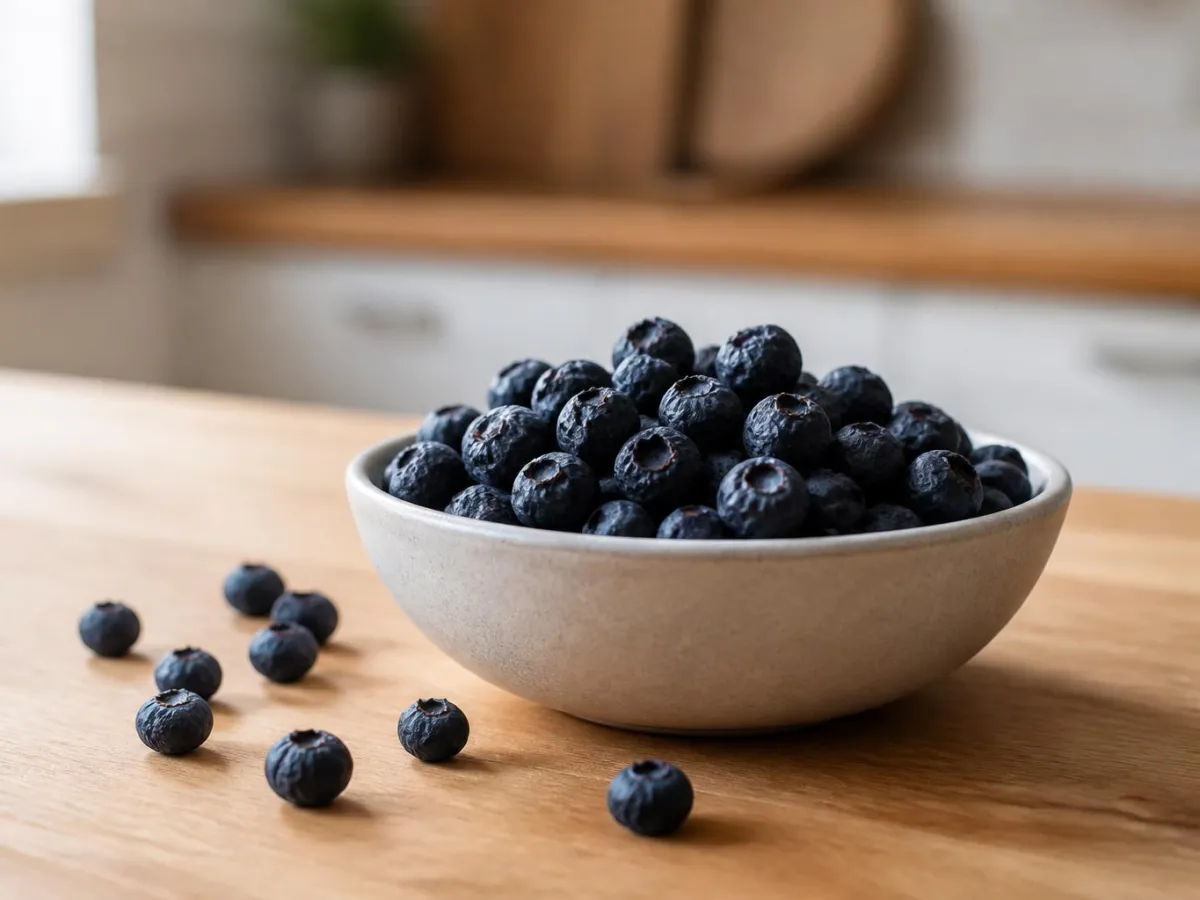
Freeze-dried blueberries are whole blueberries with almost all of their water removed under vacuum, leaving a light, crisp berry that keeps its shape, colour and flavour. Fresh blueberries are about 84 per cent water, so the ratio is roughly 6 to 1 by weight: about 600g of fresh berries makes 100g of freeze-dried, which is why a serving is only about 10g and why, gram for gram, they hold far more sugar and calories than fresh fruit. Sealed in a cool, dry cupboard they keep for a year or more, because freeze-drying takes away the water that spoilage needs.
They are also the berry that rattles: most freeze-dried fruit arrives sliced or crumbled, but blueberries are small and tough-skinned enough to come through whole, so a good pack sounds like a maraca.
What freeze-dried blueberries taste like
The flavour is a concentrated version of a properly ripe blueberry: sweet, faintly winey, with a tannic note from the skin that stops it being cloying. It is rounder and less sharp than freeze-dried raspberries and quieter on the nose than freeze-dried strawberries, which smell of jam the moment the bag opens.
The texture is where blueberries differ from every other berry: each one is hollow, so it shatters into a crunch and dissolves, with no burst of juice and no chewy skin.
You will usually meet them as whole berries, or as powder, the same fruit milled fine for icings and drinks. Packs labelled wild blueberries hold smaller, darker, sharper berries, usually the North American lowbush kind rather than the British bilberry, and they normally cost more. Both work for eating and baking; wild berries give a stronger colour.
Freeze-dried blueberries vs fresh, frozen and dried blueberries
| Typical values | Fresh | Frozen | Freeze-dried | Sugar-infused dried |
|---|---|---|---|---|
| Water content | about 84% | about 84% | about 2 to 5% | about 15 to 20% |
| Texture | juicy, bursting | soft once thawed | whole and crisp | chewy and dense |
| Usual serving | 80g | 80g | about 10g | about 30g |
| Added ingredients | none | none | none in a plain pack | often sugar or juice, plus oil |
| Cupboard life | days | months, frozen | a year or more | months |
The last column matters in a UK shop. Many "dried blueberries" on the shelf are infused with sugar or apple juice and finished with a little sunflower oil, because plain air-dried blueberries turn into hard pellets. Freeze-dried berries need none of that: see freeze-dried vs dehydrated.
How to use freeze-dried blueberries
Muffins, cakes and pancakes
This is the job they do best. Fresh and frozen blueberries carry water into a batter, sink and bleed grey-green streaks; freeze-dried berries do none of that. Fold them in dry at the very end of mixing and they stay put and turn slightly jammy in the oven. For pancakes, drop them onto the batter once it is in the pan. There is more in our guide to baking with freeze-dried fruit.
Porridge, overnight oats and cereal
Stir a small handful into hot porridge and they soften in a minute or two, turning the oats faintly purple; in overnight oats they rehydrate completely by morning. They are also the classic addition to cereal and granola, because they stay crisp in a dry mix and do not stick together. Scatter them over yoghurt just before eating, not in advance.
Smoothies, trail mix and lunchboxes
They blend into a thicker, stronger-tasting smoothie than the same weight of fresh fruit: start with 10g a glass. They also weigh nothing and will not squash, which suits hiking and camping, packed lunches and trail mix.
How much to use instead of fresh blueberries
Divide the fresh weight by about six.
| Recipe calls for | Use roughly | Handy note |
|---|---|---|
| 50g fresh blueberries | 8g freeze-dried | a small handful |
| 100g fresh blueberries | 16g freeze-dried | a standard muffin batch |
| 150g fresh blueberries | 25g freeze-dried | a 12-muffin tray |
| 300g fresh blueberries | 50g freeze-dried | a crumble or compote |
For a wet recipe such as a compote, add back about five times the dry weight in water. The fresh to freeze-dried converter does the arithmetic for other amounts and fruit.
How to rehydrate freeze-dried blueberries
Cover with just enough cool water to float them and leave for five to ten minutes, longer than sliced fruit needs because the skin is intact. Warm water halves the time. They come back plump but soft, closer to a thawed frozen blueberry than a fresh one, so use them in compotes, sauces and pie fillings rather than as a garnish. Our guide to rehydrating freeze-dried fruit covers other liquids.
Soaking in apple juice, milk or tea gives flavour back as well as moisture. For muffins, five minutes in a tablespoon of milk makes the berries jammy without wetting the batter.
Freeze-dried blueberry nutrition, typical values
Freeze-drying takes out the water and leaves the rest behind, so the figures per 100g look startling until you remember that 100g of freeze-dried blueberries is roughly 600g of fresh fruit.
| Typical values | Fresh, per 100g | Freeze-dried, per 100g | Freeze-dried, per 10g serving |
|---|---|---|---|
| Energy | about 45 to 60 kcal | about 300 to 360 kcal | about 30 to 36 kcal |
| Carbohydrate | about 10 to 13g | about 62 to 78g | about 6 to 8g |
| of which sugars | about 9 to 11g | about 55 to 68g | about 6 to 7g |
| Fibre | about 1.5 to 3g | about 9 to 18g | about 1 to 2g |
| Protein | under 1g | about 3 to 5g | under 1g |
| Fat | under 1g | about 1.5 to 3g | under 1g |
These are typical ranges from published composition data, scaled for the water that has gone. Products vary a great deal with the variety, whether the berries are wild or cultivated, the ripeness at picking and the producer, so the label on your own pack is the figure that counts. All the sugar is the fruit's own; nothing is added. Our page on sugar in freeze-dried fruit goes into the comparison with fresh.
The NHS counts 30g of dried fruit as one of your 5 A Day, and advises eating dried fruit with meals rather than between them, to reduce the risk of tooth decay. Worth knowing, because 30g of freeze-dried blueberries is a large pile and easy to eat absent-mindedly. See freeze-dried fruit and 5 A Day and freeze-dried fruit and your teeth.
How to choose a pack of freeze-dried blueberries
- Read the ingredients. Blueberries and nothing else: no sugar, juice concentrate, oil or rice flour.
- Shake the pack. Whole freeze-dried blueberries rattle. A dull, soft sound suggests they have taken up moisture.
- Wild or cultivated? Wild berries are smaller, sharper and darker; cultivated ones are milder and cheaper.
- Look at the colour. Deep blue-purple. Faded or brownish berries have had heat, light or time.
- Compare the price per 100g, not the pack price. In UK specialist shops whole freeze-dried blueberries have typically sat around £8 to £13 per 100g, wild berries at the upper end, larger bags cheaper per gram (last checked September 2026; prices change).
- Choose a resealable pack unless you are decanting into a jar straight away.
Where to buy freeze-dried blueberries in the UK
British supermarkets rarely put a plain pouch of freeze-dried blueberries on the shelf. You are much more likely to meet the berries already inside something else: baby and toddler snacks, cereals, granolas and chocolate bars. Plain packs mostly come from specialist online grocers, health-food shops and wholefood suppliers. Our guide to freeze-dried fruit in UK supermarkets covers what to look for.
Crispberry's own shop has not opened yet. Nothing is for sale on this site, so there are no Crispberry prices, stock or delivery times to quote here: join our launch list if you would like to hear when that changes.
How to store freeze-dried blueberries
Keep the pack sealed in a cool, dark, dry cupboard, away from the hob and the kettle. Once opened, press the air out and reseal, or move the berries to an airtight jar. Moisture is the only real enemy: it does not make the fruit unsafe, it just ruins the crunch. Whole blueberries survive a badly sealed bag better than any sliced fruit. See our guide to storing freeze-dried fruit and, if it is already too late, what to do when freeze-dried fruit has gone soft.
Freeze-dried blueberries for babies and toddlers
Crisp, whole freeze-dried blueberries are a choking risk for babies and young children. They are round, firm and exactly the size that causes problems.
Soften them in a little water, milk or yoghurt until properly squashy, or grind them to a powder and stir it into porridge or a fruit puree. Follow NHS weaning guidance on finger foods and choking, stay with your child while they eat, and give dried fruit with meals rather than between them. For advice about your own child, speak to your health visitor or GP. There is more in freeze-dried fruit for babies and toddlers.
Can dogs eat freeze-dried blueberries?
Blueberries are not among the fruits known to be toxic to dogs, but grapes, raisins, sultanas and currants are, and can cause kidney failure even in small quantities. A dried grape is a raisin, so a mixed pack is not automatically safe just because it is plain fruit: read the ingredients. If you do share, share a few plain blueberries and nothing else, remember they are concentrated sugar for a small animal, and check with your vet first. Our page on freeze-dried fruit for pets has the safe and unsafe list.
The practical takeaway
Buy whole berries, keep them in an airtight jar, and use about 16g wherever a recipe asks for 100g of fresh blueberries. Fold them in dry for muffins and granola, soak them for five to ten minutes for anything saucy, keep servings near 10g, and let the pack rattle.
Good questions, short answers
What do freeze-dried blueberries taste like?
They taste like a very ripe blueberry with the juice turned up: sweet, slightly winey and a little tannic in the skin. The texture is the surprise, because a freeze-dried blueberry stays whole and shatters into a hollow crunch rather than bursting. Once stirred into something moist they soften and taste closer to a cooked blueberry.
How many fresh blueberries make 100g of freeze-dried blueberries?
Blueberries are roughly 84 per cent water, so the ratio is about 6 to 1 by weight. Around 600g of fresh berries becomes about 100g of freeze-dried, and a 10g serving started life as roughly 60g of fresh fruit.
Can you use freeze-dried blueberries in muffins?
Yes, and they behave better than fresh or frozen ones. Fold them in dry at the end of mixing and they will not sink, bleed grey streaks through the batter or make the crumb wet. If you prefer a jammy pocket of fruit, soak them in a spoonful of water or milk for five minutes first.
Are freeze-dried blueberries high in sugar?
Weight for weight they contain far more sugar than fresh blueberries, because only the water has been taken away. The sugar is the fruit's own and nothing is added, but the concentration is why servings are small, usually about 10g. Check the label on your pack for the figures that apply to it.
How long do freeze-dried blueberries last once opened?
Unopened and kept cool, dark and dry, packs usually carry a best-before date a year or more ahead. Once opened, squeeze the air out and reseal tightly, or decant into an airtight jar, and use them within a few weeks before they take up moisture from the air and go chewy.
Why do my freeze-dried blueberries rattle in the pack?
Because they survive the process whole. Unlike strawberry slices or raspberry crumble, a freeze-dried blueberry keeps its round shape and its skin, so the berries stay separate and knock against the pack. A rattling pack is a good sign: it means the berries are dry and crisp.