Freeze-dried blackcurrants
Britain's sharpest berry, concentrated. How to use freeze-dried blackcurrants, what is typically in them and how to choose a pack.
- about 5:1fresh fruit to freeze-dried, by weight
- Whole berries, powdercommon forms
- Very sharp and deepflavour
- 30gone 5 A Day portion of dried fruit (NHS)
On this page
- What freeze-dried blackcurrants taste like
- How to use freeze-dried blackcurrants
- In puddings and baking
- With dark chocolate
- In ice cream, yoghurt and porridge
- In cordial-style drinks
- In sauces for game, duck and lamb
- How to rehydrate freeze-dried blackcurrants
- Freeze-dried blackcurrants nutrition per 100g
- Vitamin C in blackcurrants
- Where to buy freeze-dried blackcurrants in the UK
- How to store freeze-dried blackcurrants
- Freeze-dried blackcurrants for babies, toddlers and pets
- Freeze-dried blackcurrants: the short version
Freeze-dried blackcurrants are whole blackcurrants that have been frozen and then dried under vacuum, which removes almost all the water and leaves a crisp, near-black berry with a very sharp, deep flavour. Fresh blackcurrants are about 80 per cent water, so roughly 50g of fresh fruit becomes a 10g freeze-dried serving, a ratio of about 5 to 1.
They are the most British berry in the freeze-dried cupboard and one of the hardest to find. Blackcurrants run through British puddings, squash and jam, yet they are barely known in the United States, where cultivation was restricted for much of the twentieth century to protect white pine from blister rust.
What freeze-dried blackcurrants taste like
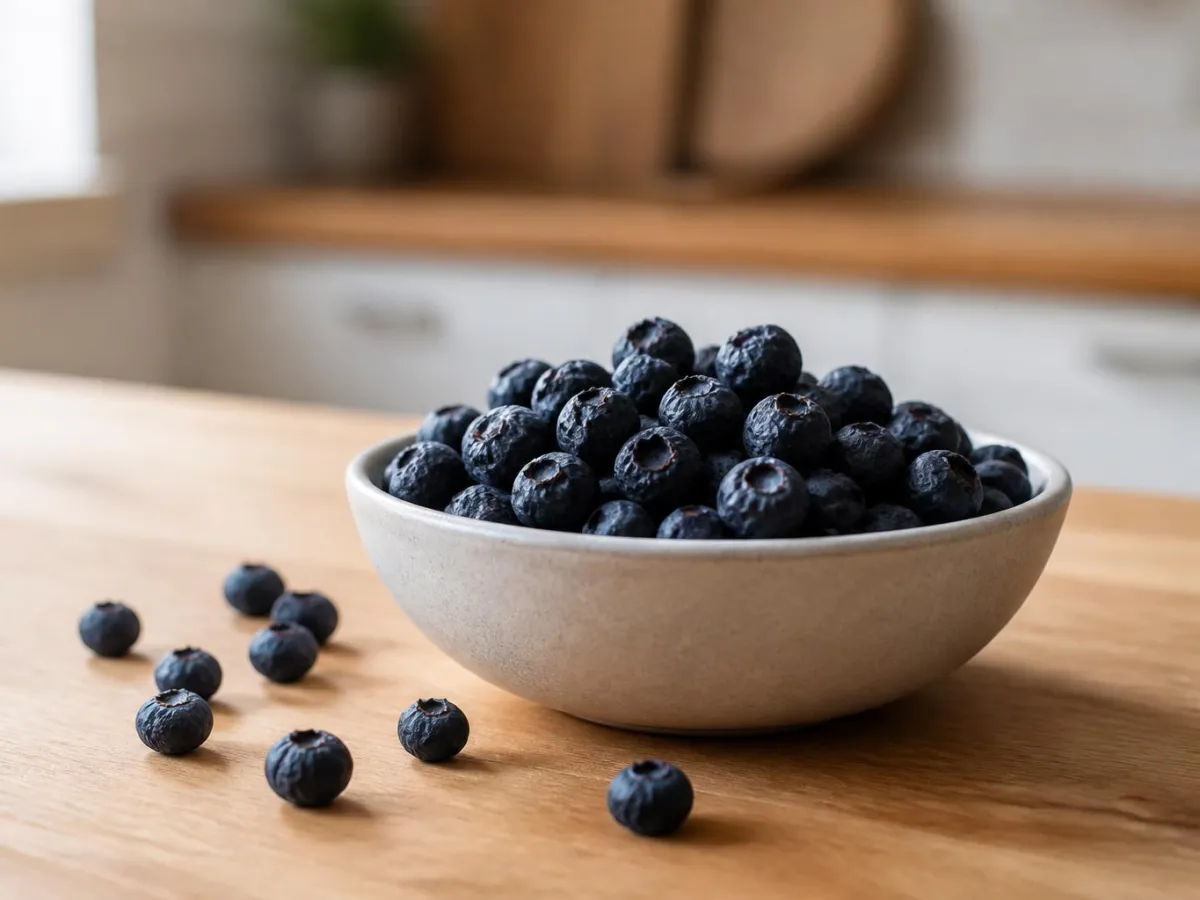
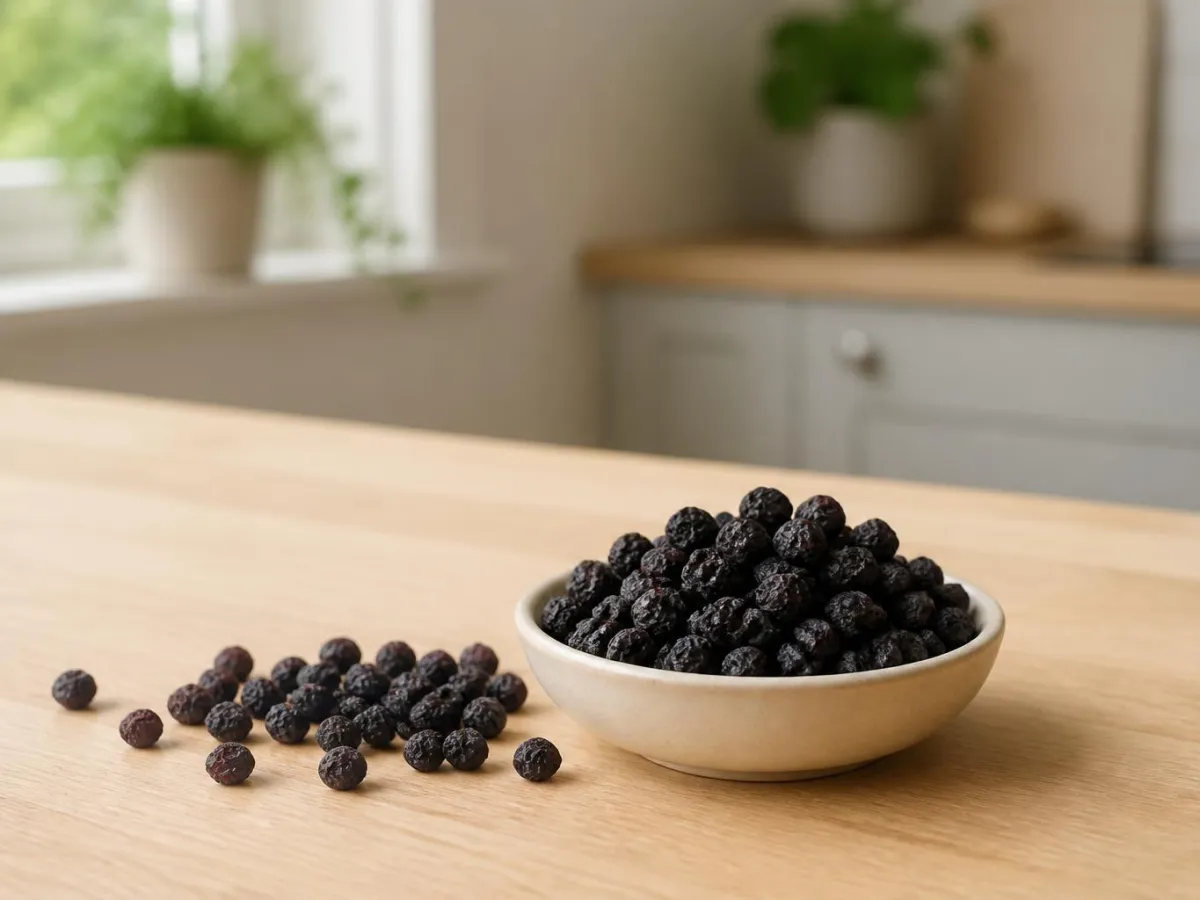
Purple-black, wrinkled and hollow, they shatter rather than snap and crush to a violet crumble that stains everything. The flavour is the sharpest of the common freeze-dried berries: deep, almost winey, with a tannic grip from the skins and little of the jamminess of strawberries. On their own they can be startling; against cream, dark chocolate or a rich sponge that sharpness is the point.
They are sold as whole berries, as crushed pieces for baking, and as powder, which is the easiest form to cook with because it disperses. Air-dried blackcurrants are a different ingredient altogether, dark and chewy rather than crisp, as freeze-dried against dehydrated fruit explains.
| Freeze-dried berry | Water in the fresh fruit | Fresh to freeze-dried, by weight | Flavour |
|---|---|---|---|
| Strawberry | about 90 per cent | about 10:1 | sweet and jammy, mild acidity |
| Raspberry | about 86 per cent | about 7:1 | sharp and perfumed |
| Blackcurrant | about 80 per cent | about 5:1 | very sharp, deep, almost winey |
Because blackcurrants hold less water than freeze-dried strawberries, a gram of dried fruit stands for fewer fresh berries. It still tastes stronger, because blackcurrants start out more intense.
How to use freeze-dried blackcurrants
In puddings and baking
They add flavour and colour without a drop of water, which is exactly what fresh or frozen blackcurrants cannot do.
- Buttercream and icing: blitz to a powder, sieve out skins and seeds and beat in, about 10g of powder to 250g of butter, because blackcurrant is far stronger than strawberry.
- Cheesecake and mousse: fold sieved powder through the cream mixture for a purple-grey colour and a sharp finish.
- Frangipane and almond bakes: scatter crushed berries over the almond mixture before baking, a classic British pairing.
- Meringue, pavlova and Eton mess: ripple powder through the cream, or crush berries over the top at the last minute.
- Shortbread and scones: fold pieces in at the end of mixing.
There is more technique in our guide to baking with freeze-dried fruit.
With dark chocolate
Blackcurrant and dark chocolate is a long-established pairing, and the freeze-dried berries suit it because they add no water to the chocolate. Press whole berries into tempered dark chocolate for bark, stir crushed berries into truffle ganache, or scatter them over warm brownies: the sharpness cuts through 70 per cent chocolate as sweeter berries cannot. Method as for chocolate-covered freeze-dried strawberries.
In ice cream, yoghurt and porridge
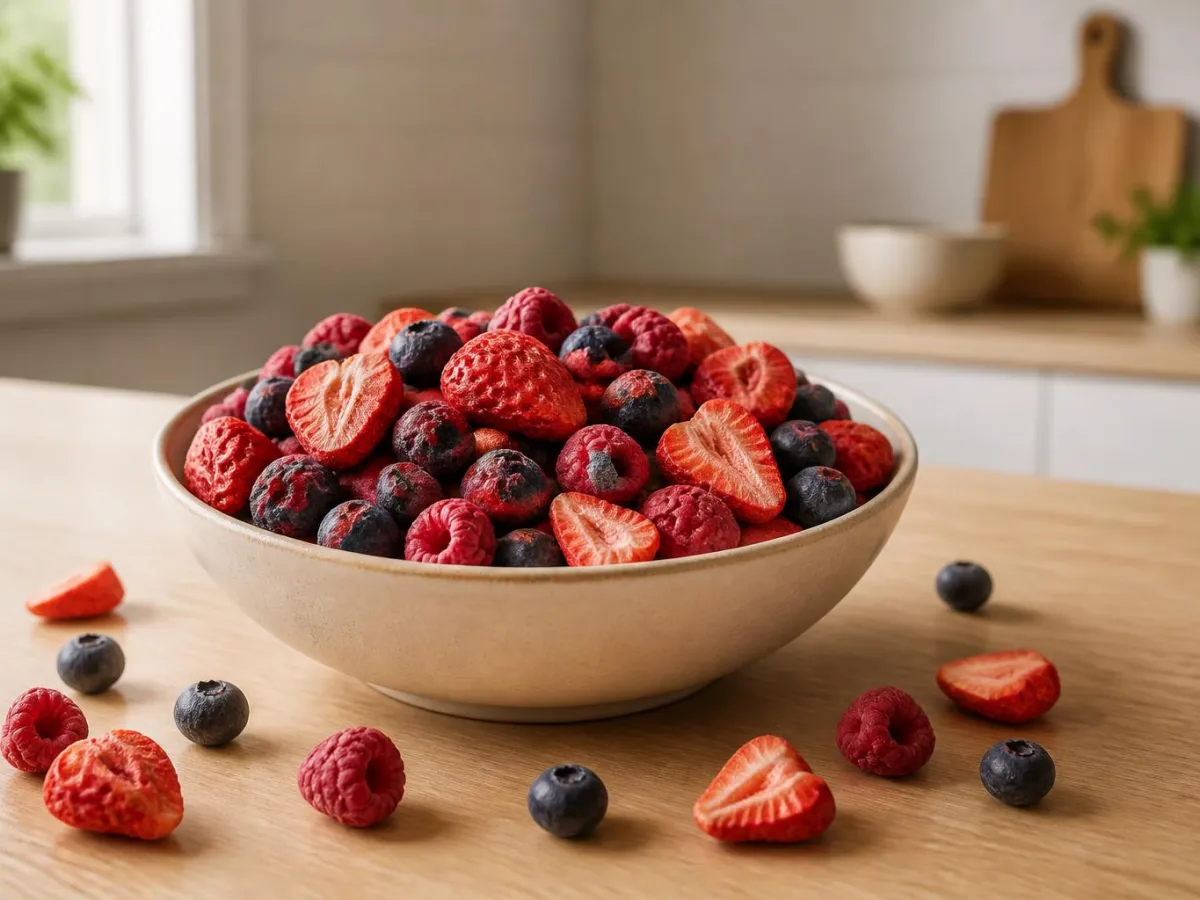
Stir powder into softened vanilla ice cream and refreeze for a ripple, or fold it through whipped cream to fill a sponge. On yoghurt, porridge or overnight oats, crushed berries give blackcurrant flavour with nothing added but fruit, though many people prefer them mixed with milder fruit, as in freeze-dried mixed berries.
In cordial-style drinks
Blackcurrant squash is a British childhood flavour, and the powder gets close to it. Stir about 5g into 250ml of cold or hot water and sweeten to taste; expect a cloudy drink with fine pulp rather than a clear cordial, and sieve it if that bothers you. It also works in fizz and cassis-style drinks: see freeze-dried fruit cocktails and drinks.
In sauces for game, duck and lamb
The use most people never think of. Crush about 5g of berries into the pan near the end of cooking, with stock and a splash of red wine vinegar or port. They dissolve, add acidity and colour and thicken the sauce slightly, which suits venison, duck breast, lamb and a quick Cumberland-style sauce.
Blackcurrants are about twice as assertive as raspberries: where a recipe gives an amount of freeze-dried raspberry, start with half as much blackcurrant.
How to rehydrate freeze-dried blackcurrants
Cover the berries with just enough cool water and wait three to five minutes, slightly longer than freeze-dried raspberries need, because the skins are tougher. Roughly 10g of berries with 40 to 50ml of water gives you the equivalent of 50g of fresh fruit; for a compote, simmer 10g in 50ml of water with sugar for two to three minutes. The result is soft and collapsed, like thawed frozen blackcurrants, so it belongs in compotes, coulis and sauces rather than on a cake; the fresh to freeze-dried converter handles other quantities.
Freeze-dried blackcurrants nutrition per 100g
Freeze-dried fruit is concentrated: weight for weight it carries far more sugar and energy than fresh fruit, because the water has gone and nothing else has. A typical serving is about 10g.
| Typical values | Fresh, per 100g | Freeze-dried, per 100g | Freeze-dried, per 10g serving |
|---|---|---|---|
| Energy | about 30 to 65 kcal | about 250 to 350 kcal | about 25 to 35 kcal |
| Carbohydrate | about 7 to 15g | about 45 to 75g | about 4.5 to 7.5g |
| of which sugars | about 6 to 12g | about 30 to 60g | about 3 to 6g |
| Fibre | about 3.5 to 8g | about 20 to 40g | about 2 to 4g |
| Protein | about 1 to 1.5g | about 5 to 8g | under 1g |
| Fat | under 1g | about 1 to 3g | under 1g |
These are typical ranges from published composition data and product labels, and they are wide for two reasons. Varieties and seasons differ, and UK and international databases count blackcurrant carbohydrate and fibre differently, so the fresh column spans two accounting conventions, which is why the freeze-dried figures are not simply five times the fresh ones. Products vary, so always go by the label on your pack. All the sugar is the fruit's own.
The NHS counts 30g of dried fruit as one of your 5 A Day, and advises eating dried fruit as part of a meal, as a pudding for example, rather than as a between-meal snack, to reduce the risk of tooth decay. See freeze-dried fruit and 5 A Day, freeze-dried fruit and teeth and sugar in freeze-dried fruit.
Vitamin C in blackcurrants
Blackcurrants are unusual among fruit for how much vitamin C they contain: published figures for the fresh berries are roughly 130 to 200mg per 100g, and the NHS lists blackcurrants alongside citrus fruit, peppers, strawberries and broccoli as foods that contain it. The NHS says adults aged 19 to 64 need 40mg a day.
Vitamin C is fragile, though, degraded by heat, light, oxygen and time in storage. Freeze-drying is gentler than hot-air drying, but nothing is lossless, and a figure on a label is a typical value, not a guarantee.
Where to buy freeze-dried blackcurrants in the UK
Britain grows a great deal of blackcurrant, but most of the crop is contracted to squash and juice makers rather than sold as fruit, with much of the rest frozen or turned into purée and jam. That is why fresh blackcurrants are scarce on shelves even in July and August, when the British crop is picked, and the freeze-dried ones are scarce all year.
- Supermarkets. Tesco, Sainsbury's, Asda and Aldi usually stock frozen blackcurrants, but their freeze-dried fruit is almost always strawberry, raspberry or apple: freeze-dried fruit in UK supermarkets covers what turns up where.
- Online wholefood shops. Where whole freeze-dried blackcurrants usually live, typically in 50g to 200g pouches, sometimes organic.
- British fruit farms. A few UK growers, several of them Scottish, freeze-dry their own soft fruit and sell blackcurrants plain and chocolate-coated.
Whichever route you take, check the ingredients say blackcurrants and nothing else, prefer deep purple-black to dull brown, and compare price per 100g rather than pack price. Treat any price as a snapshot: across UK specialist retailers, freeze-dried berries generally worked out at roughly £7 to £14 per 100g when we last checked in September 2026, and prices and stock change constantly.
Crispberry's own shop is not open yet, so we have no prices, stock or delivery of our own to quote. This page is a buying guide, not a shop.
How to store freeze-dried blackcurrants
Keep them sealed, cool, dark and dry. Moisture from the air is what ruins them, and blackcurrant skins go leathery rather than simply soft. Once open, press the air out and reseal, or decant into an airtight jar, and use the pack within a few weeks. Our guide to storing freeze-dried fruit covers jars and freezing, and freeze-dried fruit that has gone soft explains when limp fruit is still worth using.
Freeze-dried blackcurrants for babies, toddlers and pets
Crisp freeze-dried pieces are a choking risk for babies and young children, so soften them in water, milk or yoghurt first, or grind them to a powder and stir them through food. Follow NHS weaning guidance, and ask your health visitor or GP about your own child. Many small children reject blackcurrants for sharpness, so a milder fruit is an easier start: see freeze-dried fruit for babies and toddlers.
For dogs, the important point is what blackcurrants are not. Grapes, raisins, sultanas and currants are toxic to dogs, and a dried grape is a raisin whatever the packet calls it, so baking currants are off the list entirely. Blackcurrants are a different plant and not on that list, but freeze-dried fruit is concentrated and sharp: keep to a very small amount of plain fruit and check with your vet first. More in freeze-dried fruit for pets.
Freeze-dried blackcurrants: the short version
Buy freeze-dried blackcurrants for the flavour rather than the snacking: they are too sharp to eat by the handful. Keep a pouch sealed in a dark cupboard, crush 5g at a time into chocolate, cream, icing or a pan sauce, and one pack will outlast a British blackcurrant season.
Good questions, short answers
What do freeze-dried blackcurrants taste like?
Very sharp, deep and almost winey, with a tannic edge from the skins that you do not get in strawberries or raspberries. The flavour is far more concentrated than the fresh fruit because the water has gone, so a small scoop tastes intense. Most people want a little sweetness alongside them, from sugar, cream or dark chocolate.
Are freeze-dried blackcurrants high in vitamin C?
Blackcurrants contain more vitamin C than most fruit: published composition figures for the fresh berries are roughly 130 to 200mg per 100g, and the NHS lists blackcurrants among foods that contain it. Vitamin C is degraded by heat, light, air and time in storage, so freeze-dried packs vary and the figure on your label is the one that counts.
How do you use freeze-dried blackcurrants?
Crush or blitz them into a powder for icing, cheesecake, ice cream and cordial-style drinks, fold pieces into bakes, or press whole berries into dark chocolate. They also melt into pan sauces for duck, venison and lamb. Because they add flavour without water, they suit anything you do not want to make wet.
How much water do you need to rehydrate freeze-dried blackcurrants?
Cover 10g of berries with about 40 to 50ml of cool water and leave them for three to five minutes, a little longer than raspberries because the skins are tougher. The result is soft, closer to thawed frozen blackcurrants than to fresh fruit, so use it in compotes, coulis and sauces rather than as a garnish.
Where can you buy freeze-dried blackcurrants in the UK?
They are a specialist line rather than a supermarket one. Tesco, Sainsbury's and Aldi normally stock frozen blackcurrants and freeze-dried strawberry or raspberry snacks, while whole freeze-dried blackcurrants are usually sold by online wholefood shops and by British fruit farms that freeze-dry their own crop. Stock and prices change, so compare the price per 100g.
Are freeze-dried blackcurrants the same as currants in baking?
No, and the names are genuinely confusing. The currants in a currant bun or a Christmas cake are small dried grapes, while blackcurrants are a different plant altogether. This matters for dogs: dried grapes in any form are toxic to them, and blackcurrants are not the same fruit.