How to use freeze-dried fruit in cereal and porridge
Add freeze-dried fruit with texture in mind: early for softening, late for crunch.
On this page
- What freeze-dried fruit changes in a bowl of cereal or porridge
- Which format works best for your breakfast
- Whole pieces
- Slices
- Crushed fruit
- Powders
- Matching the format to the cereal
- When to add it for crunch, softness or even flavour
- Add before serving for partial softening
- Add at the table for more crunch
- Add after cooking for flavour on top and texture underneath
- Stir powder in for even flavour
- A practical breakfast approach
- How to read the packet before you use it
- Check the ingredient list
- Check the allergen statement and handling wording
- Compare nutrition on the right basis
- How to store opened packs so the fruit stays usable
- Reseal quickly
- Keep moisture out
- Follow the packet instructions
- Watch for practical signs of change
If you want a bowl that tastes more fruity without adding fresh fruit at the last minute, freeze-dried fruit can work very well in cereal and porridge. Because it is very low in moisture, it starts off crisp and light, then softens once it meets milk, yoghurt or hot oats. That change in texture is the main thing to use to your advantage.
For cereal, the best results usually come from deciding what you want before you open the packet. Do you want sharp crunch, little bursts of softened fruit, or a more even fruit flavour through the whole bowl? The answer affects the format you choose, when you add it, and how carefully you need to store the opened pack afterwards.
What freeze-dried fruit changes in a bowl of cereal or porridge
The biggest difference is moisture. Freeze-dried fruit has had water removed, so it behaves very differently from fresh, frozen or standard dried fruit. In a dry cereal mix it stays crisp for a time. In milk or hot porridge, it begins to take moisture back in and soften.
That low moisture changes three things straight away.
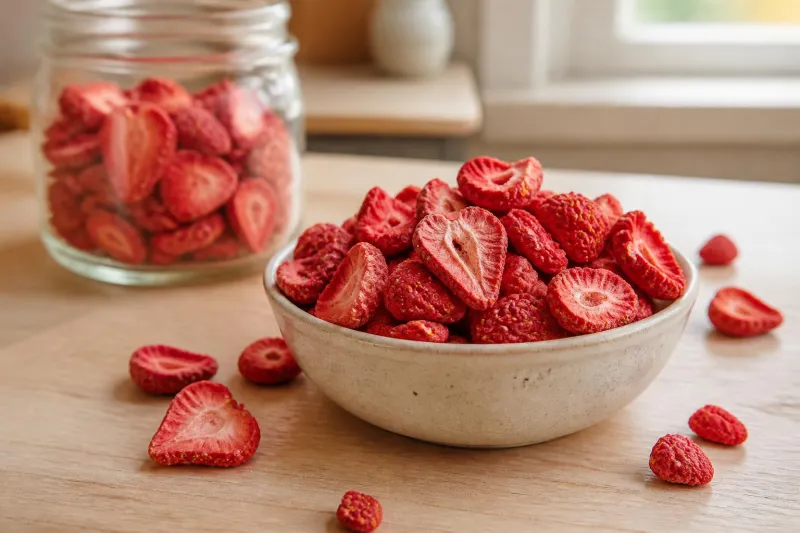
First, texture. A strawberry slice or raspberry piece can feel brittle and crisp straight from the packet. Sprinkled over muesli or granola at the table, it adds a dry crunch that standard dried fruit does not. Once it sits in cold milk for a few minutes, or in hot porridge for even less time, the crispness starts to fade.
Second, flavour concentration. Without the water that fresh fruit contains, the flavour can seem more direct. That does not mean every piece tastes identical, but it does mean a small amount can make itself known in a bowl. This is particularly noticeable with tart fruits such as raspberries and blackcurrants, and with powders stirred through oats.
Third, colour distribution. Freeze-dried fruit often gives a more visible finish than fresh fruit stirred in. Crushed strawberries or raspberries can sit on top of porridge as a distinct topping, while powders can tint the whole bowl pink or red if mixed through.
How quickly the fruit softens depends on several practical details:
- the size of the piece
- the fruit itself
- whether the liquid is cold or hot
- how much liquid is in the bowl
- how long it sits before eating
Small crushed pieces soften faster than large slices. Powders change almost immediately because there is so much surface area. Hot porridge softens fruit much faster than cold milk does. A thick bowl of oats may soften the fruit on contact where it touches the surface, while pieces left on top can stay partly crisp for a short time.
This is why freeze dried fruit for cereal and porridge is less about one correct method and more about timing. If you like contrast, add it late. If you want it integrated, add it earlier.
For readers who are still getting used to these ingredients, our first steps with freeze-dried fruit guide covers the basic handling points that make a noticeable difference in the kitchen.
Which format works best for your breakfast
The best format depends on the breakfast itself. Whole berries, slices, crushed fruit and powders each behave differently, and each suits a slightly different bowl.
Whole pieces
Whole raspberries, blueberries or similar pieces are useful when you want distinct bites of fruit rather than an even flavour throughout. They work well in:
- granola
- toasted muesli
- thicker Greek-style yoghurt bowls
- porridge topped just before serving
Whole pieces usually give the strongest contrast between crisp outside and softened centre, especially if added late. They are less convenient if you want a uniform spoonful every time.
Slices
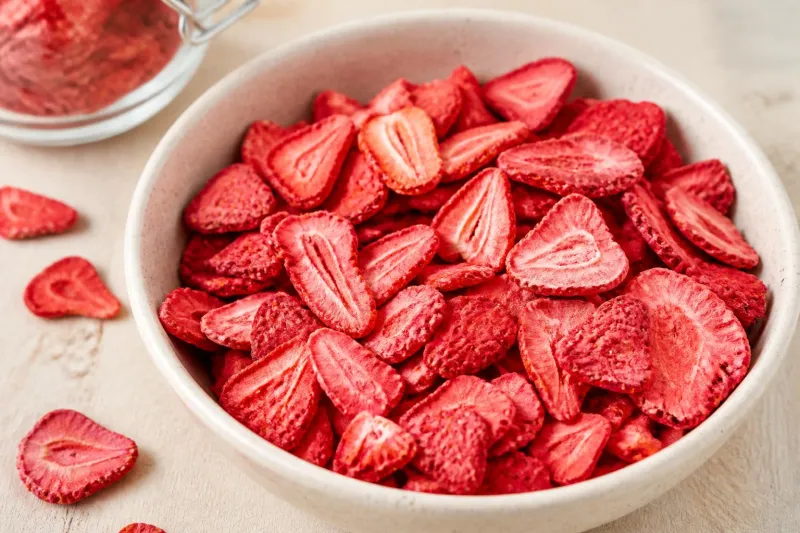
Slices, especially strawberries and bananas, spread more evenly across the bowl. They are often easier to portion visually because you can see how much you have added. Slices suit:
- cornflakes or bran flakes with fruit on top
- overnight oats finished in the morning
- porridge where you want visible fruit without large lumps
- breakfast bowls with nuts and seeds
If you are using freeze-dried strawberries for breakfast toppings, slices are often the easiest format to start with because they are familiar and simple to scatter.
Crushed fruit
Crushed fruit sits between pieces and powder. It is useful when you want fruit in more spoonfuls, but do not want a fully blended effect. It works well in:
- bircher-style oats
- porridge stirred once before serving
- wheat biscuits broken into a bowl
- yoghurt and cereal combinations
You can crush larger pieces yourself inside the packet or in a small bowl with the back of a spoon, but do it gently. Turning everything to dust by accident makes the result closer to powder than to crushed fruit.
Powders
Powders are the best option when you want flavour and colour throughout the bowl rather than distinct pieces. They work particularly well in:
- porridge
- overnight oats
- blended breakfast bowls
- yoghurt stirred smooth before topping
A fruit powder can be mixed into oats during cooking or stirred in afterwards. The result is more even, and there are no soft fruit pieces to account for. This is useful if someone in the household likes fruit flavour but not the texture of softened berries.
Our guide to using freeze-dried fruit powder in everyday cooking is helpful if you want to move from toppings to stirred-in flavour.
Matching the format to the cereal
A simple way to choose is to match the fruit format to the structure of the breakfast.
- Fine cereals, such as oats or puffed grains, usually suit crushed fruit or powder.
- Chunkier cereals, such as granola, can handle slices and whole pieces.
- Smooth porridge suits powder for even flavour, or slices on top for contrast.
- Layered yoghurt pots benefit from keeping the fruit separate until serving, so it does not lose all its crunch.
There is no need to force one format into every use. Many households keep both pieces and powder because they solve different breakfast problems.
When to add it for crunch, softness or even flavour
Timing matters almost as much as format. The same strawberry slice can be crisp, chewy or soft depending on when it goes into the bowl.
Add before serving for partial softening
If you stir freeze-dried fruit into cereal with milk and leave it briefly while you make tea or coffee, the fruit starts to soften but may still keep some structure. This works well when you want the fruit to feel part of the bowl rather than a topping.
For porridge, stirring in just after cooking gives a similar effect. The heat starts rehydrating the fruit quickly, especially smaller pieces. You get a more blended bowl, but still with visible fruit.
This method suits:
- porridge with crushed berries
- overnight oats finished with slices in the morning
- muesli left a few minutes before eating
Add at the table for more crunch
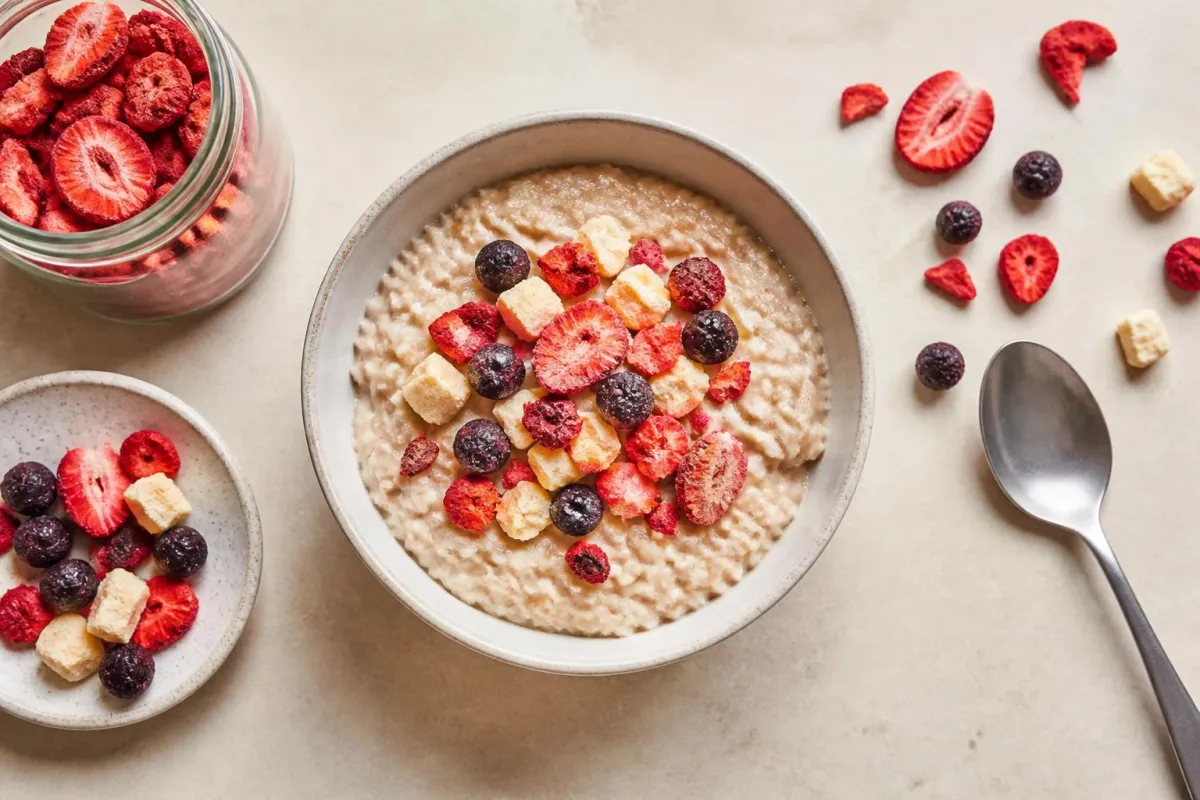
If crunch is the priority, add the fruit at the last moment. Scatter it over cereal after the milk is in, or over porridge once it is in the bowl. Then eat straight away.
This is the best method for:
- granola topped with berries
- cornflakes with strawberry slices
- thick porridge finished with a crisp fruit topping
- yoghurt bowls where you want texture contrast
Even then, remember that freeze-dried fruit is not waterproof. It will not stay crisp indefinitely once it meets moisture.
Add after cooking for flavour on top and texture underneath
For porridge, there is a useful middle option. Cook the oats plain, spoon them into the bowl, then add fruit on top without stirring much. The fruit touching the hot surface softens first, while pieces sitting higher remain drier for longer.
That gives variation in a single bowl, which many people prefer to a fully mixed texture.
Stir powder in for even flavour
Powder behaves differently from pieces. If you want a pink strawberry porridge or a raspberry yoghurt-oat mix that tastes fruity throughout, stir the powder into the base rather than sprinkling it only on top.
An illustrative approach would be to start with a small spoonful, stir well, then decide if you want more. Exact amounts depend on the powder and on the packet information, so there is no universal number of grams that fits every brand or fruit.
A practical breakfast approach
For a quick weekday bowl, one simple pattern is:
- cereal or porridge first
- milk or yoghurt next
- freeze-dried fruit last
- stir only if you want softness
That order gives you more control. Once the fruit is mixed into hot or wet ingredients, you cannot restore the original crispness.
If you want more ideas for using opened packs efficiently, our article on using freeze-dried fruit without wasting it covers small-quantity kitchen uses that fit normal routines.
How to read the packet before you use it
Before adding any freeze-dried fruit to breakfast, read the packet properly. This matters for ingredients, allergens and nutrition comparisons.
Check the ingredient list
Some products are simply fruit. Others may include additional ingredients, depending on the product type. Powders and blends may be more likely to include anti-caking agents, carriers or mixed fruits. Read the ingredient list rather than assuming.
If you are choosing fruit for a household with allergies or intolerances, the ingredient list and allergen information are essential. In the UK, prepacked food must provide allergen information, and consumers should use the label to assess suitability rather than guessing from the product name alone, as set out in Food Standards Agency guidance: Food Standards Agency consumer allergy guidance.
Where a rule differs between the UK and the EU more generally, the practical point for most readers is this: use the label on the specific product sold in the UK market, because labelling presentation and business practices can vary. Do not rely on a photo of packaging from another country.
Check the allergen statement and handling wording
Even if freeze-dried fruit sounds straightforward, always look for:
- the declared allergens in the ingredients list
- any separate allergen statement
- storage wording after opening
- any preparation or use instructions
This is especially important if you are adding the fruit to a shared breakfast setup where several people help themselves.
Compare nutrition on the right basis
Nutrition tables can be misunderstood very easily with freeze-dried ingredients. Because the water has been removed, the figures per 100g often look much higher than readers expect from fresh fruit. That does not mean the packet is wrong. It means 100 grams of a freeze-dried ingredient is a dry, concentrated amount.
The NHS explains that per 100g and per portion are different comparison bases, and both can be useful depending on what you are comparing: NHS guidance on reading food labels.
For breakfast use, the practical rule is:
- use per 100g to compare one freeze-dried fruit with another
- use the portion information, if given, to understand the amount you are actually likely to add to a bowl
Do not compare the per 100g figure on a freeze-dried fruit packet with a casual idea of a spoonful in your breakfast. Those are not the same basis.
Also be careful with serving suggestions shown in pictures. A bowl image is not a standard portion. If the packet gives a portion size in grams, use that as the starting point. If it does not, weigh what you actually use once or twice at home so you know what your normal handful or spoonful looks like.
How to store opened packs so the fruit stays usable
Once opened, freeze-dried fruit needs dry storage and good resealing. Its low moisture is what gives it that useful crisp texture, so protecting it from humidity matters.
Reseal quickly
Open the packet, take what you need, then reseal it promptly. Leaving it open on the worktop while you make breakfast gives the fruit extra time to pull moisture from the air, especially in a steamy kitchen.
If the original pack has a reliable zip closure, press it shut fully. If it does not, transfer the contents to a clean, dry, airtight container if the packet instructions allow for that.
Keep moisture out
Avoid using damp spoons. Do not shake the fruit over a pan of steaming porridge and then put the packet straight back in the cupboard open or half-closed. Steam is enough to start changing the texture.
It also helps to keep the pack away from the kettle, toaster and hob, where warm moist air is common during breakfast.
Follow the packet instructions
Do not assume a fixed shelf life after opening. Different products and pack formats can behave differently, and the manufacturer’s storage wording is the first thing to follow. The Food Standards Agency’s general consumer storage guidance also supports following product instructions where provided: Food Standards Agency food storage guidance.
That matters because one pack may say to store in a cool dry place and use within a stated period after opening, while another may use different wording. We should not invent a universal rule where the packet gives a specific one.
Watch for practical signs of change
If the fruit has lost its crispness, clumped together, or gone noticeably softer, it may still be usable in applications where texture matters less, such as stirred porridge, overnight oats or baking. But quality has changed, and that is often a sign the pack has taken in moisture.
For a topping on cereal, that same fruit may no longer give the texture you wanted. This is one reason smaller packs can be useful for some households, even though the right choice depends on how often you use them.
For a fuller storage routine, see our guide on how to store freeze-dried fruit.
Freeze-dried fruit earns its place in breakfast cupboards because it is flexible. You can keep it crisp for topping, soften it into porridge, or stir it through in powdered form for even flavour. The useful habit is to think about texture first, then choose the format, timing and storage to match. That is what makes freeze dried fruit for cereal and porridge practical rather than disappointing.