Choosing apple pieces for granola that stay crisp
Cut size affects crunch, distribution and breakage in granola.
On this page
Choosing apple pieces for granola comes down to one practical question, will they still feel crisp when the oats are toasted, stored and finally eaten. In most home kitchens, the easiest route is to use freeze-dried apple pieces for granola, added in a way that limits contact with moisture for as long as possible. They bring apple flavour and visible fruit without the chewiness that dried apple strips or soft baked fruit can introduce.
The best choice is usually a clean, fairly even cut that is large enough to stay noticeable in the mix but not so large that it dominates each spoonful. After that, timing matters. If you want the sharpest crunch, adding the apple after the granola has cooled is usually the safer option. If you prefer a more integrated cluster and do not mind a little softening, baking with the oats can work, but only if you accept that crispness will not be identical to a freshly opened packet.
What matters most when comparing apple pieces for granola
When we compare apple pieces for granola, four things make the biggest difference in the bowl, cut size, texture, sweetness balance and how evenly the fruit distributes through the oat mix.
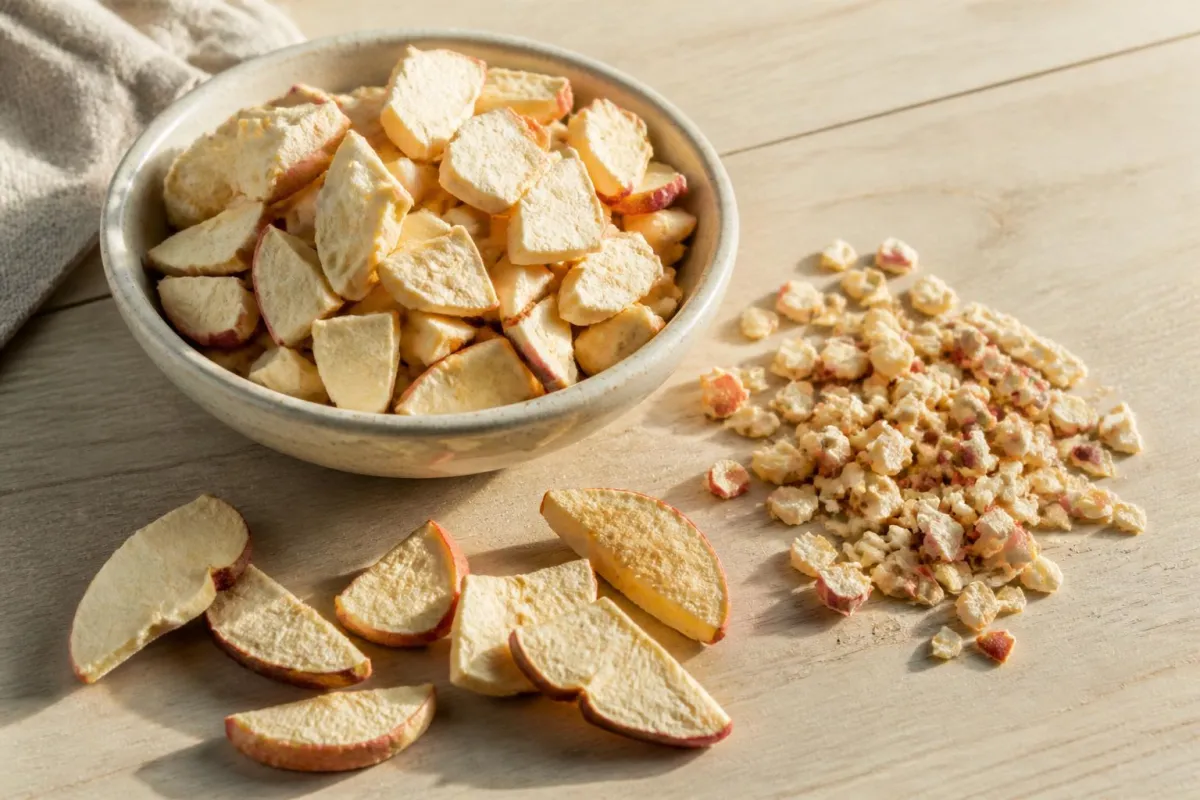
Cut size affects more than appearance. Very tiny pieces disappear into the background and can sink through gaps in the oats during storage. Oversized chunks look generous at first, but they often create an uneven spoonful, with one bite full of fruit and the next with none. For many granolas, a mid-sized cut works best because it gives visible apple in each serving without making the mix awkward to eat.
Texture is the next deciding factor. Granola is usually built around crisp oats, nuts, seeds or puffed grains. If the apple is leathery or sticky, it changes the whole feel of the mix. Freeze-dried fruit suits granola because it is dry and brittle rather than chewy. That means it can echo the crunch of toasted ingredients instead of fighting against them. If you are choosing between soft dried apple and freeze-dried apple pieces for granola, the freeze-dried option is normally the closer match for a crisp breakfast or snack mix.
Sweetness balance matters too. Apples vary naturally, and labels do not always tell you exactly how sweet a piece will taste in context. Granola often already includes syrup, honey, sugar, coconut sugar or sweet inclusions such as raisins. A very sweet apple inclusion can tip the mix from balanced to cloying. On the other hand, a sharply tart apple note can brighten a sweeter oat base. The useful question is not whether the apple is sweet in isolation, but whether it balances the rest of the jar.
Even mixing is easy to overlook until the last quarter of the container turns dusty and fruit-heavy. Pieces that are too light, too fine or too irregular can separate from the oats every time the jar is handled. That is why a reasonably consistent cut is worth looking for. If you are building your own pantry approach, our guide to first steps with freeze-dried fruit in the kitchen is a useful starting point, especially if you are still learning how these ingredients behave once opened.
One more point is worth keeping in mind. Granola is not judged only on day one. The right apple piece is the one that still feels pleasant after a week or two of opening and resealing, assuming the packet and your storage conditions support that. A fruit inclusion that starts crisp but quickly turns stale or dusty is less useful than one that stays stable in ordinary cupboard use.
Small pieces, larger chunks or powdery crumbs
Size changes the eating experience more than many labels suggest.
Small pieces are often the easiest to distribute evenly. They scatter well through oats and seeds, and they make it more likely that each spoonful includes some apple. They also tend to be kinder to clusters, because they sit between flakes and baked bits rather than breaking them apart. The downside is that very small pieces can lose visual impact. If the granola includes cinnamon, bran flakes, chopped nuts or darker toasted ingredients, tiny apple fragments may hardly register.
Larger chunks are more dramatic. They look generous, and they give a clear apple hit when you bite into one. This can suit a simpler granola where the fruit is meant to stand out. The trade-off is spoonability. Big pieces can make the mix feel less even, and they can drift to the top of the jar because they do not settle in the same way as oats. In a breakfast bowl with yoghurt or milk, larger chunks also absorb moisture more slowly at first, then soften noticeably if left to sit.
Powdery crumbs are the least useful form for most granolas. A little fruit dust is normal in almost any packet, especially with brittle ingredients, but a bag that is heavily crushed can create two problems. First, the dust settles at the bottom of the jar, so the early servings lack fruit while the final servings become concentrated and uneven. Second, fine particles cling to syrupy clusters and can turn patchy or slightly tacky over time.
That does not mean crumbs are always wasted. If you already have a packet with some broken pieces, the finer bits can still be useful in a streusel topping, flapjack mixture or a dusting for porridge. They are simply less reliable if your goal is a clean, crisp granola blend.
For many adult home cooks, the practical middle ground is best. Choose pieces large enough to be recognisable, but small enough to mix through without sorting themselves out in storage. If you also use other fruit, think about matching sizes so the mix feels intentional. Our overview of freeze-dried fruit for cupboard baking and topping ideas can help when you are combining apples with berries or other crisp inclusions.
When to add freeze-dried apple pieces
This is where many texture problems begin. The same apple piece can seem excellent or disappointing depending on when it meets heat and moisture.
Adding freeze-dried apple pieces before baking is the most integrated option. The fruit becomes part of the raw oat mixture, and the finished granola can look well combined rather than assembled afterwards. The drawback is that the apple is exposed to syrup, oil and oven humidity. Even if it starts crisp, it may lose some of that brittle texture in the bake. In some recipes it can also catch more colour than you want, especially if the pieces are small and the oven runs hot. If you choose this route, it usually helps to fold the apple in near the end of mixing rather than crushing it with vigorous stirring.
Adding the apple after baking, once the granola is fully cool, is usually the best choice if crispness is the priority. The oats, nuts and seeds can toast as normal, then the fruit goes in only when residual heat has gone. That limits moisture uptake and preserves the dry snap that makes freeze-dried fruit appealing in the first place. For most batches, this is the approach we would suggest first.
Serving time is the other useful option. If you are making a base granola for storage and want maximum control, keep the apple separate and add it to each bowl. This works especially well if your household eats granola in different ways, some with cold milk, some with yoghurt, some by the handful. It also protects the fruit from repeated exposure to air every time the main granola jar is opened.
There is no single correct method for every kitchen. The right choice depends on whether you value appearance, convenience or crispness most. If you want the clearest crunch, add after cooling or at serving time. If you want a more unified baked mix and accept some softening, add before baking. What matters is knowing the trade-off before you start.
If you use yoghurt, stewed fruit or soaked oats, remember that freeze-dried apple softens quickly once in contact with moisture. That is not a fault. It is simply how a dry, porous ingredient behaves. The practical fix is timing. Add it later, eat sooner, or keep part of the fruit back for topping.
How to compare labels without mixing up the numbers
Labels can look straightforward until you compare two packets and realise they are using different bases.
Start with the ingredient list. If you are looking for plain apple pieces, check that the ingredient is simply apple, or apple with any clearly stated processing aids if relevant. A shorter ingredient list is easier to interpret. If sugar, oils or flavourings are present, that does not automatically make the product unsuitable, but it does mean you are no longer comparing like with like.
Then check allergen information carefully. In the UK, prepacked food must provide allergen information in line with current rules, and the Food Standards Agency explains why both ingredients and allergen details matter for consumers with allergies or intolerances Food Standards Agency consumer allergy guidance. Do not assume that a fruit-only product is suitable for every person with an allergy. Manufacturing environments, handling and labelling statements all matter, and individual suitability is personal, not something we can infer from a general description.
Nutrition panels are where many comparisons go wrong. One packet may show values per 100g, another may emphasise per portion. Those are not interchangeable. The NHS advises using nutrition information to compare foods on a like-for-like basis and notes that a portion and 100g are different comparison bases NHS food labels guidance. When you compare apple pieces for granola, use the same basis for both products before drawing conclusions.
This matters because freeze-dried ingredients are light. A portion can look visually generous while weighing only a small number of grams. That can make per portion figures appear modest, but they are only meaningful if the stated portion matches how you actually use the ingredient. If you scatter 15 grams over a batch and the label portion is 5 grams, the panel is not wrong, but it is not describing your use.
It also helps to separate nutrition comparison from recipe planning. A label may list values per 100g, while your granola recipe uses 25 grams of apple pieces in a 750 gram batch. Those are different calculations. Keep the packet nearby, write down the actual amount used, and avoid mental shortcuts.
Where rules differ between the UK and the EU generally, the broad structure of food labelling is similar, but product presentation and language can still vary. For a UK home cook, the packet in hand is what counts. Follow the wording on the actual product sold to you in the UK rather than relying on a generic image or an overseas listing.
Storage choices that help granola stay crisp
Crispness is not only about what you buy. It is also about what happens after opening.
Freeze-dried fruit is highly sensitive to moisture from the air. Once opened, apple pieces can lose their brittle texture if they sit in a steamy kitchen, an unsealed pouch or a jar that is opened repeatedly over a long period. That is why the packet instructions should lead. The Food Standards Agency’s general storage guidance is clear on the importance of following product instructions and storing food appropriately Food Standards Agency food storage guidance. For shelf-stable ingredients such as these, the practical point is simple, read the label first, then build your routine around it.
If the packet is resealable and closes properly, keep using it unless the manufacturer says otherwise. Original packaging is often designed to limit air and moisture exposure. If the seal is weak or the packet is awkward once partly full, transfer the contents to a clean, dry, airtight container with a reliable lid. Make sure the container is fully dry before use. Even a little trapped moisture can undo the texture you are trying to preserve.
Cupboard conditions matter more than many people expect. A cool, dry cupboard away from the hob, kettle and dishwasher is usually better than a shelf near regular steam. Avoid leaving the packet open while you prepare breakfast, particularly if the kitchen is warm. Open, measure, reseal.
For granola itself, the same principle applies. Let the baked mixture cool completely before packing it away. If warm granola goes into a jar, condensation can form, and that moisture will move into both the oats and the fruit. If you are mixing in freeze-dried apple after baking, wait until the granola is fully cool, then combine and store promptly.
If you make large batches, consider storing the apple separately from the granola base and combining smaller amounts as needed. This is especially useful if your granola contains ingredients that are slightly sticky, such as maple syrup or date syrup, because those can slowly soften nearby fruit pieces during storage.
At Crispberry, our aim is to help UK cooks make sensible cupboard choices, not to push a one-size-fits-all method. In practice, the crispest result usually comes from three habits. Choose a mid-sized piece rather than dust or oversized chunks. Add the apple after baking or at serving time if crunch matters most. Store both the fruit and the finished granola in a way that limits moisture exposure.
That simple approach will not make every packet identical, because cut style, recipe and kitchen conditions still vary. But it does make it much easier to keep apple noticeable, crisp and pleasant from the first bowl to the last. Crispberry is published by Fleeta Limited, and we write these guides to help you use freeze-dried ingredients with fewer disappointments and better everyday results.