How to use dragon fruit pieces without soggy bakes
freeze-dried dragon fruit adds colour and crunch with very little moisture
On this page
- What freeze-dried dragon fruit is and why it behaves differently
- How to choose the right format for your recipe
- How to use it without making texture mistakes
- What to check on the label before you cook
- How to store freeze-dried dragon fruit once opened
- Easy kitchen ideas for colour, crunch and flavour
- Porridge finish
- Yoghurt pot layer
- Meringue decoration
- Traybake topping
- Cake side finish
- Biscuit mix-in
- Cheesecake top
- Buttercream colour boost
If you want dragon fruit in bakes without wet patches, collapsed toppings or streaky icing, use freeze-dried dragon fruit rather than fresh. It brings colour and a light crunch, but very little moisture, so it can sit on top of biscuits, fold into cake mixtures in small amounts, or blend into icings without watering them down.
The main thing to remember is that freeze-dried fruit behaves more like a crisp dry ingredient than a juicy one. That helps with texture, but it also means it can soften quickly if you add it too early to wet mixtures or leave it exposed to steam, cream or humid air for long. Once you treat it as a low-moisture garnish or mix-in, it becomes much easier to use well.
What freeze-dried dragon fruit is and why it behaves differently
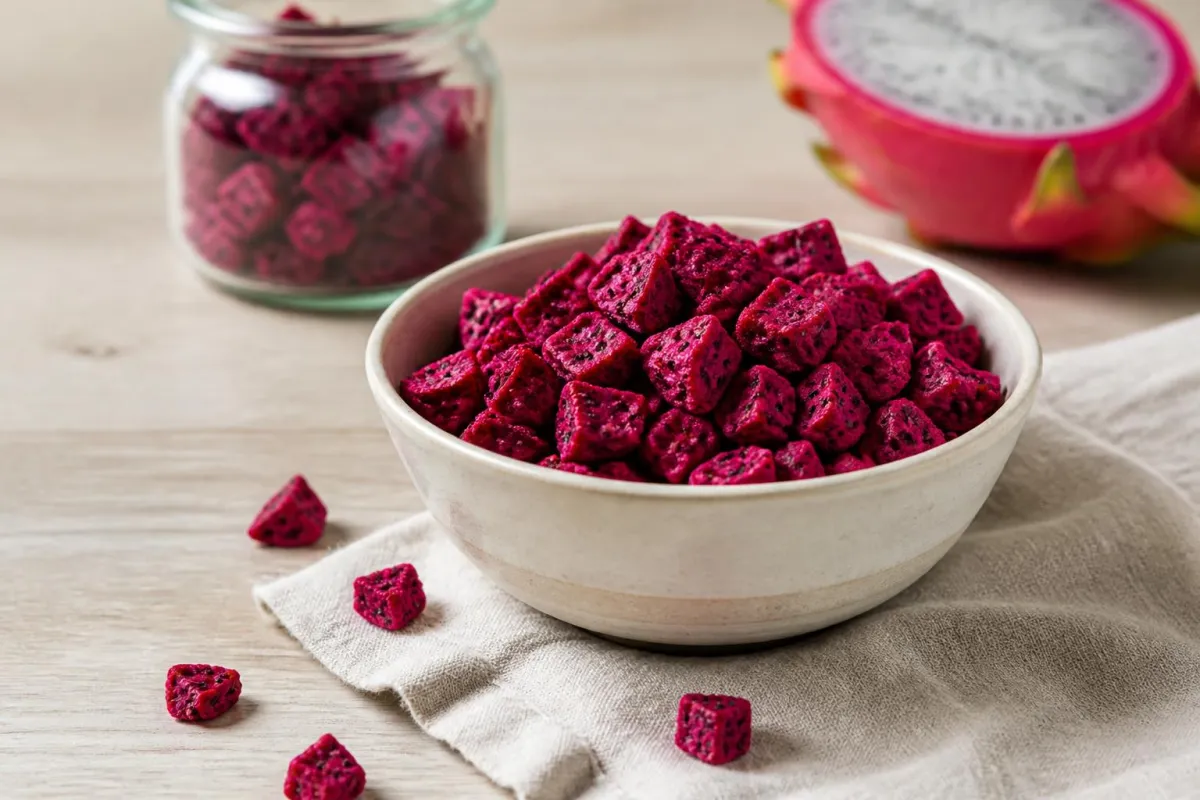
Freeze-dried dragon fruit starts as fresh fruit, but the water is removed during processing. What reaches your kitchen is light, dry and fragile, with a crisp texture rather than the soft, wet texture of fresh dragon fruit. That difference is exactly why it is useful in baking.
Fresh dragon fruit contains enough moisture to affect batter, icing and toppings. If you scatter fresh fruit over a sponge, press it into biscuit dough, or stir it through whipped toppings, the liquid can seep out as the bake stands or cooks. That can lead to soggy spots, uneven baking, softened crusts or diluted decoration.
Freeze-dried fruit works differently because it contributes flavour, colour and texture with very little water. In practice, that means:
- it can stay crisp on a dry surface
- it adds colour without turning a batter loose
- it is easier to crush into crumbs or powder
- it can absorb moisture from surrounding ingredients if left in contact for too long
That last point matters. Freeze-dried dragon fruit is not permanently crisp in every setting. Put it on buttercream just before serving and it can give a bright, crunchy finish. Put the same pieces onto a still-warm cake or onto yoghurt the night before, and they will start taking up moisture and soften.
For home baking, it helps to think in two groups. First, there are dry applications, such as topping meringues after baking, finishing white chocolate bark, or folding a few crushed pieces into biscuit dough. Second, there are wet applications, such as icing, whipped cream, cheesecake filling or porridge. In dry applications, pieces often hold their texture better. In wet applications, powder or very fine crumbs usually behave more neatly.
If you are new to this ingredient, our first steps with freeze-dried fruit guide is a useful place to get familiar with the general handling of freeze-dried ingredients.
How to choose the right format for your recipe
The best format depends on whether you want visible pieces, even colour, or a smooth finish.
Slices or larger pieces are best when appearance matters. They work well for topping cakes, traybakes, pavlovas and dessert pots because they are recognisably fruit and give a sharper decorative look. The trade-off is that larger pieces are more likely to soften unevenly if they sit on a moist topping for long.
Small pieces are often the most flexible option. They are easier to scatter over porridge, stir through granola, or fold into a biscuit or flapjack-style mixture where you want bits of colour without large shards. If the pieces are still too big for the recipe, you can crush them lightly in a bowl with the back of a spoon.
Crumbs are useful when you want colour and texture to spread more evenly. They suit cake sides, truffle coatings, cheesecake tops and dessert finishes where full pieces would look bulky. Crumbs also cling better to soft icings and chocolate than large pieces do.
Powder is the right choice when texture needs to stay smooth. If you are colouring buttercream, royal icing glaze, whipped fillings or white chocolate decorations, powder disperses far better than pieces. It also gives a more even pink tone, rather than obvious speckles. We cover related options in our guide to freeze-dried fruit powder for baking and decoration.
A simple way to choose is to ask what you need the fruit to do.
- For crunch on top, choose pieces or crumbs.
- For folding through dough or mixture, choose small pieces or lightly crushed fruit.
- For smooth icing, glaze or filling, choose powder.
- For a final flourish just before serving, choose the prettiest larger pieces.
If you only have one format at home, you can often adapt it. Pieces can be crushed into crumbs. Crumbs can be ground further into powder with a spice grinder or mini processor, provided the equipment is completely dry. Powder cannot be turned back into pieces, so if you want the most flexibility, whole or broken pieces are often the better starting point.
How to use it without making texture mistakes
The biggest texture mistakes come from timing. Freeze-dried dragon fruit should usually go in late, not early, unless you are happy for it to soften.
For toppings on cakes, blondies, brownies or traybakes, wait until the bake is fully cool before adding fruit to icing or melted chocolate. If the surface is warm, steam and residual heat will soften the fruit quickly. If you want a crisp finish, decorate as close to serving as practical.
For cake batters, use a light hand. A small handful of crushed pieces can work well in a loaf cake or muffin batter, but too much dry fruit may pull moisture from the mixture in patches while also softening itself. The result can be chewy fragments rather than crisp ones. If your main aim is colour, powder gives a cleaner result than pieces folded through the batter.
For biscuit and cookie doughs, small pieces are usually better than large shards. Large pieces can catch on the knife when slicing chilled dough, or scorch slightly if exposed on the surface. Pressing a few pieces onto the top of each biscuit after shaping often looks better than mixing in a lot.
For buttercream and soft icings, avoid stirring in large pieces far in advance. They will gradually soften and can bleed colour into pale icing, especially if the icing contains enough moisture for the fruit to rehydrate. For a speckled look, add crushed crumbs shortly before spreading or piping. For a uniform colour, use powder and beat it in gradually.
For meringues, pavlovas and similar dry desserts, freeze-dried dragon fruit is especially useful because there is very little moisture to upset the structure. Fold a small amount of crumbs through meringue for a flecked effect, or scatter pieces over the top after baking. If you add powder, do it sparingly so you do not deflate the mixture while overmixing.
To avoid colour streaking, match the format to the job. Pieces and crumbs create spots and flecks. Powder creates broad, even colour. If you stir pieces into yoghurt frosting or whipped cream and then keep mixing, the fruit can break down in patches and leave uneven pink streaks. That is not wrong, but it is usually not the neat finish people expect.
To avoid sogginess, keep these habits in mind:
- add fruit to wet toppings at the last practical moment
- never decorate warm bakes with it if you want crunch
- store opened packs carefully between uses
- use powder, not pieces, when a smooth finish matters
- crush only what you need, because finer fruit absorbs moisture faster
If you do want a softer result, for example in overnight oats or a spoon dessert, then early addition is fine. The key is doing it on purpose, rather than expecting the fruit to stay crisp in a wet mixture for hours.
What to check on the label before you cook
Before using any freeze-dried dragon fruit, read the packet rather than assuming all brands are the same. Ingredient lists vary. Some products are simply fruit. Others may include added sugar, flavourings, anti-caking agents in powders, or other ingredients that affect flavour and handling.
Allergen information matters too. Under UK food information rules, prepacked foods should declare ingredients and emphasise any of the regulated allergens present in the ingredients list. The Food Standards Agency advises consumers to check labels every time, because recipes and manufacturing arrangements can change, and a general assumption is not enough for someone managing an allergy or intolerance (Food Standards Agency consumer allergy guidance).
Nutrition panels also need a careful read. The NHS explains that per 100g and per portion are different bases, and they should not be compared as though they mean the same thing (NHS food labels). That point matters with freeze-dried fruit because the product is light. A small handful may weigh fewer grams than people expect, while a nutrition panel per 100g can look concentrated because the water has been removed.
In practical terms, check:
- the ingredients list, to see whether it is pure fruit or a blend
- the allergen statement, including any precautionary wording on the packet
- the nutrition panel, noting whether you are looking at per 100g, per portion, or both
- the storage instructions, because they vary by pack and format
- the best before date and any guidance for use after opening
If a packet gives both per 100g and per portion values, use per 100g to compare similar products, and use the stated portion information only if the packet clearly defines that portion. If it does not, weigh the amount you plan to use in grams so you know what you are actually adding.
Where rules differ between the UK and the EU generally, the layout and wording on labels can vary slightly by market, so readers in the UK should rely on the packet sold for the UK market and follow its information first.
How to store freeze-dried dragon fruit once opened
Once opened, freeze-dried dragon fruit needs protection from air and humidity. Its crisp texture is the result of being dry, so the storage goal is simple, keep it dry.
Start with the packet instructions. We cannot give one fixed shelf life after opening because products, pack sizes and closures differ. The Food Standards Agency’s food storage guidance is broad rather than product-specific, but the basic principle applies here as well, follow the product instructions and store foods appropriately to maintain quality and safety (Food Standards Agency food storage guidance).
At home, these steps help:
- reseal the original pack straight away if it has a reliable zip closure
- if not, transfer the fruit to a clean, fully dry airtight container
- keep the container in a cool, dry cupboard, away from the hob, kettle and dishwasher
- avoid storing it in the fridge, where condensation can be a problem when the container comes in and out
- use a dry spoon or dry fingers when taking some out
- close the container promptly after each use
If the fruit starts to feel leathery, bendy or tacky rather than crisp, it has taken up moisture. It may still be usable in some recipes, such as blitzing into crumbs for a topping that does not rely on crunch, but it will not perform the same way as a fresh, crisp batch.
Powder needs even more care than pieces. Because it is finer, it can clump more quickly if exposed to damp air. If you make your own powder from pieces, grind only what you need for that bake rather than processing the whole pack in advance. We have more general storage advice in our guide on how to store freeze-dried fruit.
Easy kitchen ideas for colour, crunch and flavour
These are kitchen ideas rather than tested recipes, so use them as starting points and adjust to your own ingredients and packet guidance.
Porridge finish
Make plain porridge, then top each bowl with a spoonful of freeze-dried dragon fruit pieces just before serving. For a brighter pink swirl, stir a pinch of dragon fruit powder into a little yoghurt and spoon it over the top. Add the fruit at the table if you want crunch to remain obvious.
Yoghurt pot layer
Use thick yoghurt in a glass or bowl, then add a layer of crushed freeze-dried dragon fruit between spoonfuls. Finish with a few larger pieces on top. If assembled far ahead, expect the fruit to soften, so this works best made shortly before eating.
Meringue decoration
Bake plain meringues, then once cool, dip the base or top in melted white chocolate and scatter over dragon fruit crumbs. The chocolate helps the crumbs adhere while keeping them away from direct moisture in the meringue itself.
Traybake topping
Ice a cooled vanilla or lemon traybake, then scatter a light layer of dragon fruit crumbs over one side or around the edge rather than covering the whole surface thickly. This gives colour contrast without loading the icing with too much dry material.
Cake side finish
For a frosted sponge, apply the buttercream first, chill briefly until the surface is slightly firm, then press dragon fruit crumbs gently onto the lower half or around the sides. This is usually tidier than placing delicate pieces on vertical surfaces.
Biscuit mix-in
Crush a small amount of freeze-dried dragon fruit and fold it into a plain biscuit dough with white chocolate chunks. Keep some larger fragments back to press onto the tops before baking so the fruit remains visible.
Cheesecake top
For a no-bake cheesecake, use dragon fruit powder in the topping or decoration rather than stirring pieces through the filling too early. Finish with pieces just before serving for a contrast between smooth filling and crisp garnish.
Buttercream colour boost
Beat a little dragon fruit powder into plain buttercream for a natural-looking pink tone, then decorate with a few crumbs or pieces at the end. Add the powder gradually so you can stop when the colour looks right.
If you want to explore similar ingredients and formats, our overview of freeze-dried fruit for home baking and topping ideas gives a broader picture of how different fruits behave.
Used well, freeze-dried dragon fruit is one of the easiest ways to add colour without adding extra liquid. Choose the right format, add it at the right stage, and keep it dry once opened. Those three habits do most of the work.