Once opened, how long does freeze-dried fruit keep well?
An opened packet usually deteriorates from moisture and air, not from a single fixed deadline.
On this page
If you want the shortest honest answer, opened freeze-dried fruit usually keeps best for as long as it stays dry, well sealed, and protected from heat and light. There is no single number of days that fits every packet. The moment moisture gets in, the fruit starts to lose the crisp texture that makes it useful straight from the cupboard.
That is why, when people ask us how long freeze dried fruit lasts once opened, our first answer is always, check the packet first. The manufacturer’s storage instructions and best before date are the nearest thing to a product-specific guide. After that, the practical question is not only time, but condition.
What you can and cannot say about opened freeze-dried fruit
We can say with confidence that freeze-dried fruit is designed to be shelf stable while it remains dry and properly packed. We cannot honestly give one reliable opened-life figure that covers every brand, every fruit, and every kitchen.
There are a few reasons for that.
First, packets are not all packed in the same way. One product may come in a foil pouch with a strong zip seal and a low-moisture packing environment. Another may be in a simpler bag that is perfectly suitable unopened, but less protective once repeatedly opened. Some packs include oxygen absorbers or have better moisture barriers than others.
Second, different fruits behave differently after opening. Freeze-dried strawberries, raspberries, apples and bananas do not all pick up moisture at the same rate, and they do not all show texture changes in the same way. A berry with many small pieces and lots of exposed surface area may soften faster than larger slices that are handled less often. If you want a feel for how different formats behave in the kitchen, our guides to using freeze-dried fruit in everyday baking and cooking and first steps with freeze-dried fruit at home are a good place to start.
Third, home storage conditions vary enormously. A cool hallway cupboard is not the same as a shelf beside the kettle, and a packet opened once a week is not the same as one passed around the kitchen every day with damp fingers.
So the label remains the first reference point. If a packet says to reseal immediately, store in a cool dry place, or use within a stated period after opening, that instruction should come before any general rule of thumb. Labels also matter because ingredient lists, allergens and nutrition bases differ by product. The NHS notes that portions and per 100g figures are not the same basis, so readers should compare like with like on the actual packet, not assume one general serving size for all products (NHS food labels guidance).
In other words, the useful answer is conditional. Opened freeze-dried fruit can keep well for a while, but only if you limit the things that shorten its life.
What actually shortens its life after opening
The main enemy is moisture.
Freeze-dried fruit is crisp because most of its moisture has been removed. Once the seal is broken, it starts competing with the air around it. In a humid kitchen, the fruit can absorb enough moisture to turn chewy, leathery or slightly tacky quite quickly. That change does not automatically mean it is unsafe, but it does mean the texture and eating quality have started to slip.
Air also matters. Oxygen exposure does not usually ruin a packet in one go, but repeated contact with air can gradually dull flavour and aroma. Fruit that was bright and sharp when first opened may become flatter over time, especially if the pieces are small or crushed.
Warmth speeds things up. A cupboard above an oven, beside a radiator, or near a sunny window is a poor place to keep an opened pouch. Higher temperatures can accelerate quality loss, and warmth often goes hand in hand with condensation risk in a busy kitchen.
Light is less dramatic than moisture, but it still matters for long keeping quality. Direct sunlight and strong daylight can contribute to flavour and colour changes. Opaque containers and dark cupboards are usually better than leaving a half-opened bag on the worktop.
Repeated handling is another common problem. Every time the packet is opened, moisture and air enter. Every time someone reaches in with fingers, there is more chance of introducing crumbs, grease or damp. Even a small amount of contamination can make the contents less pleasant to keep using.
A few very ordinary kitchen habits make a noticeable difference:
- leaving the bag open while you measure flour and butter
- scooping fruit over steaming porridge or a pan on the hob
- storing the packet near the kettle
- using a spoon that is not fully dry
- tipping unused fruit back into the packet after it has sat out in a bowl
None of these is unusual, but together they explain why one opened packet stays crisp for ages and another seems tired very quickly.
How to store it once the seal is broken
For most home cooks, the aim is simple. Keep opened freeze-dried fruit dry, sealed, cool and out of bright light.
If the original pouch has a reliable zip seal and the fruit will be used fairly soon, you can often keep it in that pack. Press out as much excess air as you reasonably can, seal it carefully, and return it to a cool dry cupboard straight away. Do not leave it on the worktop after breakfast and expect it to stay at its best.
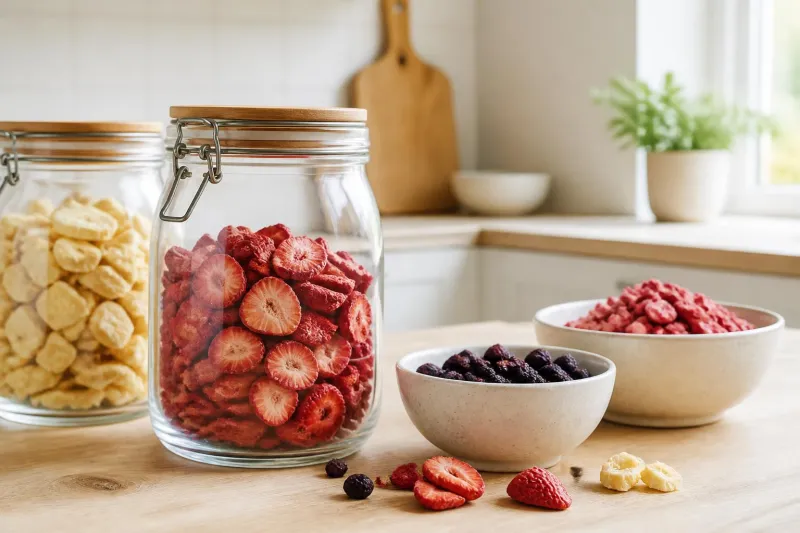
If the original pack does not reseal well, transfer the fruit to a clean, fully dry airtight jar or container. Glass jars with tight-fitting lids work well if they are dry and stored in the dark. Opaque food containers are also useful. What matters is not the material alone, but whether the container keeps out moisture and closes properly.
Clips can help with non-zip pouches, but they are only as good as the seal they create. A loosely clipped bag folded over once is better than nothing, but it is not the same as a proper airtight container.
Our practical guide on how to store freeze-dried fruit at home goes into this in more detail, but the everyday method is straightforward:
- Open the packet only when you are ready to use it.
- Measure out what you need with a dry spoon, or pour it into a dry bowl.
- Reseal the pack immediately, or transfer it at once to an airtight dry container.
- Store it in a cupboard away from heat, steam and direct light.
- Avoid opening and closing it more often than necessary.
It is usually better to keep freeze-dried fruit in the cupboard rather than the fridge, unless the pack specifically says otherwise. Fridges are damp environments, and moving a cold container in and out can create condensation. That moisture is exactly what crisp fruit does not need. The Food Standards Agency’s broader storage guidance is to follow product instructions and store food appropriately for safety and quality (Food Standards Agency storage guidance).
If you buy or use larger packs, splitting the contents into two smaller airtight containers can help. One can stay closed while you work from the other. That reduces repeated exposure of the whole amount.
How to tell whether it is still worth using
A fixed timeline is less useful than a quick condition check.
Start with texture. Good freeze-dried fruit is usually crisp or brittle, depending on the fruit. If it has gone soft, leathery, bendy or chewy, it has taken on moisture. That does not automatically mean it must be thrown away, but it is a sign that it will not perform the same way in toppings, decoration or recipes that rely on crunch.
Look for clumping. Pieces that have stuck together, especially crushed fruit or powdery fragments at the bottom of the pack, have often absorbed moisture. A few small clumps are not unusual in a humid kitchen, but heavy clumping suggests the texture has moved on.
Smell the fruit. The aroma should still seem recognisably fruity. If it smells stale, oddly flat, musty, or otherwise off, it is safer to discard it.
Check for visible damage. Discard the contents if you can see mould, unusual discolouration, signs of pests, damp patches inside the container, or anything that suggests contamination. Likewise, if the fruit has been exposed to water, steam, or a wet utensil, caution is sensible.
Think about how it has been handled. If the packet has been open in a warm kitchen for long periods, shared around during baking, or exposed to crumbs and sticky fingers, that history matters as much as the calendar.
A useful kitchen distinction is this:
- If the fruit is merely softer than before but still looks, smells and tastes normal for cooking use, it may still be worth using in recipes where crispness does not matter.
- If there is any sign of spoilage, contamination, or an off smell, discard it.
We do not recommend relying on a home experiment or invented test. You do not need to weigh it, heat it, or try to “re-crisp” questionable fruit and hope for the best. If in doubt, especially where moisture exposure has been obvious, it is better to bin it than to force a fixed shelf-life rule onto a packet that is no longer in good condition.
Kitchen uses for fruit that has softened a little
A slight loss of crispness does not always make opened freeze-dried fruit useless. It simply changes the best use for it.
If the fruit still appears sound, softened pieces can work well in baking. Stir them into cake batter, muffin mixes, traybakes or flapjacks, where they will soften further during baking anyway. Small amounts can also be mixed into biscuit dough or folded into scone mixtures.
They are useful as toppings too, just not where you need a dramatic crunch. Softer pieces can still go over porridge, yoghurt, overnight oats or desserts. In these uses, texture matters less than flavour and colour.
Another good option is to turn the fruit into crumbs or powder. Crush softened freeze-dried fruit in a dry spice grinder, mini chopper, or sealed bag with a rolling pin, then use it to flavour icing sugar, buttercream, cheesecake topping, meringue mixtures, or cake decoration. If you regularly use powders, our guide to freeze-dried fruit powder and how it is used in the kitchen may help with ideas and handling.
You can also mix slightly softened pieces into granola after baking, blend them into milkshake-style drinks, or fold them through whipped cream fillings where a crisp bite is not essential.
The limit is straightforward. If the fruit has only lost texture, you may still have good culinary uses for it. If it shows signs of spoilage, contamination or unpleasant aroma, discard it rather than trying to rescue it in a recipe.
Label checks, allergens and related guidance
Packet instructions matter for more than storage time.
Always check the actual label for the best before date, storage wording after opening, ingredient list, and allergen information. Even where freeze-dried fruit sounds simple, products can vary. Some are single-ingredient fruit. Others may include additional ingredients, anti-caking agents in powders, or be packed in environments where allergens are relevant.
For allergy and intolerance concerns, the Food Standards Agency’s consumer guidance is the right starting point. Ingredient and allergen information should be checked on the actual product, and general assumptions are not enough (Food Standards Agency consumer allergy guidance). In the UK, prepacked food must provide allergen information, but the practical point at home is still the same, read the packet each time, especially if you have bought a different brand or format.
It is also worth checking the nutrition panel carefully. The NHS explains that per portion and per 100g values are different comparison bases, which matters because freeze-dried ingredients are light, concentrated, and easy to misread if you assume the serving basis (NHS food labels guidance). If you are measuring for a recipe, weigh your ingredient in grams rather than guessing by handfuls. If you are rehydrating or blending, note your liquid in millilitres so you can repeat a result that worked.
Where UK and EU practice differ, follow the labelling and food information presented for the UK market on the pack you have in hand. General online advice from outside the UK can be useful for ideas, but it should not override the storage wording, allergen information or other instructions on your own packet.
At Crispberry, by Fleeta Limited, we treat opened freeze-dried fruit as a cupboard ingredient that rewards careful handling. The best answer to how long it keeps once opened is not a dramatic promise. It is a practical routine. Keep it dry, seal it promptly, store it well, and judge it by the label and by its condition, not by a one-size-fits-all countdown.