Freeze-dried fruit packets worth checking before you choose
Check the ingredient list first to see whether the packet is pure fruit or includes sugar, oils or anti-caking agents.

On this page
When you are deciding what to check on a freeze dried fruit packet before buying, the quickest useful answer is this: turn the packet around. The front may tell you the fruit name and show an attractive serving idea, but the back usually tells you whether you are looking at pure freeze-dried fruit, a sweetened blend, a powder with carriers, or a product that needs more careful storage once opened.
For most home cooks and bakers, five checks matter most. Read the ingredient list first, compare nutrition on a like-for-like basis, look closely at allergen and suitability wording, match the fruit form to the job you want it to do, and follow the storage instructions rather than guessing. Those checks tell you far more than the front of pack ever will.
Start with the ingredient list, not the front of pack
If you only make one check, make it the ingredient list. For plain freeze-dried fruit, the simplest version is often exactly what many cooks want to see: the fruit name on its own. For example, “strawberries” or “raspberries” as the only ingredient. That usually means the packet contains fruit only, with no added sugar, oil, starch, flavouring or anti-caking agent.
That matters because added ingredients change how the product behaves in the kitchen. Pure freeze-dried fruit tends to absorb moisture quickly, soften in wet mixtures, and keep a concentrated fruit flavour. A sweetened product may dissolve differently in icing, bake differently in sponge, or taste much sweeter than you expected. A fruit powder with another ingredient added for flow may not colour cream, buttercream or yoghurt in quite the same way as a 100 per cent fruit powder.
The ingredient list also helps you separate fruit formats that sound similar on the front. “Freeze-dried strawberry powder” might be only strawberries, or it might include sugar, maltodextrin or another added ingredient. “Berry pieces” might be single-fruit pieces, or a blend. “Smoothie topper” can sound fruit-led while still including extras that make it more of a mixed pantry product than a straightforward fruit ingredient.
In the UK, ingredients are listed in descending order by weight at the time of manufacture. That means the first item is the largest ingredient. If the fruit is not first, that is a clear sign the packet is not mainly fruit. This is established food labelling practice, and it is one reason we always suggest reading the full label rather than choosing from the front alone.
Kitchen use is where this becomes practical. If you want fruit to fold through meringue, top porridge, stir into granola or crush over a cheesecake, plain slices or pieces are often the most predictable option. If you want a vivid powder for icing, buttercream or yoghurt, a single-ingredient powder is usually easier to work with because you know the flavour and colour are coming from the fruit itself. If you are still getting familiar with how these ingredients behave, our guide to what freeze-dried fruit is and how to use it well explains the texture and moisture side in more detail.
A final point here is naming. In the UK, “freeze-dried” is not the same thing as dried, dehydrated or candied. The ingredient list and description together usually make that clear. If the packet uses broad language on the front, the legal name or descriptive name elsewhere on the pack often gives a more accurate picture of what is inside.
Compare nutrition on the same label basis
The next check is nutrition, but only if you compare it fairly. The NHS advises using nutrition information to compare foods and notes that a portion and 100g are different comparison bases NHS food labels guidance. That matters a great deal with freeze-dried fruit because packets often suggest different serving sizes, and those serving sizes are not useful for direct comparison between brands or fruit types.
The simplest method is to compare the per 100g column first. That gives you a common basis. If one packet lists values per 100g and another pushes the serving size more prominently, ignore the serving size at first and line up the per 100g figures instead.
Why is this especially important for freeze-dried fruit? Because removing moisture concentrates what remains. A small handful can weigh very little, while still bringing a strong flavour and a concentrated nutrition panel. If you compare one packet “per serving” and another “per 100g”, you can easily come away with the wrong impression.
A practical example helps. Imagine Packet A shows nutrition per 100g and Packet B highlights nutrition per 12g serving. Packet B may look lower in sugars or energy simply because the serving is small. That does not mean the product is lower on a like-for-like basis. To compare them properly, use the per 100g figures first, then decide whether the suggested serving is realistic for your own kitchen use.
This is also where fruit type matters. Banana powder, strawberry slices and raspberry crumb are not interchangeable ingredients, so their nutrition panels will differ. A fair comparison is not always about finding the “best” numbers. Often it is about understanding what you are buying. If you need a bright, sharp berry note for decorating, you may only use a little. If you want fruit stirred through overnight oats or baked into flapjacks, the amount you use may be larger. The packet helps you compare, but only if you read the same basis across products.
If a label gives both per 100g and per portion, use them for different jobs. Use per 100g for comparing products. Use per portion only after that, when you are thinking about how much you are likely to put into a recipe or bowl. That is the cleanest way to avoid confusion.
Check allergens and suitability statements carefully
Allergen information deserves careful reading every time, even when the ingredient list looks simple. The Food Standards Agency guidance for consumers explains why ingredient and allergen information matters and why people should not infer personal suitability from a general label Food Standards Agency consumer allergy guidance.
For a packet of freeze-dried fruit, start with the ingredients and then check the allergen statement separately. In the UK, allergens that must be declared are usually emphasised within the ingredient list when they are deliberate ingredients. But that is not the only wording to look for. You may also see precautionary statements such as “may contain” or “not suitable for” because of shared equipment or shared packing environments.
Those statements are not decorative. They tell you something about cross-contamination risk in the supply chain or packing process. A packet that contains only fruit as an ingredient can still carry a precautionary statement if it is handled in a place that also processes allergens. That is why “only fruit” does not automatically mean suitable for every household.
Suitability notes can also cover more than allergens. Some packets state whether the contents are suitable for certain dietary patterns. Others say nothing at all. Silence is not confirmation. If a statement matters to you, look for it directly on the pack rather than assuming from the ingredient list alone.
Country rules can create confusion here. In the UK, food sold here must meet UK labelling requirements. If you are comparing a packet produced for another market, the presentation of allergen information may look different. Imported products may still be compliant for UK sale, but the format can vary. That is another reason to slow down and read the actual wording rather than relying on familiar layout cues.
We do not make personal dietary claims on Crispberry, and it is worth being equally cautious in your own kitchen. A packet can provide useful information, but it does not replace advice tailored to an individual condition or allergy plan. For general label-reading practice, the NHS and Food Standards Agency are the best starting points, and the packet itself remains the key document for the specific food in your hand.
Look at pack size, fruit form and how you plan to use it
Net weight matters, but it does not tell the whole story. Freeze-dried fruit is light, brittle and low in moisture, so a 20 gram packet can be more useful than it sounds, while a larger packet may not suit the job you have in mind. To choose well, look at three things together: pack size, fruit form, and intended use.
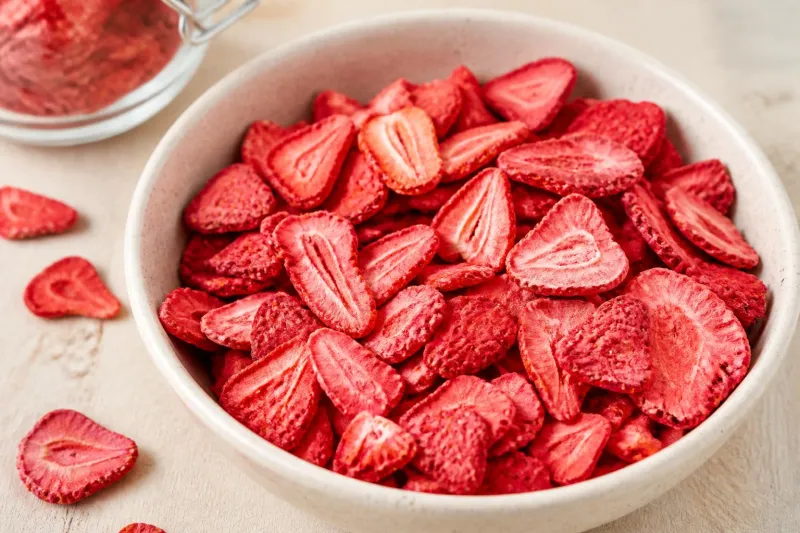
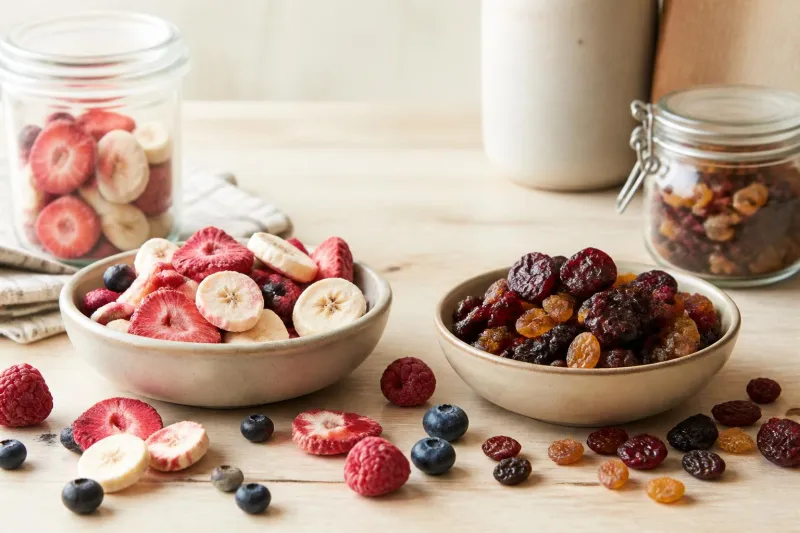
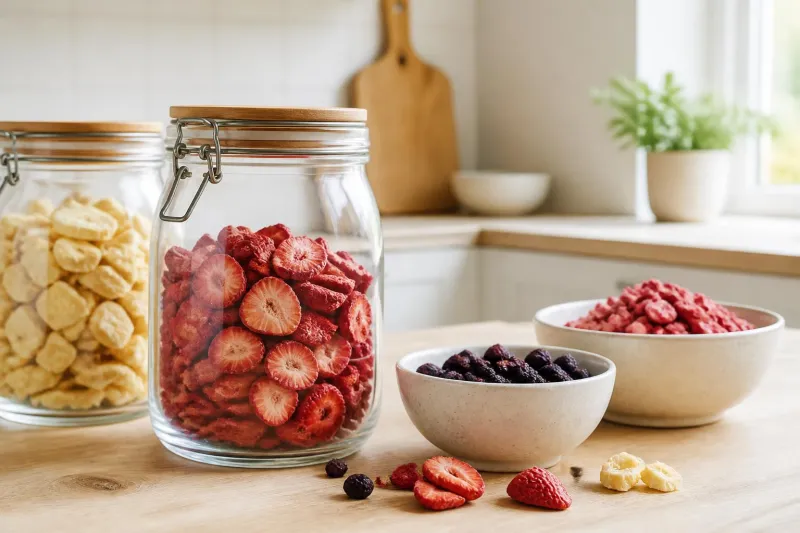
Fruit form is often the deciding factor. Slices are useful for visible decoration, topping cereal, garnishing cakes and adding texture where you want recognisable pieces. Smaller pieces or broken fragments are often easier to stir through traybakes, cookie dough or granola. Powders are best where you want flavour and colour without lumps, such as icing sugar blends, buttercream, yoghurt, milkshakes or dusting. Crumb sits somewhere in between, useful for topping desserts or mixing through coatings where powder would disappear too completely and slices would be too large.
The intended use should guide the format. If you want fruit on top of a pavlova, slices or pieces usually make more sense than powder. If you want to flavour whipped cream without adding extra liquid, powder is often the easier route. If you want a ripple effect through cheesecake filling, crushed pieces may work better than either whole slices or a fine powder.
This is also why one packet cannot be judged by weight alone. A 15 gram packet of raspberry powder may go a long way if you are dusting, colouring icing or adding a sharp fruit note to a dry mix. A 15 gram packet of large apple slices may feel much smaller in practical use if you are topping several lunch pots or baking multiple batches. The right question is not just “how many grams are in it?” but “how much usable fruit in the right form does this give me for the job?”
An illustrative example. Suppose you are planning to make a simple buttercream for 12 cupcakes. A packet of strawberry powder may be the more practical choice than strawberry slices, because slices would need crushing and may still leave larger flecks. If, instead, you want to finish a tray of brownies with a crisp berry topping, pieces or crumb may be better than powder, which could vanish into the surface. The exact amount needed depends on the recipe and the packet, so the point is not a fixed quantity but a better match between form and use.
If you are choosing between formats, our ingredient guides on freeze-dried fruit and freeze-dried fruit powder can help you think through which type is likely to suit your cupboard and your cooking style.
Storage instructions can matter as much as the fruit itself
Storage guidance is not an afterthought on a freeze-dried fruit packet. It tells you how vulnerable the contents are to moisture, and moisture is the main thing that changes texture once the packet is opened.
Freeze-dried fruit is prized for being crisp and dry, but that crispness is temporary if the fruit is left exposed to humid kitchen air. A packet that says “store in a cool, dry place” before opening and “reseal after opening” is giving you practical information, not generic wording. It is telling you the fruit can pick up moisture from the air and soften if handled carelessly.
Some packets are resealable, some are not. That difference matters. If the packet is not resealable, you may want to transfer the contents promptly to a clean, airtight container after opening. If it is resealable, check whether the closure feels substantial enough for repeated cupboard use. The packet cannot guarantee how your kitchen behaves, but the storage instructions tell you what the maker expects you to do to preserve quality.
The Food Standards Agency storage guidance is broad rather than freeze-dried specific, but the principle is still relevant: follow the product instructions, because appropriate storage helps maintain food safety and quality Food Standards Agency storage guidance. With freeze-dried fruit, quality is often the first noticeable issue. Crisp fruit turns chewy, powder clumps, and pieces stop crumbling cleanly.
Here is a practical example that differs from our other guides. Say you open a packet of freeze-dried raspberry crumb on a damp baking day and use only part of it to top chocolate mousse. If the packet says reseal immediately after use, do that before you carry on with the rest of the recipe. Leaving it open beside a steaming kettle or simmering pan for even a short time can be enough for the crumb to soften. The result may still taste good, but it will not behave the same way next time you want a dry, crisp finish.
Storage wording can also hint at realistic cupboard planning. If a packet gives after-opening guidance that sounds fussy, it may not be the best choice for occasional use unless you are ready to repackage it properly. If you cook with freeze-dried ingredients often, that may not bother you. If you only use them now and then, it matters more.
For a broader starting point on choosing and handling these ingredients sensibly, our first steps with freeze-dried fruit information guide pulls together the basics without turning packet reading into guesswork.
A good packet check is less about finding a perfect front label and more about understanding what you are actually bringing into the kitchen. Ingredient list first, per 100g for fair comparison, allergen wording read in full, format matched to use, and storage instructions taken seriously. If you do those five checks, you will have a much clearer idea of whether a packet suits your baking, cooking and cupboard habits before you buy it.