Smarter adult packed lunches with freeze-dried fruit
Freeze-dried fruit adds flavour and texture without adding lunchbox moisture.
On this page
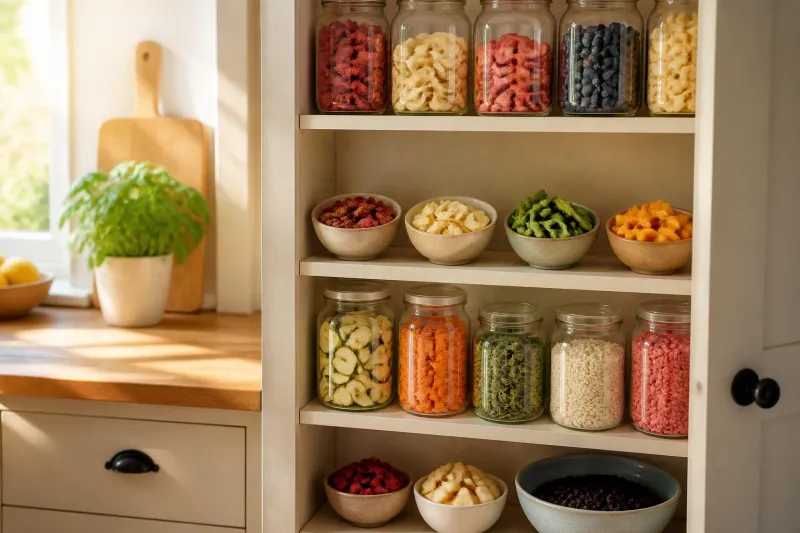
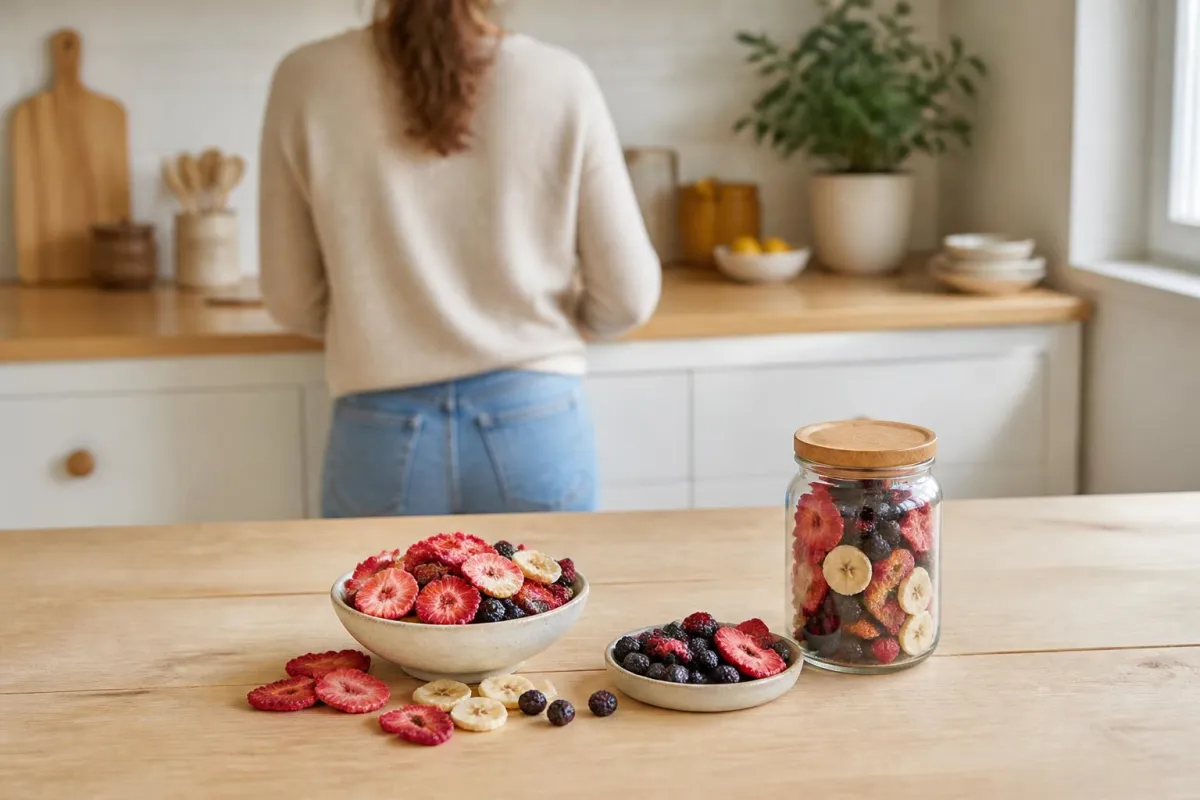
Packed lunches are easier to live with when the ingredients travel well, stay tidy, and still feel worth eating by midday. That is where freeze-dried fruit can be useful in adult packed lunches. Its low moisture means it is light to carry, less messy than many fresh fruit options, and easy to portion into small containers, yoghurt pots, oats, bakes, and savoury-sweet combinations.
The main practical point is texture management. Freeze-dried fruit starts crisp or brittle, but it softens quickly if it sits against yoghurt, cut salad, or any other damp ingredient. If you pack it with that in mind, it can add a clean fruit note and a different texture without turning the whole lunch bag into a sticky job.
Why freeze-dried fruit suits adult packed lunches
For a work lunch, convenience usually comes down to four things. Can it sit in a cupboard until you need it, can it travel without leaking, can you portion it quickly, and will it still be pleasant to eat a few hours later. Freeze-dried fruit answers those practical questions well, provided it is packed properly.
First, it is a dry ingredient. That matters in a lunchbox because moisture is what makes many foods slump, weep, or go soggy. Fresh berries, orange segments, and chopped apple can be excellent foods, but they also release moisture into neighbouring ingredients. Freeze-dried fruit does not do that on its own. It is already dry, so it can sit in a small tub, screw-top jar, or sealed snack compartment without adding liquid to the rest of the meal.
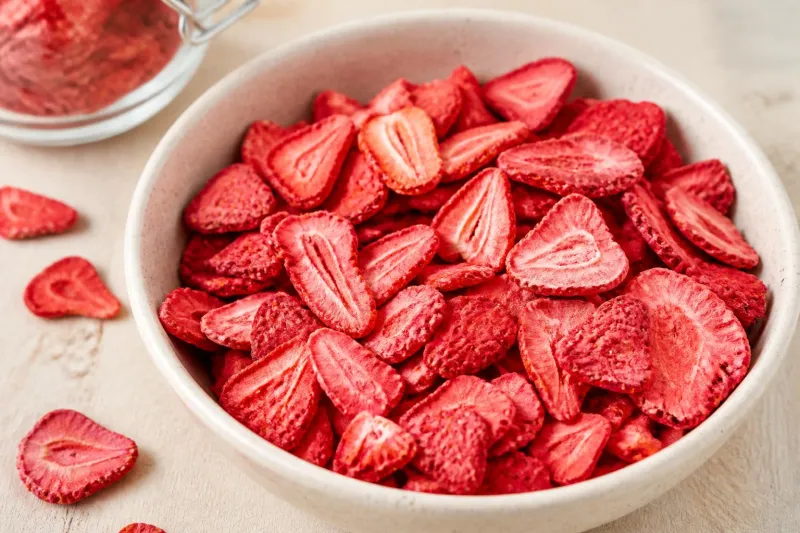
Second, it is portable. A handful of freeze-dried strawberry slices or raspberry pieces weighs very little and does not need peeling, coring, or draining at your desk. If you keep a packet at home for lunches, you can use a small amount at a time and build variety into otherwise repetitive weekday meals. For readers who want a broad introduction to formats and uses, our first steps with freeze-dried fruit information guide covers the basics.
Third, the texture is different from both fresh and dried fruit. Traditional dried fruit is chewy and dense. Freeze-dried fruit is usually crisp, airy, or crumbly, depending on the fruit and cut size. That can be useful when the rest of the lunch is soft, such as overnight oats, a hummus wrap, or a yoghurt pot. It gives contrast without needing last-minute prep.
Fourth, it is easy to keep separate until you want it. This is often the difference between a good lunch and a disappointing one. If you scatter freeze-dried fruit over yoghurt at 7 am and leave it there until 1 pm, it will usually lose its crispness. If you carry it in a separate dry compartment and add it just before eating, the texture is much closer to what you intended.
That is the real advantage of freeze dried fruit in adult packed lunches. It is not that every lunch needs it, or that it replaces fresh fruit in every situation. It is that it gives us another cupboard ingredient that is neat, lightweight, and easy to use when moisture and portability matter.
How to choose the right format for the lunch you are packing
The best format depends less on the fruit itself and more on where it is going in the lunch.
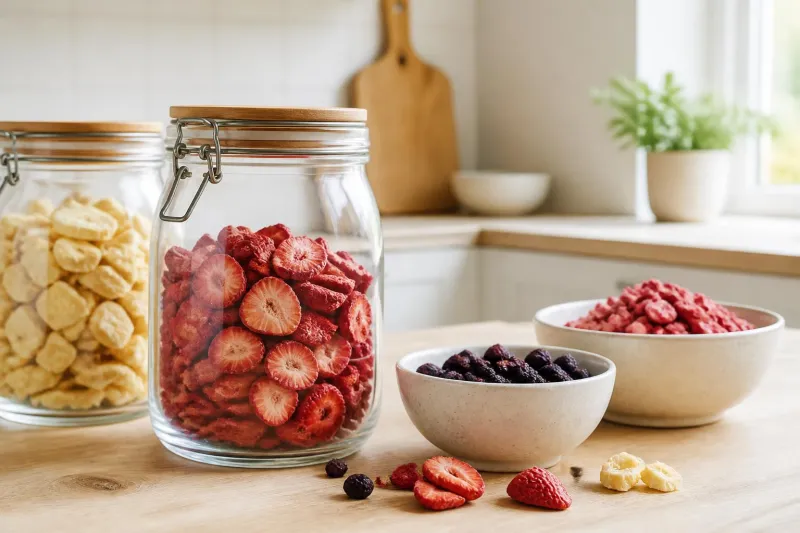
Pieces are the most flexible option. These might be small berry fragments, broken slices, or chunkier cut fruit. They work well when you want visible fruit and a bit of bite. Use them for trail-mix style additions, grain bowls with a sweet note, couscous salads, or a separate crunchy topping for yoghurt. Pieces are also practical in desk-drawer lunch supplies because they are easy to spoon out without crushing everything further.
Slices are better when appearance matters or when you want a more deliberate topping. Strawberry slices, for example, sit neatly on porridge oats, baked oats, or a lunchbox flapjack. They can also work in a cheese-and-cracker style lunch where you want a sweet contrast without using a sticky chutney pot. If you are comparing formats, our ingredient pages for freeze-dried strawberries for slices and topping ideas and freeze-dried raspberries for sharper fruit notes may help.
Crumbs are useful when you want flavour and colour spread through a food rather than sitting on top of it. Think of crumbs as the in-between format. They are larger than powder, but smaller than pieces. They suit yoghurt pots, soft cheese on crispbreads, muesli, and simple home bakes cut into lunchbox portions. Because they are small, they distribute more evenly, which can be handy if you are packing one shared bake for several days of lunches.
Powders are best when you want the fruit incorporated rather than noticed as a separate texture. A spoonful can be stirred into plain yoghurt, folded into overnight oats, mixed into porridge before chilling, or added to a simple icing on a lunchbox loaf cake. In savoury-sweet combinations, a little fruit powder can be easier to manage than pieces. For example, a small amount in a dressing or soft cheese spread gives a fruit note without introducing chunks that may soften awkwardly. We cover the basics of this format in our guide to using freeze-dried fruit powder in everyday cooking and baking.
A few practical pairings make the choice clearer.
If you are packing a yoghurt pot, keep slices or pieces separate until lunch if you want crunch. If you are happy with a softer finish, crumbs can go in earlier.
If you are packing overnight oats, powder and crumbs mix through more evenly than whole slices. Whole slices are better added on top just before eating.
If you are baking a tray of oat bars for the week, crumbs or powder usually distribute more predictably than large pieces.
If you are packing a savoury lunch with a sweet accent, such as crackers, hard cheese, and salad, slices or pieces in a separate compartment are usually simpler than powder.
There is no single right format. The useful question is, do we want visible fruit, a crisp topping, an even mix, or just a background fruit note.
What to check on the label before it goes in the lunch bag
A packed lunch ingredient still needs the same label checks as anything else in the kitchen. The most important are ingredients, allergens, and the basis used for nutrition information.
Start with the ingredients list. Some freeze-dried fruit products are simply fruit. Others may include additional ingredients, especially in powders, coated pieces, or mixed products. If you are choosing between two packets, read the actual ingredient line rather than relying on the front-of-pack wording.
Next, check allergen information carefully. In the UK, allergen information must be communicated clearly for prepacked food, and the Food Standards Agency advises consumers to read ingredient and allergen information every time, particularly if a food allergy or intolerance is relevant in the household Food Standards Agency. That matters for lunch prep because the fruit itself may be straightforward, but the product could have been packed with other ingredients or carry handling information that affects your decision. We cannot infer personal suitability from a general description on a website.
Then compare nutrition information on the right basis. This is where people often get caught out with dry ingredients. The NHS explains that nutrition labels may show values per 100g and per portion, and those are different comparison bases NHS. For freeze-dried fruit, this matters because it is very light. A small spoonful may weigh far less than people assume, while a nutrition table per 100g can look concentrated simply because the product is dry.
So, if you are comparing packets for lunch use, ask three separate questions:
- What are the values per 100g, so I can compare one product with another on the same basis?
- What does the manufacturer define as a portion, if they provide one?
- How many grams am I actually likely to pack?
Those are not the same question, and the answer to one does not automatically answer the others. If the packet gives portion guidance, use it only as packet guidance, not as a universal rule for every brand or every lunch.
It is also worth remembering the broader lunch context. The NHS Eatwell Guide explains dietary balance across what we eat over a day or week, not as a test that every single snack or lunch component must pass on its own NHS. That is useful here because freeze-dried fruit is usually one small part of a packed lunch, not the whole picture.
How to pack it so it stays crisp until lunch
If crispness matters, separation matters more than anything else.
The main rule is simple. Keep freeze-dried fruit away from damp foods until you are ready to eat. Yoghurt, soft cheese, cut cucumber, tomatoes, dressed grains, and cooked oats all give off moisture. Even if there is no visible liquid, the enclosed lunchbox environment is enough to soften dry fruit over time.
In practice, that means packing the fruit in its own small dry container. A screw-top pot, mini clip-lid tub, or sealed snack compartment usually works well. If your lunchbox has only one large compartment, a separate little pot is often better than wrapping the fruit in paper or dropping it loose into the box.
Choose the container size sensibly. Too much empty space can encourage the fruit to bounce around and break into dust. Too little space can crush slices. For powders, a very small leak-proof pot is best, especially if you plan to stir the powder into yoghurt or oats at lunchtime.
Follow the packet instructions for storage once opened. The Food Standards Agency's general food storage guidance is clear that storage conditions matter and product instructions should be followed Food Standards Agency. For freeze-dried ingredients, that usually means keeping the main packet well sealed and stored as directed after opening, then only packing what you need for that day.
A few lunch-specific habits help preserve texture.
Pack moist components cold and properly contained. If yoghurt or salad dressing leaks into the fruit compartment, crispness is gone.
Let cooked items cool before boxing them up. Warmth trapped in a sealed container creates condensation, and condensation softens dry toppings very quickly.
Add fruit at the last sensible moment. If you are eating at a desk, carrying a tiny pot to sprinkle over yoghurt or oats takes seconds and gives a much better result.
Keep the lunch bag out of direct heat where possible. Heat itself is not the same as moisture, but a warm lunch bag can encourage condensation around chilled items.
We have a separate guide on storing freeze-dried fruit once opened and between uses, so we will not duplicate that here. For this article, the key lunchbox point is simple, dry fruit stays crisp when it stays dry.
A practical lunchbox example for a desk day
Here is one illustrative example, using assumed quantities. It is not a tested recipe, not a nutrition plan, and not a standard portion guide. Check the actual packet for ingredients, allergens, and nutrition information, and adjust the quantities to suit the lunch you are packing.
Illustrative desk-day packed lunch:
- 1 wholemeal wrap
- 60 grams hummus
- 40 grams grated carrot
- 40 grams sliced cucumber
- 30 grams roasted peppers, well drained
- 1 plain yoghurt pot, 150 grams
- 8 grams freeze-dried strawberry slices, packed separately
- 15 grams plain oats, packed separately to stir into the yoghurt if wanted
- 1 small handful of unsalted nuts, packed separately if suitable for the setting
- Water bottle or flask, packed separately as usual
How to assemble it:
Spread the hummus on the wrap, then add carrot, cucumber, and roasted peppers. Roll and wrap securely. Keep the wrap chilled until you leave.
Put the yoghurt in a lidded pot if it is not already in one. Pack the freeze-dried strawberry slices in a separate small dry tub. If you like a thicker yoghurt pot, carry the oats in another small tub or add them to the yoghurt shortly before leaving, depending on how soft you want them by lunch.
At your desk, eat the wrap as it is. Stir the oats into the yoghurt if you packed them separately, then top with the strawberry slices just before eating so they keep more of their crisp texture.
Why this example works:
The wrap contains the moist savoury elements, but they are contained within one item rather than spread through the whole lunchbox. The yoghurt and fruit are separated, so the fruit stays dry until needed. The fruit format is slices rather than powder because this lunch benefits from a visible topping and a contrast in texture. If we wanted the fruit note mixed through the yoghurt instead, a small amount of powder would be the tidier choice.
You could also take the same structure in a slightly different direction. Swap the strawberry slices for raspberry pieces, or use a little fruit powder stirred into the yoghurt and keep the crunchy element for seeds or plain cereal. If you want to build a fuller savoury lunch around cupboard ingredients, our article on fast adult lunches with freeze-dried vegetables gives separate ideas without repeating this example.
Used thoughtfully, freeze-dried fruit in adult packed lunches is less about novelty and more about control. We can keep ingredients dry, add them when we want them, and make a weekday lunch feel better planned with very little extra effort.