Small-cupboard ways to use freeze-dried ingredients well
Choose by use first: garnish, baking, sauces or snacking all need different formats.
On this page
Small cupboards reward ingredients that do more than one job without needing bulky storage. Freeze-dried fruit, vegetables and powders can work very well in that setting, but the best format depends less on trend and more on shape, density and how you actually use them. If you mostly bake, decorate and flavour in small amounts, powder often earns its space. If you want visible pieces for porridge, granola, traybakes or quick toppings, pieces can be easier to portion and less messy.
At Crispberry, we find that using freeze dried ingredients when cupboard space is limited comes down to three practical questions. How much room does the pack take for the kitchen jobs it covers, how easily can you keep moisture out once opened, and are you buying a format you will finish before texture changes. The answers are usually clearer on the shelf than in marketing copy.
Which freeze-dried format wastes least space in a small cupboard?
For a small cupboard, the least wasteful format is usually the one that gives the most useful kitchen tasks per centimetre of shelf depth. That is not always the smallest bag.
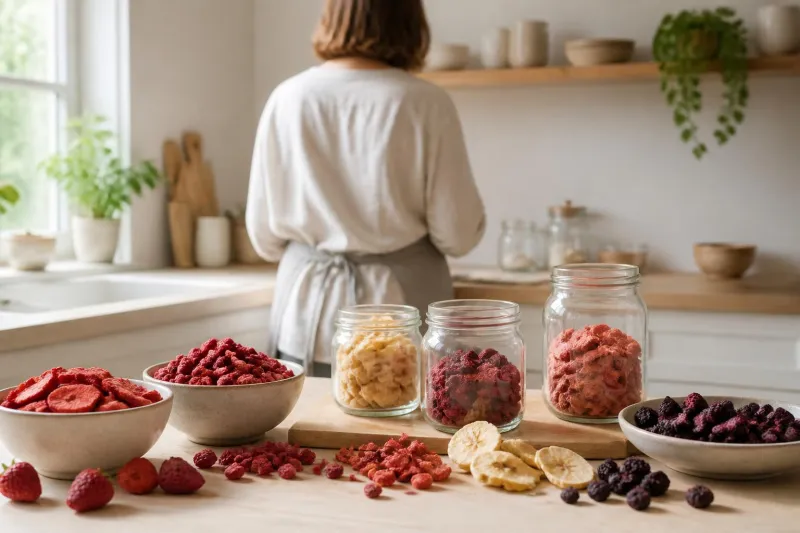
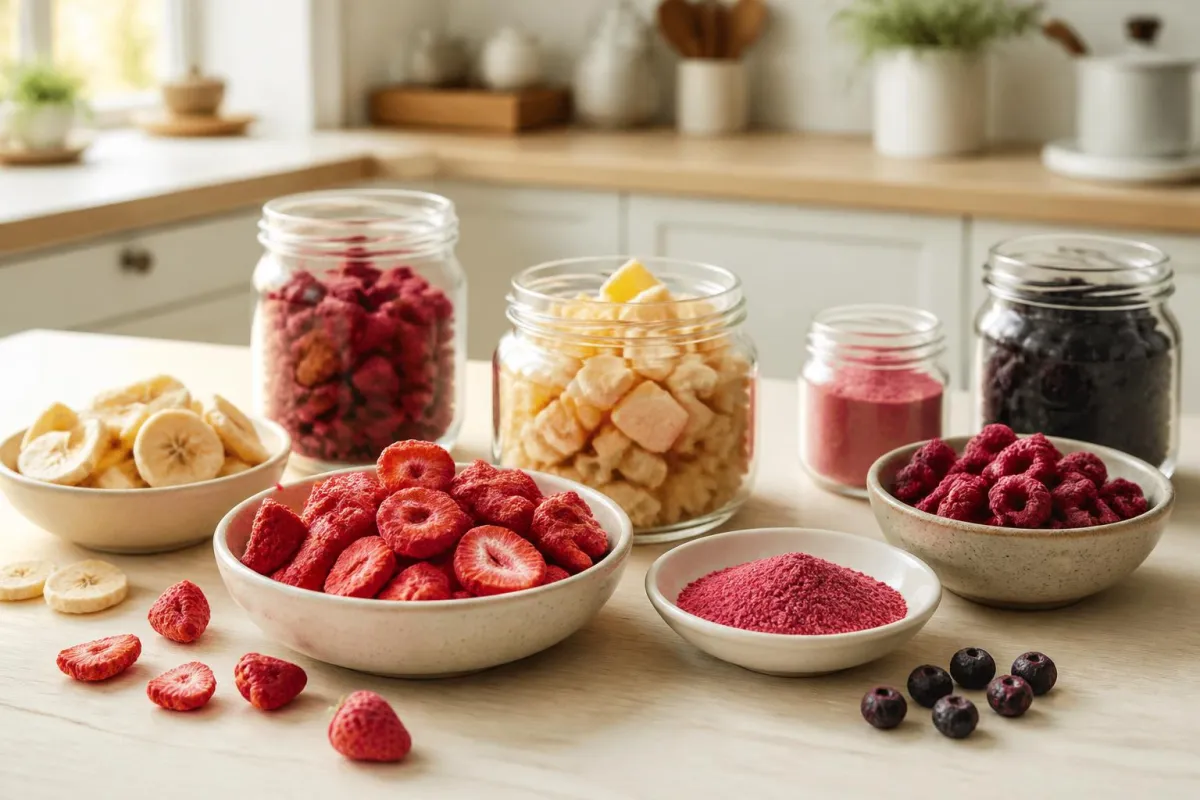
Whole pieces, such as whole raspberries or larger strawberry pieces, tend to take the most room for their weight because they trap air in the pack. They are also more crush-prone, so they are often packed in a way that protects shape rather than saves space. That can still be worth it if appearance matters. A whole raspberry on top of a cheesecake or a meringue nest does a different job from raspberry powder stirred into icing.
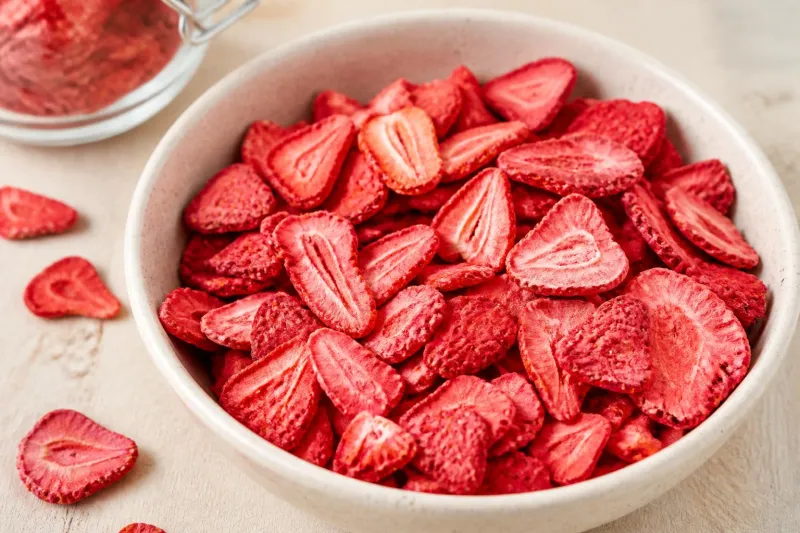
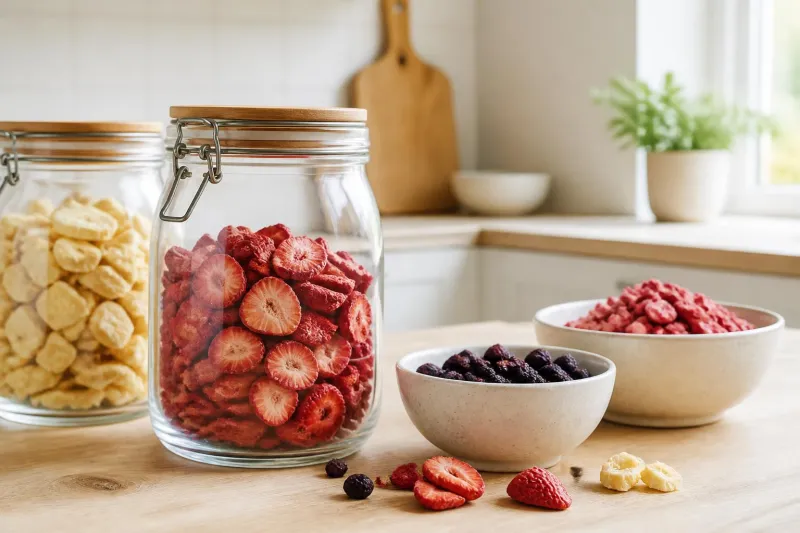
Slices often sit in the middle. They usually stack more neatly than whole pieces and can fit flatter pouches or tubs, especially when the pieces are fairly uniform. If you use fruit for cereal toppings, biscuit decoration or quick garnish, slices can be a good compromise between visible texture and cupboard efficiency.
Powders are usually the most space-efficient format for repeated small uses. A powder packs densely, settles into corners of a pouch or jar, and is easy to decant into a shorter container that fits under a shelf lip or in a door rack. For the jobs powder does well, such as colouring buttercream, flavouring icing, stirring into yoghurt or blending into sponge batter, it often gives more uses from less cupboard volume than pieces do. Our guide to freeze-dried fruit powder formats is useful if you are deciding between a powder and a piece format for baking.
Mixed ingredients are the hardest to store efficiently unless you use them exactly as packed. A blend of several fruits, or fruit mixed with other dry ingredients, can save you from keeping multiple bags. But if one ingredient is doing most of the work and the others are occasional extras, the blend may take more room than a single-format ingredient you would use more often. Mixed packs can also make label comparison slower, because you need to check not just the front of pack but the full ingredient list and allergen information.
Pack shape matters as much as ingredient format. A slim, flat pouch that can stand upright often wastes less useful cupboard space than a wide tub, even if the tub looks tidy. In a narrow cupboard, depth is usually the limiting factor. Two flat pouches clipped closed and stored upright in a magazine file or narrow basket often fit better than one rigid container with a broad footprint.
A simple way to judge space efficiency is to match format to task count.
- Whole pieces, best when appearance matters.
- Slices, best when you want visible fruit but easier stacking.
- Powders, best when you need many small measured uses.
- Mixed ingredients, best only if you regularly use the mix as packed.
If you want a practical starting point, keep one visible-fruit format and one powder, rather than several overlapping packs. For example, a pouch of freeze-dried strawberries for topping and baking decoration plus one fruit powder often covers more real kitchen use than three different large bags of pieces.
When powder is the better choice and when it is not
Powder is the better choice when you need flavour, colour or fruit character without adding noticeable chunks. It suits baking and finishing work where a spoonful matters more than a handful.
Good uses for powder include:
- Stirring into buttercream, cream cheese frosting or royal icing.
- Mixing into sponge, shortbread or macaron batter.
- Dusting over desserts through a small sieve.
- Flavouring porridge, yoghurt or overnight oats in modest amounts.
- Blending into drinks where you want fruit flavour without watery dilution.
That last point matters in cocktails and mixed drinks. Freeze-dried powder or finely crushed fruit can add flavour without the extra liquid that fresh fruit or juice brings. We cover that in more detail in our guide to using freeze-dried fruit in cocktails without watery results.
Powder is also easier to portion precisely. If cupboard space is tight, precision helps because it reduces half-used bags of specialist ingredients. A teaspoon taken, clipped and returned to the cupboard is easier than opening a large pouch of pieces for one decorative sprinkle.
But powder is not automatically more convenient. It can be less suitable when you want clear shape, bite or contrast. If you are topping flapjacks, folding fruit through a rocky road mixture, or adding visible pieces to granola, powder can disappear into the background or coat the mixture unevenly. Pieces are usually better when texture is part of the result.
Powder can also be messier in humid kitchens. Fine particles cling to spoons, funnels and jar rims. If you dip a damp spoon into the pouch, or leave the pack open while steam is in the air, the powder may clump. Clumping does not always make it unusable, but it does make accurate measuring and smooth mixing harder.
Pieces have their own advantages in small cupboards because they are often more self-explanatory. You can see at a glance whether you have enough left for topping six buns or finishing one bowl of porridge. With powder, volume in the jar can be deceptive because a little goes a long way in some recipes and disappears quickly in others.
So the practical split is simple. Choose powder when the ingredient is mainly there to flavour, colour or blend in. Choose pieces when the ingredient needs to be seen, felt or scattered.
How to plan portions when you cannot spare a full shelf
The most useful storage plan for a small cupboard is not a fixed serving chart. It is a system that shows, at a glance, what each ingredient is for, how quickly you use it, and how much space it is allowed to take.
We suggest a three-container rule for opened freeze-dried ingredients.
- Keep the original packet until you have copied over the key details.
- Decant only what fits your cupboard and your usage pattern.
- Label the new container with the information you need to make sensible decisions later.
For home use, that often means one of these setups:
- A small screw-top jar for powder you use weekly.
- A clip-top pouch or bag clip for larger pieces you want to keep in the original pack.
- A smaller food-safe tub for the next few weeks' worth of a bulky ingredient, with the rest left sealed if the original packaging allows it.
Your label does not need to be elaborate. The useful basics are:
- Ingredient name.
- Date opened.
- Best before date from the packet.
- Any allergen or "may contain" wording copied exactly if relevant.
- A note on your usual use, such as "icing only" or "porridge topping".
That last note sounds simple, but it stops cupboard drift. If a jar is labelled "raspberry powder - icing and yoghurt", you are less likely to buy another fruit powder for the same narrow purpose before finishing the first one.
Here is an illustrative example, not a serving claim.
Say we have one flat half-shelf available in a narrow kitchen cupboard. We want room for a fruit powder, one decorative fruit piece, and one vegetable ingredient for quick cooking. We might set it up like this:
- One 250 millilitres jar for strawberry powder.
- One clipped pouch of freeze-dried raspberries stored upright in a slim basket.
- One small tub of peas or another vegetable ingredient for quick soup or pasta finishes.
- A note inside the cupboard door listing what each pack is for and where the original packet is kept if it contains the full label details.
The key is not guessing how many portions each holds. Check the actual packet weight in grams, how you use it, and the nutrition panel basis before planning. A powder used by the teaspoon in icing will last differently from the same powder blended into smoothies or stirred into porridge most mornings. The packet tells you the weight. Your own kitchen habits tell you the pace.
If you want to compare formats before choosing containers, our overview pages on freeze-dried fruit for adult home kitchens and vegetables can help you narrow the ingredient first, then the storage method.
What changes first when freeze-dried ingredients meet moisture?
The first change is usually texture, not safety signalling that you can reliably judge by sight alone. Freeze-dried ingredients are valued because they are dry and crisp. Once they meet moisture from steam, damp utensils, condensation or humid air, they start losing that crispness.
For pieces, the early signs are softness and reduced snap. A strawberry slice that was brittle may turn leathery. A raspberry may soften on the surface and become more fragile when handled. In toppings, that means less crunch and less clean definition.
For powders, the early sign is usually clumping. Fine powder absorbs moisture from the air more readily than larger pieces because more surface area is exposed. Small clumps may still break up in a sieve or by rubbing through fingers, but larger clumps can mix unevenly into icing or batter.
In kitchen results, this matters in three ways.
First, visible texture changes. Crisp fruit on top of a frosted cake can soften quickly once it sits on a moist surface. If you want a dry finish, add freeze-dried toppings close to serving rather than hours in advance.
Second, measuring changes. A free-flowing powder is easier to spoon, level and blend. Once clumped, it is harder to distribute evenly through dry ingredients.
Third, storage life after opening becomes more dependent on handling. Established guidance is to follow the product's storage instructions and keep food properly stored. The Food Standards Agency's consumer-facing storage guidance focuses on following storage instructions and keeping foods under suitable conditions for safety and quality where relevant Food Standards Agency. For home use, our practical interpretation is straightforward. Open the pack for as short a time as possible, reseal it well, avoid steam, and do not use wet spoons.
That interpretation is about preserving texture and usability, not creating a guaranteed shelf-life rule. We do not suggest a fixed number of days or weeks because that depends on the actual packaging, your cupboard conditions and the ingredient format. A powder in a frequently opened jar beside a kettle will usually change faster than a tightly clipped pouch stored in a cool, dry cupboard.
If a product's own instructions differ from a general habit, follow the packet. In the UK, that is the sensible baseline for household storage. Where people read wider European advice online, remember that packaging conventions and wording can vary, so the product label in hand should lead.
How to compare labels without overbuying
A small cupboard punishes vague shopping. The easiest way to avoid overbuying is to compare labels for purpose, not just for pack size.
Start with the ingredient list. If you want a single freeze-dried fruit powder for baking, check whether the pack is pure fruit or a blend with other ingredients. Neither is automatically wrong, but they do different jobs. A pure powder is easier to use when you want predictable flavour and colour. A blend may be useful for a specific application but less flexible if space only allows one jar.
Then check allergen information carefully. The Food Standards Agency advises consumers to use ingredient and allergen information and not to assume suitability from a broad description alone Food Standards Agency. For a small cupboard, this also matters because mixed-use decanted jars can create confusion later. If a pack includes allergen wording or a "may contain" statement that matters in your household, copy it onto the storage label rather than relying on memory.
Next, compare the nutrition panel on the same basis. The NHS explains that per 100g and per portion are different comparison bases, and that portions can vary between products NHS. That is especially important with freeze-dried ingredients because they are light, concentrated and often used in small amounts. A per 100g figure can look intense compared with the amount you actually sprinkle onto porridge, but that does not make portion figures interchangeable across brands or formats.
A practical label-check routine looks like this:
- Compare like with like, powder against powder, slices against slices.
- Read the ingredient list before the front-of-pack description.
- Check allergen information and any precautionary wording.
- Look at nutrition per 100g for broad comparison.
- Then check whether the packet also gives a portion figure, and how that portion is defined.
- Decide whether the pack size fits your cupboard and your likely use before buying.
The NHS Eatwell Guide also reminds readers that balance is considered over a day or week, not demanded from every single food choice NHS. For this article, the practical point is not to overcomplicate one ingredient. If you are choosing between two formats for a cupboard staple, focus on the format you will store well and actually use.
Finally, be wary of buying by imagined versatility. A large bag can seem economical until it occupies half a shelf and goes soft before you finish it. In a small kitchen, the better buy is often the pack whose label you fully understand, whose format matches your main jobs, and whose storage you can manage properly once opened.
When cupboard space is tight, good choices are rarely about having more options. They are about having the right one ready, dry and easy to use.