How to crush freeze-dried fruit for smoother baking
Crush to the texture your bake needs, not automatically to a fine powder.
On this page
Crushing freeze-dried fruit for adult baking is mostly about choosing the right texture, then keeping the fruit dry long enough to use it. If you want smooth icing, evenly coloured sponge, or a filling that does not turn patchy, the difference between coarse shards, fine crumbs and powder matters more than many recipes admit. The fruit itself is usually easy to break. The trick is stopping it from pulling in moisture from the air, or from your kitchen tools, before it reaches the bowl.
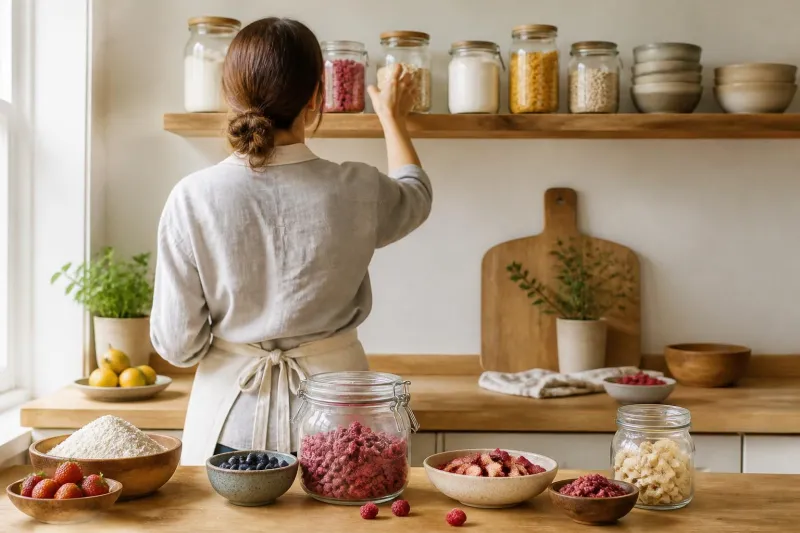
In practice, we treat freeze-dried fruit as a dry flavouring ingredient with a short window for handling. Crush only what you need, use dry equipment, and add it at the point where the recipe can absorb it without turning it sticky. If you are new to using it, our first steps with freeze-dried fruit and how to store freeze-dried fruit guides cover the basics that sit behind the method here.
What texture are you trying to make?
Start by deciding what you want the fruit to do in the finished bake.
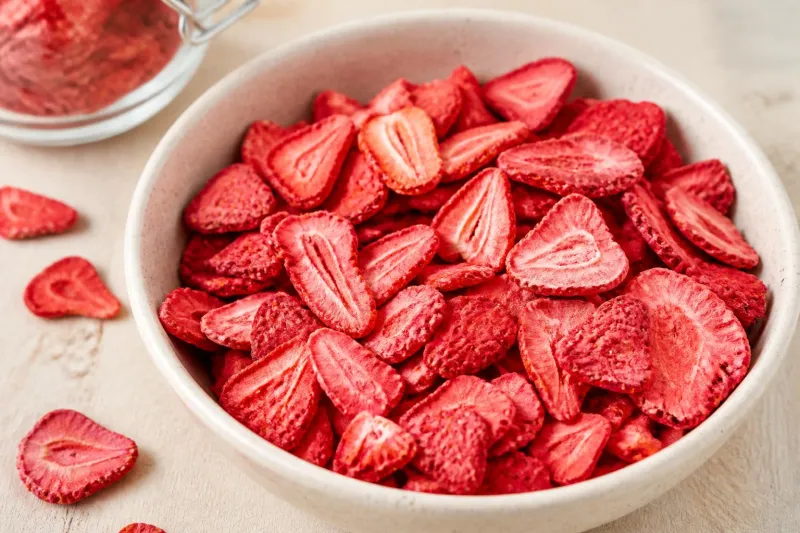
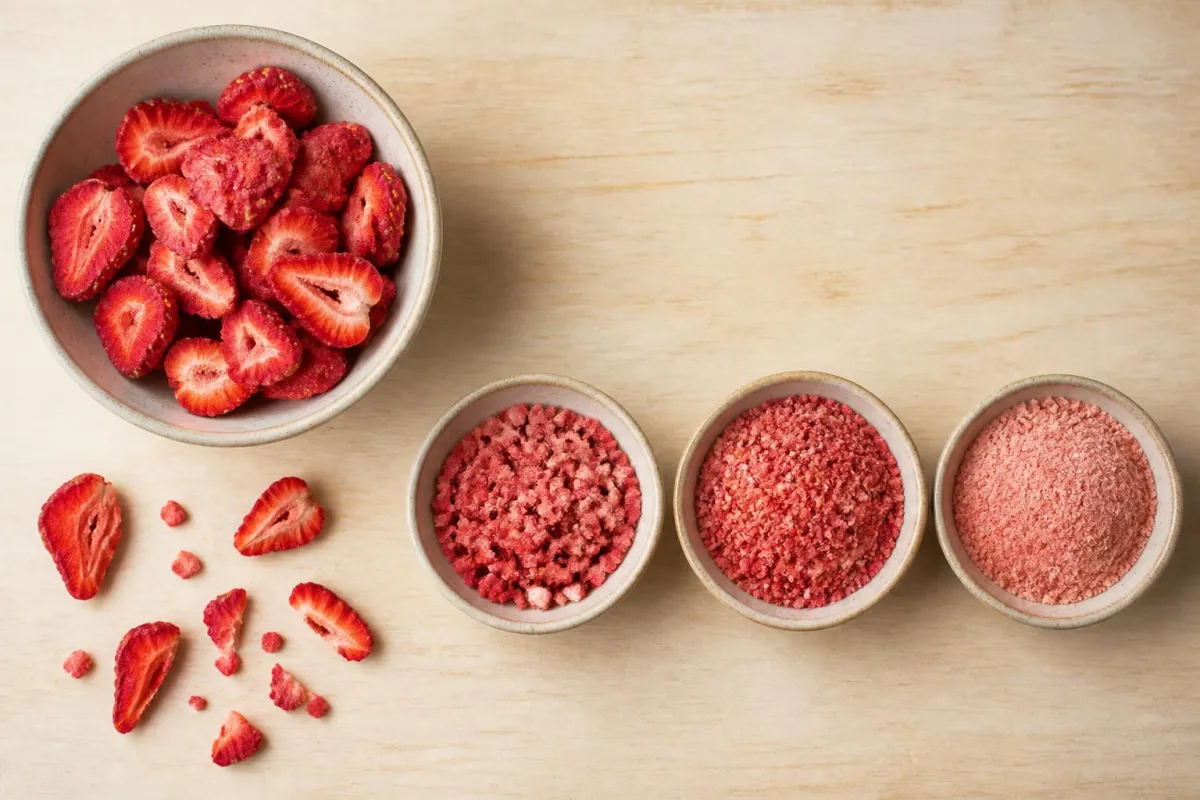
Coarse pieces work best when you want visible fruit and little bursts of flavour. Think biscuit dough, traybake toppings, muffin crowns or the outside of a chocolate coating. In those uses, irregular pieces can be an advantage. They stay recognisable, give contrast against a soft crumb, and do not disappear completely into the mixture. The trade-off is that they can soften unevenly if the bake contains a lot of moisture.
Fine crumbs are often the most useful middle ground. They distribute more evenly than larger pieces, but they still bring some texture. We use this level for buttercream folded with berry flavour, biscuit dough where we want speckling rather than chunks, and sponge batters where powder alone might over-colour one part of the mix if not sifted properly. Fine crumbs also tend to be easier to make with ordinary home equipment.
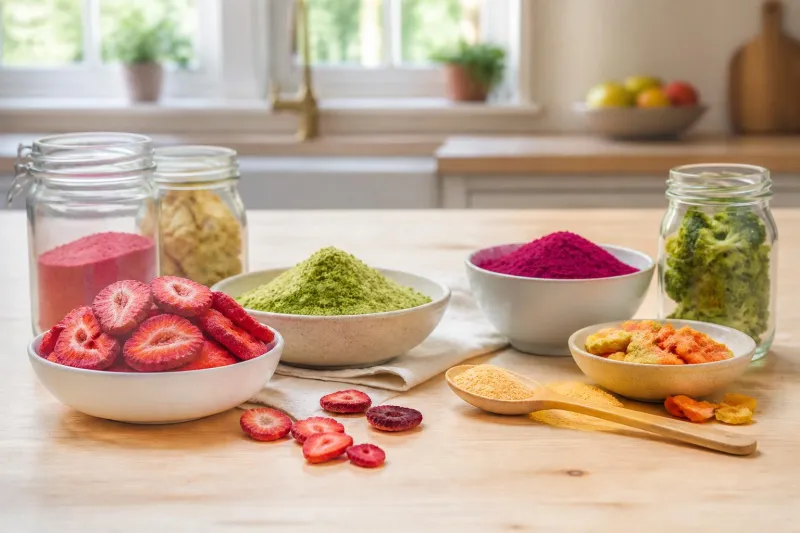
Powder is the right target when smoothness matters. That includes glacé icing, dustings, macaron shells, whipped fillings, cheesecake toppings and sponge batter where you want colour and flavour without adding extra liquid. Powder also gives the most even appearance, especially with fruits such as strawberry or raspberry. If you are using a ready-made fruit powder for baking and icing, you skip the crushing stage and go straight to sifting and blending.
Texture matters because freeze-dried fruit behaves differently from fresh fruit, jam or purée. It brings flavour and colour with very little water, but it does not melt into a batter by itself. If the pieces are too large, they can leave hard spots in an otherwise soft icing. If the powder is too fine for the method and added too early, it can cling to damp surfaces and form streaks. Matching the crush to the recipe is what makes the result look deliberate rather than accidental.
For adult baking, it also helps to think about where the fruit will sit. Inside a rich butter cake, powder gives a cleaner crumb. On top of a biscuit, coarse pieces give better visual contrast. In a cream cheese frosting, fine crumbs may be enough if you like small flecks, but a smooth piped finish usually needs powder.
Which kitchen tools work best?
You do not need specialist equipment, but the best tool depends on the quantity and the texture you want.
A mortar and pestle is good for small batches and control. It is especially useful for turning crisp slices into fine crumbs without immediately reducing everything to dust. It also lets you stop at the point that suits your recipe. The drawback is speed. If you need enough powder for a large cake filling or several batches of icing, it can become slow work.
A spice grinder or small electric grinder is usually the quickest route to powder. It works well for berries that are already light and brittle. Pulse rather than run continuously, and let the dust settle before opening the lid. The main trade-off is unevenness if the batch is too small, or heat if you run it too long. You are not likely to cook the fruit, but warmth and friction can encourage clumping once the powder meets humid air.
A mini food processor can work for crumbs, though it is often less effective for a very fine powder unless you have enough volume in the bowl. Small amounts can bounce around above the blade rather than break down evenly. For biscuit toppings and crumb coatings, that may be perfectly acceptable.
A rolling pin and freezer bag is the simplest low-tech option. Put the fruit in a clean food bag, press out excess air, and crush it on a board with light taps first, then firmer rolling. This gives you good control over coarse and medium textures. It is less reliable for a true powder, and the bag can trap larger shards in the corners.
A sieve is not a crushing tool, but it is one of the most useful finishing tools. If you crush fruit by hand or in a grinder, pass it through a dry fine sieve. The fine material goes into the recipe, and the larger bits can be crushed again. This is the easiest way to get consistency without over-processing the whole batch.
A few practical points matter whatever tool you choose:
- Make sure the equipment is fully dry.
- Work in small batches if you want an even result.
- Let grinder dust settle before opening the lid.
- If you need powder for icing, sift it before it touches the sugar.
- If your recipe can tolerate a slightly rustic finish, stop at fine crumbs rather than chasing a perfect powder.
If you already know you need a very smooth result, it can be more practical to use freeze-dried fruit powder as a baking ingredient rather than crushing pieces yourself.
How do you stop clumps and moisture problems?
Moisture is the main reason crushed freeze-dried fruit turns awkward. Once opened, it can start taking up moisture from the room quite quickly, especially in a warm kitchen or near steaming pans.
The first rule is to get everything ready before opening the packet. Set out the bowl, sieve, spoon and recipe ingredients first. If you are making icing, weigh the icing sugar in advance. If you are folding fruit into a batter, have the dry ingredients already measured. Then open, crush, use, and reseal.
The second rule is to keep tools and containers completely dry. A bowl that looks dry but still holds a trace of washing-up water is enough to start clumping. The same goes for a grinder lid or the inside of a storage jar.
The third rule is to separate crushing from wet mixing wherever possible. If you add powder directly to a damp bowl, it can stick to the sides before it disperses. We usually mix it with another dry ingredient first. For example:
- whisk fruit powder into flour before adding to cake batter
- stir it through icing sugar before adding liquid
- combine it with caster sugar for a coating or dusting
- fold crumbs into biscuit dry ingredients before butter or egg
If clumps do form, do not assume the ingredient is spoiled. Small clumps often just mean it has picked up moisture. Push the powder through a sieve and use it promptly if the aroma and appearance are still normal and the packet instructions allow. If the fruit has gone leathery, sticky throughout, or shows any sign of damage or contamination, discard it.
Storage matters too. Follow the packet instructions, and once opened, reseal promptly and keep the contents in the stated conditions. The Food Standards Agency advises consumers to follow storage instructions and handle food safely rather than guessing from appearance alone Food Standards Agency storage guidance. For cupboard ingredients such as sealed freeze-dried fruit, that usually means paying attention to the pack directions and protecting the contents from moisture once opened. Our storage guide for freeze-dried fruit at home goes into more detail on jars, resealing and where not to keep opened packets.
When should you add crushed fruit to a bake?
The best stage depends on the recipe type.
For cakes and sponge batters, powder usually goes in with the dry ingredients. This helps it disperse evenly and reduces the chance of streaks. If you add it after the wet ingredients are mixed, it can cling in patches and be harder to blend without overworking the batter. Fine crumbs can also go in with the flour if you want a speckled effect.
For biscuits, cookies and short doughs, coarse pieces or fine crumbs can go in near the end of mixing. That protects some texture. If you add them too early and beat hard, they can vanish into the dough. If the dough is very wet or sticky, dusting the fruit lightly with flour from the recipe can help it distribute.
For buttercream and soft icings, powder is usually best sifted into the sugar first, then beaten with the fat. That gives more even colour and fewer specks. If you want visible flecks, use very fine crumbs instead, but expect a less smooth finish. With glacé icing, stir the powder into the icing sugar before adding water or lemon juice in tiny amounts. The fruit contributes flavour, but it does not replace the need to control consistency carefully.
For whipped cream style fillings, mascarpone fillings and cheesecake toppings, fold in powder or very fine crumbs towards the end, after the base mixture is smooth. This reduces the chance of overmixing. It also lets you see the colour develop before deciding whether to add more.
For jams, curds or fruit fillings that are already wet, freeze-dried fruit can sometimes be used as a flavour booster or thickening element, but the result is more variable. Powder can disappear smoothly, while larger pieces may soften into seeds and skins. In these cases, add a little at a time and judge the texture as you go.
What we would not do is promise that crushed fruit can be swapped directly for fresh fruit in any recipe. Fresh fruit brings water, weight and structure changes that freeze-dried fruit does not. It is better to treat crushed freeze-dried fruit as a dry add-in, not a one-for-one replacement.
A practical example for colour and flavour without wetting the batter
Here is one illustrative example for a small loaf cake. It is not a tested house recipe, and the exact amount of fruit powder must be checked against your packet, your fruit type and your own recipe method.
Example only, strawberry loaf cake with dry fruit powder in the batter
Assume a plain loaf batter based on:
- 180 grams self-raising flour
- 150 grams caster sugar
- 150 grams unsalted butter, softened
- 3 medium eggs
- 30 millilitres milk
- 1 to 2 tablespoons freeze-dried strawberry powder, sifted
Method idea:
- Sift the flour and strawberry powder together into a bowl.
- Cream the butter and sugar until lighter in texture.
- Beat in the eggs gradually.
- Fold in the flour and strawberry powder mixture.
- Add the milk only if needed to reach your usual loaf batter consistency.
- Bake according to your base loaf recipe, tin size and oven.
Why this example works as a method: the strawberry is added with the dry ingredients, so it colours and flavours the batter without adding extra liquid. That is often the cleanest way to get a pink crumb without using purée or chopped fresh fruit.
What you still need to check:
- whether your flour already includes enough raising agent for the quantity used
- whether your fruit powder packet contains only fruit, or includes other ingredients
- whether the powder is strong enough in colour and flavour at 1 tablespoon, or needs more
- whether your base loaf recipe already uses more or less milk
- whether your tin size and baking time suit the batter volume
If you are using crushed pieces rather than a prepared powder, sift after crushing and measure the fine portion separately. Larger fragments are better saved for the top of the loaf or for icing decoration after baking. For related methods with other dried fruit ingredients, see our practical guide to dried fruits for everyday baking.
Labels, allergens and storage checks that still matter
Even for a straightforward baking ingredient, the packet still matters.
First, check the ingredient list. Some freeze-dried fruit products are simply fruit. Others may include added sugar, carriers, anti-caking ingredients or flavourings, especially in powder blends. If your recipe assumes pure fruit powder and the packet is a blend, the colour, sweetness and behaviour can change.
Second, check allergen information carefully. In the UK, prepacked food must provide ingredient and allergen information, and that matters even when the product seems simple. The Food Standards Agency’s consumer guidance is the right starting point for label and allergy checks Food Standards Agency allergy guidance. We do not infer personal suitability from a general label. If a household member has a food allergy or intolerance, use the actual packet and their own advice plan.
Third, read the nutrition panel on the right basis. The NHS explains that per 100g and per portion are different comparison bases, and both can appear on labels NHS food labels guidance. That matters with freeze-dried ingredients because they are light, concentrated and often used in small amounts. A number given per 100g can look high or low without telling you much about what you are actually adding to a cake or icing. Compare like with like, and use the packet’s serving information only in the context the packet gives.
Fourth, follow the stated storage instructions. UK labelling and food handling guidance turn on the actual product instructions, not general assumptions. If a packet says reseal and store in a cool dry place after opening, do that. If it gives a use-by or best-before date, keep the distinction clear. Where UK practice differs from broader EU assumptions, the practical point for home cooks is simple, rely on the product sold here and its UK labelling, then store and use it accordingly.
Finally, keep expectations realistic. Freeze-dried fruit is excellent for adding concentrated fruit flavour, colour and texture with little extra moisture. It is not a magic fix for every recipe, and it does not remove the need to read the packet, handle allergens carefully, or store ingredients properly. At Crispberry, published by Fleeta Limited, we focus on that kind of practical kitchen use, clear enough to help you bake better, without pretending every fruit or every recipe behaves the same way.