Fruit pieces or powders for better baking texture?
Pieces and powders behave differently because they spread moisture and flavour in different ways.
On this page
Choosing between freeze-dried fruit pieces and powder is mostly a texture decision. Pieces give you visible fruit, little bursts of flavour and a more obvious bite. Powders disappear into the mix, colour it more evenly and flavour it more consistently from edge to edge. Neither is automatically better. The right choice depends on whether you want fruit to be seen and felt, or simply to be present throughout the bake.
In practice, the question of freeze dried fruit pieces versus powders in baking comes down to four things, texture, appearance, flavour spread and moisture handling. Pieces can stay distinct and crisp for a while, then soften as they sit in batter or icing. Powders blend more smoothly, but because they are so fine they can thicken mixtures quickly and may need a small liquid adjustment. If you keep those differences in mind, recipe decisions become much easier.
What changes when you bake with pieces instead of powders
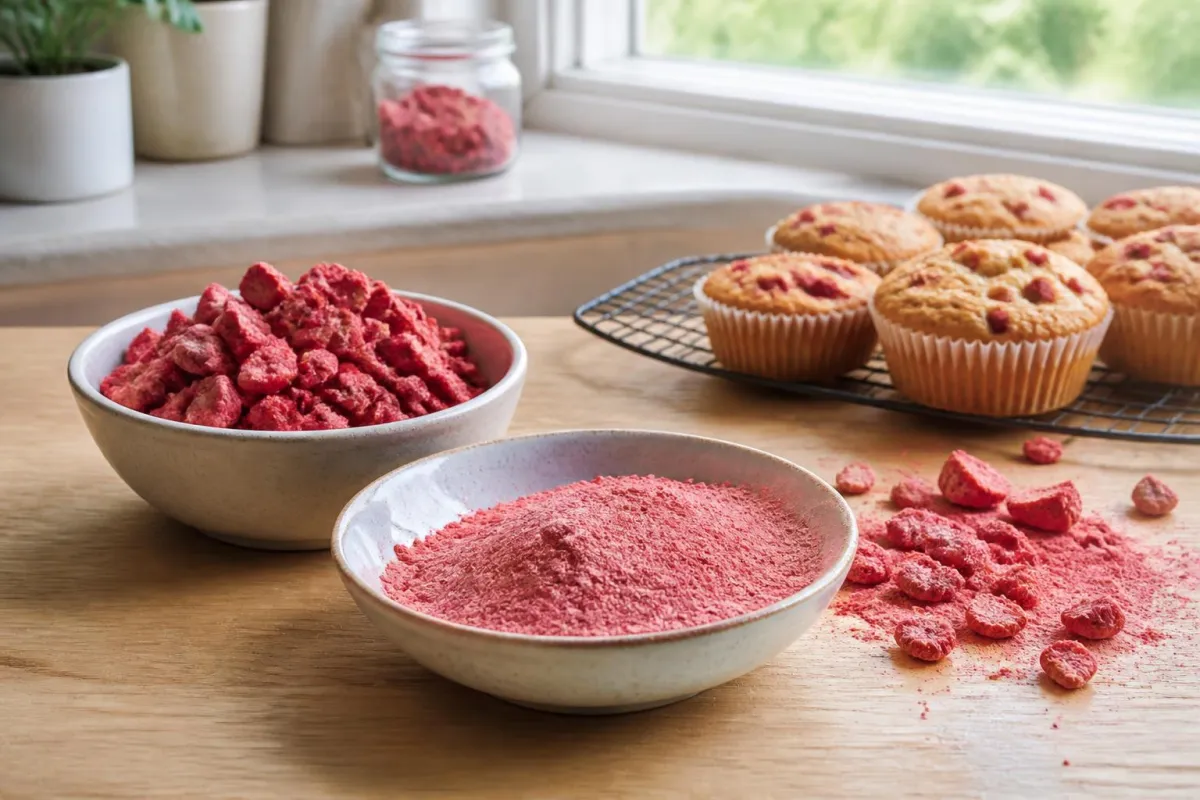
The clearest difference is texture. Freeze-dried fruit pieces remain separate particles. In a muffin, traybake or cookie dough they create little pockets of fruit. Depending on the fruit and the size of the pieces, that can mean a pleasant chew, a light crispness before baking, or a softer bite once they have absorbed some moisture from the mixture. Powder does the opposite. It behaves more like a dry flavouring ingredient, spreading through the batter so you get fruit flavour without individual bits.
Appearance changes just as much. Pieces are visible. They give you speckles, chunks or a topping that readers of a recipe would recognise immediately as raspberry, strawberry or another fruit. Powder is the better choice when you want a uniform pink sponge, a smooth berry buttercream or an icing with no visible fragments. If your goal is a neat finish rather than a rustic one, powder usually gets you there faster.
Flavour spread is another practical difference. Pieces concentrate flavour in the places where they sit. One bite may contain a bright berry note, the next may be milder. Powder distributes flavour more evenly, especially in smooth mixtures such as sponge batter, cheesecake filling or frosting. That even spread can make the whole bake taste more integrated, but it also means you lose the contrast that whole pieces provide.
Moisture handling is where many bakers get caught out. Freeze-dried fruit is dry, but that does not mean it has no effect on the recipe. Pieces absorb moisture more slowly and locally. They take water from the surrounding batter, filling or topping over time. Powder absorbs moisture much faster because its particles are smaller and have more surface area. A spoonful too much can turn a loose icing into a stiff paste, or make a cake batter thicker than expected. The reverse matters too. If you add pieces where a recipe expects powder, you may not get the same colour or flavour intensity, because the fruit is not dispersed as finely.
The fruit itself matters as well. Seeds, skins and natural acidity become more noticeable in some forms than others. Raspberry powder, for example, can still carry a fine seediness unless it has been sieved very finely after crushing. Strawberry powder often blends more smoothly. If you are making your own powder from pieces, our guide on crushing freeze-dried fruit for smoother baking is the useful starting point.
When pieces are the better choice
Pieces are the better choice when you want fruit to look like fruit. That sounds obvious, but it helps you decide quickly. If the bake benefits from visible colour contrast, recognisable fruit and a little bite, pieces usually win.
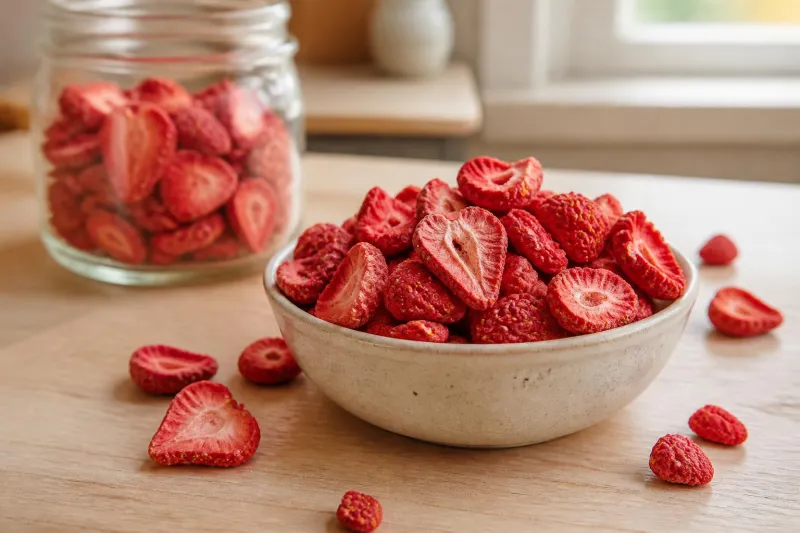
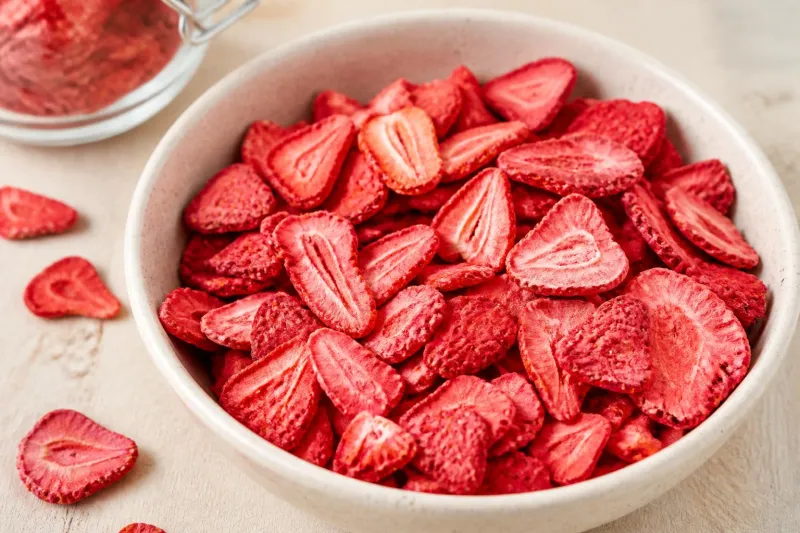
Toppings are a straightforward example. Sprinkling freeze-dried strawberry slices or raspberry pieces over yoghurt bark, iced loaf cake, chocolate bark or the top of a cheesecake gives a cleaner visual finish than stirring powder into the topping and hoping the colour carries. Pieces also work well where you want a final flourish added close to serving, because they keep their shape and stand out.
Folded-in bakes are another strong use. Muffins, cookies, blondies, flapjack-style bakes and quick breads can all benefit from fruit pieces mixed through at the end. In these recipes, a perfectly even pink colour is usually less important than finding proper fruit in the finished bake. Pieces are also helpful when the base mixture is already colourful or strongly flavoured, making powder less visible anyway.
They are often the better option for layered texture. Think about a vanilla traybake with a berry frosting and a scattering of crushed fruit on top, or a plain scone dough with fruit folded through. The fruit gives contrast rather than becoming part of the background. For home bakers, that can be the difference between a bake that looks intentionally fruity and one that simply looks tinted.
Pieces also suit recipes where you want to control distribution by eye. If you are adding 15 grams or 20 grams of fruit to a dough, you can see whether it is evenly folded through. With powder, it is easier to overdo one area or leave streaks unless you mix thoroughly.
There is a practical storage angle too. If you keep a cupboard ingredient for several uses, pieces can be more versatile. The same packet might be used whole as a topping, roughly crushed for folding into biscuit dough, or blitzed into a coarser powder for a streusel. Our ingredient guides on freeze-dried fruit pieces for baking ideas and raspberries in freeze-dried form can help you think through where visible fruit matters most.
That said, pieces are not ideal everywhere. In a very smooth buttercream or macaron shell, larger particles can interrupt the finish. In a thin batter, they may sink or soften unevenly. So the question is not whether pieces are good, but whether the recipe benefits from visible fruit and bite more than from a perfectly smooth result.
When powders are the better choice
Powders are the better choice when smoothness and even distribution matter more than visible fruit. If you want flavour in every mouthful without bits, powder is usually the simpler route.
Cake batters are one of the clearest examples. A few spoonfuls of freeze-dried fruit powder can colour and flavour sponge evenly, especially in plain vanilla-style bases where the fruit note should run through the whole crumb. This is useful when you want a deliberate colour rather than scattered specks.
Buttercreams and icings are another natural fit. Powder blends into softened butter, icing sugar or glaze far more neatly than pieces do. You get fruit flavour without adding the amount of water that fresh fruit purée would bring. Even so, powder is not moisture-free in effect. It thickens mixtures, so you often need to adjust with a little extra liquid after mixing, not before.
Fillings benefit too. Cheesecake mixtures, whipped fillings, meringue-based toppings and sandwich biscuit creams all work better with powder if the goal is a smooth finish. Pieces can drag through the mixture, soften unpredictably or make piping more awkward. Powder avoids that, provided it is fine enough.
Powder is also useful where appearance needs to be tidy and consistent. A strawberry glaze on a loaf cake, a raspberry buttercream piped onto cupcakes, or a pink shortbread dough all become easier when the fruit is in powder form. If you are aiming for delicate piping or a clean slice, powder gives more control.
It is often the better choice in recipes with short mixing times. Because the fruit is already fine, it disperses quickly. Pieces need folding in and can break down unevenly if overmixed. Powder can simply be whisked with the dry ingredients or beaten into the fat and sugar stage, depending on the recipe.
For bakers planning cupboard ingredients, powder can also be convenient when you know exactly what you want from it. If the fruit is there to flavour icing, filling or sponge rather than to provide texture, starting with a powder saves a preparation step. Our guide to freeze-dried fruit powder for baking and icing covers the common uses.
How to adjust a recipe without guessing
The easiest way to swap between pieces and powder is to treat the packet as your first reference and the bowl in front of you as your second. Do not assume that one spoonful of powder equals one spoonful of pieces, or that every brand is milled to the same fineness. Check the ingredient list, the nutrition basis and the pack weight, then make a small, observable adjustment.
Here is an illustrative example.
Say we have a simple cupcake batter that uses:
- 200 grams self-raising flour
- 200 grams caster sugar
- 200 grams butter
- 4 medium eggs
- 30 millilitres milk
- 20 grams freeze-dried strawberry powder
That 20 grams of powder will flavour the batter evenly and give some colour. Because powder absorbs moisture quickly, the batter may thicken slightly after mixing. If it looks stiffer than your usual cupcake batter, add 5 to 10 millilitres milk, mix, and reassess. Stop as soon as the batter drops from the spoon in the way you expect.
Now imagine you only have freeze-dried strawberry pieces. Start by checking the packet size and deciding whether you want visible fruit or a near-powder effect.
If you want visible fruit, use roughly 25 to 35 grams small pieces as a folded-in addition rather than trying to match the powder exactly. Keep the rest of the batter the same at first. Fold the fruit in at the end. Then watch the mixture. If the batter seems normal, bake as usual. If the fruit pieces are very fine and seem to soak up some liquid while the batter stands, you may need an extra 5 millilitres milk. The result will not be the same as the powdered version, and that is the point. You will get a plainer crumb with distinct fruit flecks and pockets.
If instead you want to mimic powder more closely, crush the pieces first and sieve if needed. Then weigh the crushed fruit. Start with less than the original powder quantity if your homemade grind is coarse, perhaps 15 grams, because coarse crumbs can affect texture before they deliver the same strength of flavour. Mix the batter, let it stand for a minute, then judge thickness. If needed, add milk in 5 millilitre steps.
The same logic works in buttercream. Suppose a recipe uses:
- 250 grams unsalted butter
- 500 grams icing sugar
- 15 grams freeze-dried raspberry powder
- 15 to 30 millilitres milk
If swapping powder for pieces, blitz the pieces first. Add 10 grams of your crushed fruit, beat it in, then decide if the flavour and colour are enough before adding more. Coarser fruit can make buttercream look flecked rather than smooth, which may be welcome or not. If using uncrushed pieces, expect a very different finish, more decorative than silky.
The key is not chasing a fixed conversion. Pack density, particle size and fruit type all vary. Use weights in grams, check the actual packet, and make liquid changes in small millilitres steps. That approach is more reliable than any blanket rule.
Labels, allergens and storage checks before you start
Before baking, check the ingredient list carefully. Some freeze-dried fruit products are simply fruit. Others may include added ingredients, especially in blends or flavoured powders. If you are comparing two products, do not rely on the front of pack wording alone. The Food Standards Agency guidance on food allergy and intolerance for consumers is the primary reference here, and it is the right reminder that ingredient and allergen information must be read on the actual label rather than inferred from a product type.
Allergen information matters even when the ingredient sounds simple. A plain fruit powder may still carry a precautionary statement depending on where and how it was packed. That does not tell someone whether a food is personally suitable, but it does tell you what the manufacturer is declaring. In the UK, follow the packet in front of you. If you are reading wider online material, remember that UK labelling rules may be presented differently from EU-wide summaries, so use the actual UK pack as your working document.
Nutrition comparison is another area where readers can be misled if they rush. The NHS guide to reading food labels explains that per 100g and per portion are different comparison bases. That matters with freeze-dried ingredients because a small spoonful of powder and a larger handful of pieces may both come from the same fruit but look very different on the scale. If you compare labels, compare like with like. Per 100g is useful for product-to-product comparison, but your recipe may only use a much smaller amount.
Storage instructions deserve the same attention. Freeze-dried ingredients are valued because they are cupboard-friendly, but they still need careful handling after opening. Moisture is the enemy of crisp texture and free-flowing powder. Once opened, reseal promptly, keep the product dry, and follow the packet instructions. The Food Standards Agency storage guidance supports the broader point that food should be stored according to its instructions to help maintain safety and quality. For practical kitchen handling, our own storage guidance for freeze-dried fruit at home sets out the everyday checks that help pieces stay crisp and powders stay usable.
If you are new to these ingredients and want the basics before choosing between forms, our first steps with freeze-dried ingredients in the kitchen is the best companion guide.
The short version is simple. Choose pieces when you want fruit to be seen and felt. Choose powder when you want it to blend in smoothly and evenly. Then let the packet, the bowl and the texture in front of you guide the final adjustment. That is the most reliable answer to freeze-dried fruit pieces versus powders in baking, and it is the one that works best in a real home kitchen.