How to use freeze-dried vegetables in a UK kitchen
Freeze-dried vegetables are best chosen by intended use, cut size and label details
On this page
Freeze-dried vegetables are useful in a UK kitchen when you want dependable cupboard ingredients that can go straight into cooking, add flavour or colour in small amounts, or stand in for fresh vegetables when texture is not the main event. They are not a perfect substitute for every cooking job, but they are very handy for soups, noodle bowls, savoury baking, dry mixes and quick lunches where a little moisture from stock, sauce or steam will do the work.
At Crispberry, we find it helps to think about them as a texture-led ingredient rather than a miracle replacement. Some pieces are best used dry for crunch or seasoning. Others improve with a short soak, and some need fuller rehydration before they feel at home in a dish. If you are new to the category, our first steps with freeze-dried ingredients and our guide to different freeze-dried vegetables for home cooking give useful background before you start comparing packs.
What freeze-dried vegetables are useful for at home
Freeze-dried vegetables fit best into the part of the cupboard where you keep practical ingredients, not emergency gimmicks. They are useful when you want vegetables on hand without planning a fresh shop around them, and when the dish already includes liquid, steam or fat that can soften them.
Good uses at home include:
- soups, broths and instant-style noodle bowls
- pasta sauces and quick pan sauces
- couscous, bulgur and savoury grain bowls
- savoury scones, muffins and crackers
- breadcrumb coatings and stuffing-style mixes
- seasoning blends, garnishes and savoury toppings
They are often most convincing in dishes where vegetables are not expected to arrive with the same bite as freshly chopped produce. A spoonful of freeze-dried peas stirred into a hot noodle bowl is one thing. Asking a freeze-dried mushroom or pepper piece to behave exactly like a freshly sautéed one is another.
This matters because the drying process changes structure. Once moisture has been removed, the vegetable becomes very light and porous. That is useful in the kitchen because it takes up liquid quickly, but it also means texture can move from crisp to soft quite fast. In a soup, that is often exactly what you want. In a salad, usually not.
They are also useful for small-quantity cooking. If you live alone, cook for two, or like to keep backup ingredients for days when the fridge is sparse, a packet can be more practical than opening a whole bag of fresh vegetables for one bowl of lunch. That is convenience, not a nutritional claim.
For adult home cooks in the UK, this is where the phrase “freeze dried vegetables UK” tends to come up naturally, not as a trend but as a cupboard planning question. Which vegetables are easy to keep, easy to portion, and easy to use in ordinary British home cooking? The answer is usually the simpler ones first, peas, sweetcorn, onion, leek, carrot, herbs and mixed soup vegetables.
How to choose the right pack
The best pack for your kitchen depends on what you want the vegetable to do. Start with the ingredient list. If you want a straightforward cooking ingredient, a short list is usually easier to work with. That might mean a single vegetable on its own, or a simple mix with no added flavourings. If salt, sugar, starches, anti-caking agents or seasonings are included, that is not automatically a problem, but it changes how the pack behaves in recipes and how you compare it with another product.
When reading UK labels, compare like with like. The NHS explains that per 100g figures are useful for comparing foods, but they are not the same as a serving, and the packet may define portions differently or not at all NHS guidance on reading food labels. This matters even more with freeze-dried ingredients because they are very light. A per 100g panel can look striking simply because 100 grams of a dry ingredient is a large amount in practical kitchen terms.
Check these points on the label:
- ingredient list
- allergen declaration
- nutrition panel basis, usually per 100g and sometimes per portion
- whether the pack contains one vegetable or a mix
- cut size, if shown
- any preparation advice, such as soak first or add directly to hot liquid
The Food Standards Agency advises consumers to read ingredient and allergen information carefully, especially if allergies or intolerances are relevant Food Standards Agency allergy guidance. In the UK, allergens should be emphasised in the ingredients list when present, but that does not mean every product suits every person. “May contain” information and factory handling notes still matter.
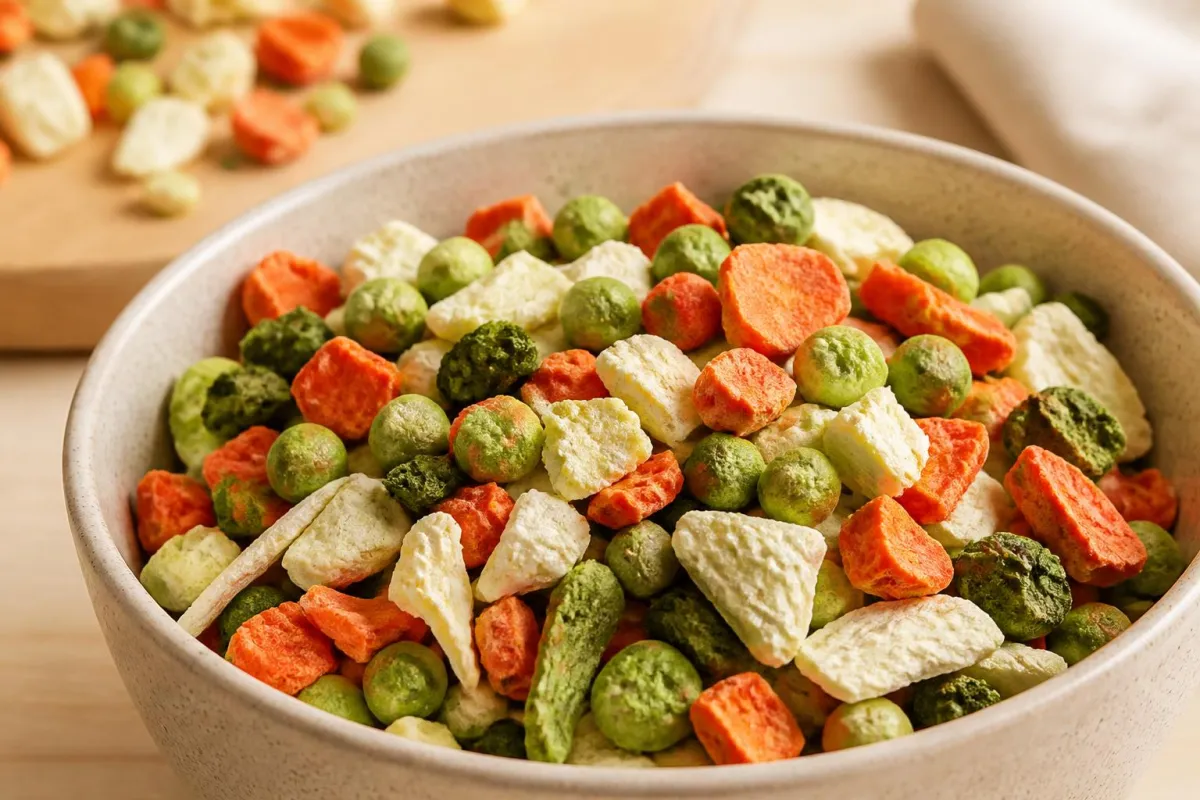
Cut size is more important than many people expect. Fine flakes disappear into doughs, coatings and seasoning blends more easily. Larger cubes or slices suit soups and noodle dishes better. Powdered or crumb-like vegetables can be useful in savoury baking or dry rubs, but they will not give visible pieces in the finished dish.
Mixed packs are convenient if you want one packet for soup or couscous-style lunches. Single vegetables are usually easier if you bake, make your own blends, or want control over flavour. If you know you use peas often, for example, a single-ingredient pack is easier to portion than a mixed vegetable blend. Our page on using freeze-dried peas in everyday cooking is a good example of how one vegetable can serve several different kitchen jobs.
Where UK and EU rules differ in detail, rely on the actual UK label in front of you rather than assuming an EU-wide convention applies unchanged. For home use, the practical point is simple: read the packet you bought, not a generic online description of the category.
When to use them dry, soaked or fully rehydrated
The main decision is about moisture. Texture changes fast once freeze-dried vegetables meet water, stock, sauce or steam, so choose the method that matches the role in the dish.
Use them dry when you want light crunch, quick flavour release, or a small amount dispersed through another ingredient. Examples include:
- sprinkling vegetable flakes over soup just before serving
- adding fine pieces to breadcrumb coatings
- stirring powdered or crushed vegetables into savoury biscuit dough
- mixing flakes into instant noodle cups or dry couscous pots before adding boiling water
Dry use works best with smaller pieces and with vegetables that taste good even when only partly softened. It is less successful when the pieces are large or when you want them to resemble cooked fresh vegetables.
Use a brief soak when you want the pieces softened but not fully swollen before they go into the pan or bowl. A short soak in warm water for a few minutes can help in:
- quick noodle dishes
- couscous-style bowls
- fillings for wraps or savoury muffins
- pan sauces where you do not want the vegetables to pull too much liquid from the sauce itself
A brief soak is also useful when you want to control salt or flavour concentration in a dish. If the vegetables go in completely dry, they absorb from the surrounding liquid, which can slightly change the texture of the sauce or broth.
Use fuller rehydration when the vegetables need to behave more like an ingredient in their own right. That is often the case for:
- thicker soups where visible vegetable pieces matter
- savoury scone or bread doughs that would otherwise lose moisture
- stuffing-style mixtures
- baked egg dishes or vegetable bakes
There is no universal soaking time that fits every pack. Piece size, vegetable type and the end use all matter. Treat any quantity here as illustrative, not fixed. For example, if you soak 10 grams of mixed vegetable pieces in 60 to 100 millilitres of warm water, you may get something suitable for folding into a batter, but the actual packet may need a different approach.
One practical rule helps. If the surrounding dish contains plenty of free liquid, soup, broth, a loose sauce, then adding the vegetables dry is often fine. If the dish is relatively dry, dough, crumbs, stuffing, a thick filling, pre-soak first so they do not draw moisture from the mixture unevenly.
Practical ways to cook with them
In soups, freeze-dried vegetables are at their easiest. Stir them into stock early enough to soften, then judge whether the soup needs more liquid before serving. Fine mixed vegetables can disappear into a blended soup, while larger pieces suit brothy soups where you want visible bits in the bowl.
For noodle dishes, think in layers. Dry vegetables can go into the bowl first, then noodles, then boiling water or hot stock. Cover and let the steam work. If the pieces are large, a short soak before assembly gives a more even result. This is especially useful for office lunches or quick suppers where you want minimal washing up.
In couscous-style bowls, add the vegetables to the dry grains before pouring over boiling liquid. They will soften along with the couscous. If you are adding ingredients that do not release much moisture, such as toasted seeds or crumbled cheese, check the texture before serving and add a little extra hot water if needed.
In savoury baking, use restraint. Freeze-dried vegetables can be excellent in scones, muffins, crackers and soda bread style mixes, but too much can make the crumb patchy or thirsty. Fine flakes or crushed pieces are usually easier than large chunks. Pre-soaked vegetables suit softer batters. Dry flakes suit crisp bakes where a little colour and savoury flavour are enough.
Breadcrumbs and crumb coatings are another strong use. Crushed freeze-dried onion, leek or herb-heavy vegetable mixes can be stirred through breadcrumbs for topping pasta bakes, coating chicken or fish alternatives, or finishing stuffed mushrooms. Keep the vegetable component fairly fine so it toasts rather than catches.
Seasoning blends are worth considering too. If the vegetables crush easily between your fingers or in a spice grinder, they can be mixed with salt, pepper, dried herbs or seeds for savoury finishing blends. That is particularly useful for soups, buttered toast, roasted potatoes or popcorn. If you also use fruit powders in baking, the same dry-mixing logic applies in sweet kitchens, and our guides to freeze-dried fruit powder for baking and finishing show how moisture changes behaviour there as well.
A final practical point, distinct from a recipe. Add freeze-dried vegetables in stages when you are learning a new pack. Start with less than you think you need, let the texture settle, then add more next time. Because the pieces are light and concentrated in volume, it is easy to overshoot.
How to store opened packs well
Once opened, freeze-dried vegetables need protection from moisture more than almost anything else. Their crisp, dry structure is what makes them useful, and kitchen steam can undo that quickly.
After opening:
- reseal the pack promptly if it has a good closure
- if not, transfer to a dry, airtight container
- keep the container away from the cooker, kettle and dishwasher
- use a dry spoon, not damp fingers
- do not leave the packet open while a pan boils beside it
- follow any storage instructions printed on the packet
The Food Standards Agency’s food storage guidance is general rather than freeze-dried specific, but the principle is still relevant, store food appropriately and follow product instructions Food Standards Agency storage guidance. For freeze-dried ingredients, the practical risk is usually loss of quality first, softening, clumping, stale flavour, before you notice anything else.
Avoid transferring them into containers that have any residual moisture from washing. “Air dry” can still mean not fully dry. If you are using glass jars, let them dry completely before filling.
Do not assume every opened pack will last the same length of time. Packet material, home humidity, how often you open it, and whether you introduce steam all make a difference. That is why we do not give a fixed shelf life for every opened pack. The packet instructions come first.
If a pack has visibly softened, clumped heavily or picked up kitchen odours, it may still tell you something useful about your storage habits even if the food is not obviously unsafe. Next time, decant faster, seal faster and keep it farther from steam.
What labels can and cannot tell you
Labels are useful, but they do not answer every kitchen question on their own.
They can tell you what is in the pack, which allergens are declared, and the nutrition information basis used for comparison. The NHS is clear that per 100g figures help compare foods, but they are not the same as what you are likely to eat in one go NHS guidance on reading food labels. With freeze-dried vegetables, this distinction matters a lot because dry weight can look deceptively intense on paper.
Labels cannot tell you exactly how a vegetable will feel in your soup, batter or noodle bowl. They also cannot tell you whether a mixed pack suits your own cooking style better than separate single-vegetable packs. That is a kitchen judgement.
A short ingredient list can be useful, but it does not automatically make a pack nutritionally complete, nor does it mean every dish made with it is balanced. The NHS Eatwell Guide looks at dietary balance across a day or week, not in every single ingredient or snack NHS Eatwell Guide. So it is sensible to treat freeze-dried vegetables as one ingredient among many, not as a shortcut to judging the whole meal.
They also cannot settle portion size for you. Some packets give serving suggestions, some do not, and the right amount depends on whether you are making a garnish, a soup base, a dough addition or a dry seasoning. That is why we recommend checking the actual packet and using your dish as the guide.
Finally, labels cannot replace allergy judgement. Even with clear UK allergen rules, personal suitability depends on the individual, and the Food Standards Agency guidance is the right starting point for understanding what label information does and does not cover Food Standards Agency allergy guidance.
Used well, freeze-dried vegetables earn their place in a UK kitchen because they solve practical cooking problems. They help when you need cupboard flexibility, quick assembly and small, controllable amounts. Choose the pack for the job, pay attention to moisture, and let the label inform your decision without expecting it to do all the cooking for you.