Simple baking ideas when your cupboard is running low
Fewer-ingredient baking works best when each ingredient has a clear job.

On this page
- What counts as a few-ingredient bake
- How to keep simple recipes from turning dry or heavy
- Where freeze-dried fruit fits into easy baking
- Easy bake formats that suit a short ingredient list
- Traybakes
- Loaf cakes
- Muffins
- Scones and drop scones
- Shortbread and simple biscuits
- Crumbles and baked fruit toppings
- What to check on labels, storage and allergens
When the cupboard is looking bare, the easiest baking usually comes from recipes built around one dry ingredient, one fat, and one sweetener, with eggs or milk added only if the texture needs help. That means shortbread, simple flapjacks, traybakes, drop scones, loaf cakes and basic muffins are often more realistic than anything layered, filled or heavily decorated. If you are searching for easy baking recipes with few ingredients in the UK, the useful question is not whether a bake has exactly three items. It is whether you can make it well from ordinary cupboard staples without needing a special trip to the shops.
At Crispberry, we find that simple baking works best when you know which ingredients do the real structural work, and which ones are there mainly for flavour. That matters even more if you want to add freeze-dried fruit, because it can bring colour and flavour without introducing the extra moisture that fresh fruit often does.
What counts as a few-ingredient bake
In a home kitchen, a few-ingredient bake usually means five to seven ingredients, not counting a pinch of salt or a little water. That is a practical definition rather than a strict rule, but it reflects how most UK cupboards are stocked. If you already have self-raising flour, plain flour, caster sugar or soft brown sugar, butter or baking spread, oats, eggs, and some form of milk, you can make a surprising number of bakes.
The most useful staples are these:
- Flour, either plain or self-raising
- Sugar, white or brown depending on the bake
- Butter, baking spread, or oil
- Eggs
- Rolled oats
- Milk
- Baking powder, if you do not rely on self-raising flour
- Salt
- A flavour ingredient such as cocoa, lemon zest, jam, or freeze-dried fruit
A few-ingredient bake does not have to be plain. It just needs to avoid recipes where each extra ingredient solves a problem created by the previous one. For example, a sponge with buttercream, fresh fruit filling and glaze is not really a low-effort cupboard bake, even if each component is simple on its own.
It also helps to think in terms of swap-friendly formulas. A basic biscuit dough might be 200 grams flour, 100 grams butter and 75 grams sugar. A simple flapjack might be oats, butter, sugar and syrup. A basic muffin batter might use self-raising flour, sugar, eggs, fat and milk, with one extra flavour ingredient folded through. These are the kinds of bakes that forgive minor changes.
In UK kitchens, self-raising flour is especially useful because it removes the need to balance plain flour with baking powder. If you only have plain flour, you can still bake, but recipes that do not depend on much lift, such as shortbread, oat bars and some traybakes, become the safer choice.
The other staple that matters more than people expect is fat. Butter gives flavour, but any recipe with very few ingredients depends on fat for tenderness as well. If you reduce it too far, the bake often turns dry, sandy or tough. That is why truly simple baking is often richer than people first assume.
For readers new to freeze-dried ingredients, our first steps with freeze-dried fruit guide explains the basics of what they are and how they behave in home baking.
How to keep simple recipes from turning dry or heavy
Low-ingredient baking goes wrong in fairly predictable ways. Dryness usually comes from too much flour or oats for the amount of fat and liquid available. Heaviness usually comes from overmixing, old raising agents, or trying to stretch a mixture too far.
The first safeguard is accurate measuring. In a simple recipe, being 25 grams out on flour matters. So does guessing milk by eye and adding too little. If a batter looks thick enough to stand in stiff lumps, but the recipe expects a soft dropping consistency, the finished bake is likely to be dense. If you need to adjust, do it gradually, in 10 to 15 millilitres of milk at a time.
The second safeguard is understanding what the flour is meant to do. In biscuits and shortbread, you want just enough mixing to bring the dough together. Too much handling develops gluten and makes the result harder. In muffins and quick loaf cakes, a few streaks of flour are better than aggressive beating. Once flour and liquid meet, overmixing is the fast route to a heavy crumb.
A few practical fixes help:
- If a batter seems stiff, add a small amount of milk rather than extra egg unless the recipe is designed around eggs.
- If a dough is crumbly, let it sit for a few minutes before adding more liquid. Flour and oats need time to absorb moisture.
- If using cocoa or fruit powder, remember they absorb moisture too. You may need a little extra liquid.
- If using whole oats in a traybake, check that the syrup or melted butter has coated them thoroughly before baking.
- If your self-raising flour or baking powder has been in the cupboard for a long time, choose a flatter bake rather than one that depends on a strong rise.
Oven temperature matters more than people think. A bake cooked too hot can brown outside before the centre has set, which often leads to overbaking while you wait for the middle. A bake cooked too cool may dry out before it colours properly. If your oven runs unevenly, traybakes, bars and loaf tins are usually more forgiving than cupcakes.
Moisture-retaining ingredients also help. Brown sugar, golden syrup, honey, yoghurt and fruit purée can all soften texture, though each changes flavour and structure. In very simple recipes, one substitution can alter the result quite a lot, so it is usually better to make one change at a time.
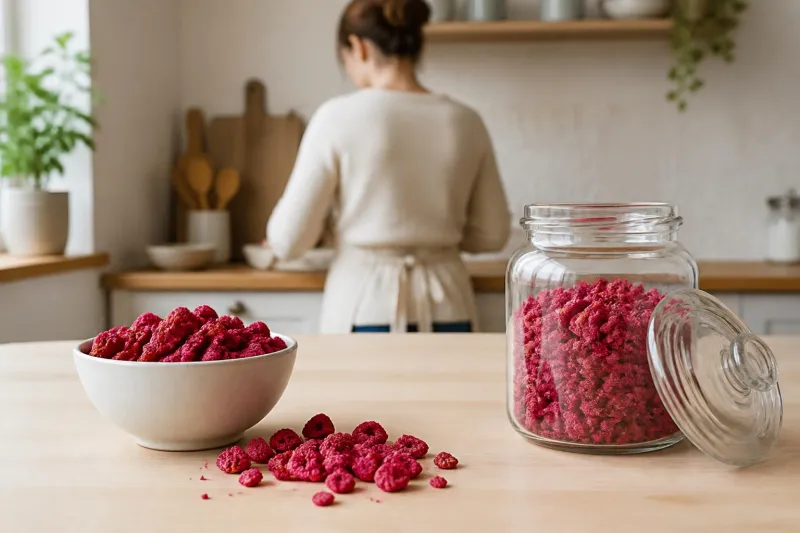
Freeze-dried fruit can support texture when used carefully. Crushed pieces folded into scone or muffin batter tend to behave better than large chunks, because they distribute more evenly. Fine fruit powders are stronger still, but they act a little like an extra dry ingredient. If you add them generously, plan for a touch more liquid. We cover that in more detail in our guide on how to bake with freeze-dried raspberries without soggy results.
Where freeze-dried fruit fits into easy baking
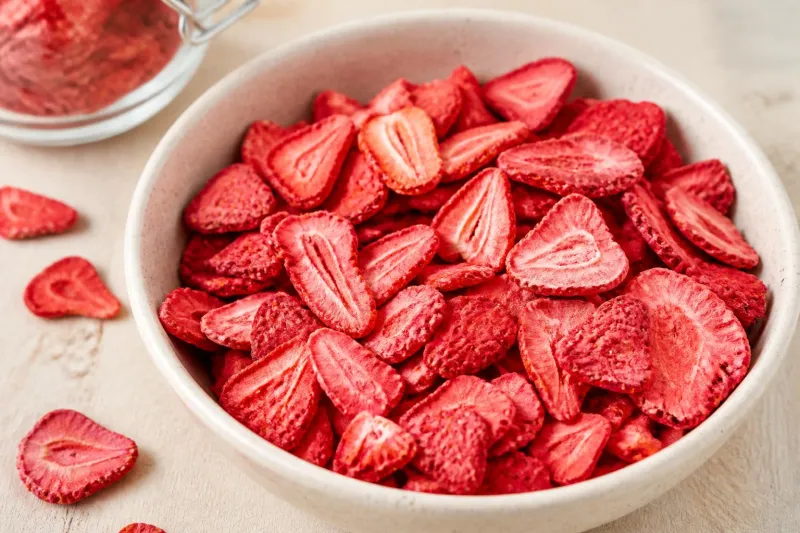
Freeze-dried fruit is useful in simple baking because it adds flavour without bringing the water content of fresh fruit. That makes it especially handy when your aim is a straightforward cupboard bake rather than a recipe that needs extra draining, coating or reduced cooking time.
The easiest ways to use it are:
- Crushed into biscuit or shortbread dough
- Folded into muffin or scone batter
- Stirred through flapjack mixtures
- Mixed into icing or buttercream
- Sprinkled on top after baking
- Ground into a powder and added to cake batter in small amounts
For a simple example, if you are making a plain muffin batter with 250 grams self-raising flour, 100 grams sugar, 2 eggs, 80 millilitres oil and about 150 millilitres milk, you might fold in a small handful of crushed freeze-dried strawberries or raspberries near the end. That keeps the method simple and avoids the wet pockets that fresh fruit can create.
The same principle works in biscuits. A plain vanilla biscuit dough can take a spoonful or two of fruit powder, but once you start replacing too much flour with powder, the dough may become fragile or dry. With low-ingredient baking, small additions are usually more reliable than bold ones.
Freeze-dried fruit is also useful when the cupboard is short on fresh flavourings. If you have no lemons, no fresh berries and no cocoa, a packet of freeze-dried fruit can stop a basic sponge or icing from tasting flat. That does not mean every bake needs it. It means the ingredient earns its place because it keeps the method simple.
Storage matters too. Freeze-dried ingredients absorb moisture from the air quickly, so it helps to open them only when the rest of your ingredients are ready. Reseal the packet promptly, or transfer leftovers to an airtight container if the original pack does not reseal well. If you want practical ways to use partial packets sensibly, our guide on how to use freeze-dried fruit without wasting it is a good next read.
Easy bake formats that suit a short ingredient list
Some bake formats are simply more forgiving than others. When ingredients are limited, choose shapes and methods that do not rely on perfect aeration, exact decoration, or multiple stages.
Traybakes
Traybakes are one of the best cupboard options because they bake evenly, cut easily, and tolerate simple mixtures. Flapjacks, oat bars and basic sponge traybakes all work well here. If you are low on eggs, flapjack-style bakes are especially useful because they often rely on fat and syrup rather than egg structure.
Loaf cakes
A loaf tin is ideal for simple mixtures because the shape supports the batter while it rises. A plain yoghurt loaf, banana loaf, or lightly fruited cake all fit the format well. The key is not to overload the batter with extras. With a short ingredient list, restraint usually gives a better crumb.
Muffins
Muffins are fast and flexible, particularly if you have self-raising flour. They also suit small additions of freeze-dried fruit well. The main risk is overmixing. Stir only until combined, then stop. If you keep them plain on top rather than trying to add a crumble or glaze, they stay firmly in the easy category.
Scones and drop scones
These are excellent when you have flour, milk and a little fat but not much else. Traditional scones need a light hand and enough heat to rise quickly. Drop scones, which use a softer batter spooned or ladled onto a pan or tray depending on the recipe, can be even easier because shaping is minimal.
Shortbread and simple biscuits
Few-ingredient baking is often at its best here. Flour, butter and sugar can take you a long way. These bakes also suit small amounts of flavouring well, whether that is citrus zest, vanilla, cocoa or crushed freeze-dried fruit. Because they do not depend on much rise, they are a good choice if your raising agents are old or absent.
Crumbles and baked fruit toppings
Strictly speaking, not every reader will count these as baking in the cake-tin sense, but they are practical, low-stress desserts when supplies are limited. A crumble topping can be made from flour, butter and sugar, with oats if available. If you have tinned fruit in the cupboard, this becomes an easy option.
What makes these formats useful is not just simplicity. It is tolerance. A forgiving bake can handle minor measuring variation, a modest substitution, or a less-than-perfect oven. That is exactly what you want when working from what is already in the cupboard.
If you want more format ideas, we keep a broader collection of simple baking recipes and ingredient ideas for home use.
What to check on labels, storage and allergens
When you are baking from packaged ingredients, the packet matters almost as much as the recipe. Start with the ingredient list, then the allergen information, then the storage guidance.
For allergens, UK rules require clear declaration of specified allergens on prepacked food labels. That is the practical baseline, but it does not remove the need to read each packet every time, especially if you have changed brand or bought a product in a different size. The Food Standards Agency’s consumer guidance is the right reference point here, particularly for understanding why ingredient and allergen information must be checked on the actual product rather than assumed from memory or from a similar item: Food Standards Agency consumer allergy guidance.
If you use freeze-dried fruit blends or fruit powders, check whether the packet contains only fruit or whether anti-caking agents, carriers or other ingredients have been added. For straightforward home baking, that can affect both flavour and how the ingredient behaves in a batter or icing.
Nutrition labels are also easy to misread. The NHS points out that per 100g and per portion are different bases for comparison, and the packet should make clear which one you are looking at. That matters if you are comparing one fruit powder or baking ingredient with another, or trying to understand what a suggested serving on pack actually means: NHS food labels guidance.
Storage guidance is worth following closely with dry baking ingredients. Flour, oats and sugar are usually straightforward, but nuts, seeds, dried fruit and freeze-dried ingredients can all deteriorate faster if left warm, damp or exposed to air. The Food Standards Agency’s general storage advice is aimed at food safety and good handling, and the principle is simple, follow the pack instructions and store foods appropriately once opened: Food Standards Agency storage guidance.
A few practical checks help in everyday baking:
- Look at the best before date on flour and raising agents if a bake seems unexpectedly flat or stale tasting.
- Check whether a fruit powder is pure fruit or a blend.
- Read allergen wording on every new packet, even if the ingredient seems obvious.
- Keep opened freeze-dried ingredients sealed and dry.
- Do not assume an imported product follows identical presentation to a UK-labelled equivalent.
Where UK practice differs from EU-wide general expectations, the key point for home bakers is labelling and market placement. A product sold in the UK should meet UK food labelling requirements, and presentation can differ from EU packaging even when the ingredient seems similar. For ordinary home use, that means relying on the actual UK pack in your hand, not on a photo, old memory, or a general description online.
Simple baking is easier when the ingredient list is short, but it is safest and more reliable when the labels are read properly. That is especially true with concentrated ingredients such as freeze-dried fruit and powders, where small amounts can make a noticeable difference to flavour, texture and handling.
A low-stock cupboard does not rule out good baking. It just rewards the bakes that are structurally simple, carefully measured, and realistic about what each ingredient is doing. If you keep a few dependable staples, understand how moisture and mixing affect texture, and use freeze-dried ingredients thoughtfully, you can make straightforward bakes that feel intentional rather than improvised.