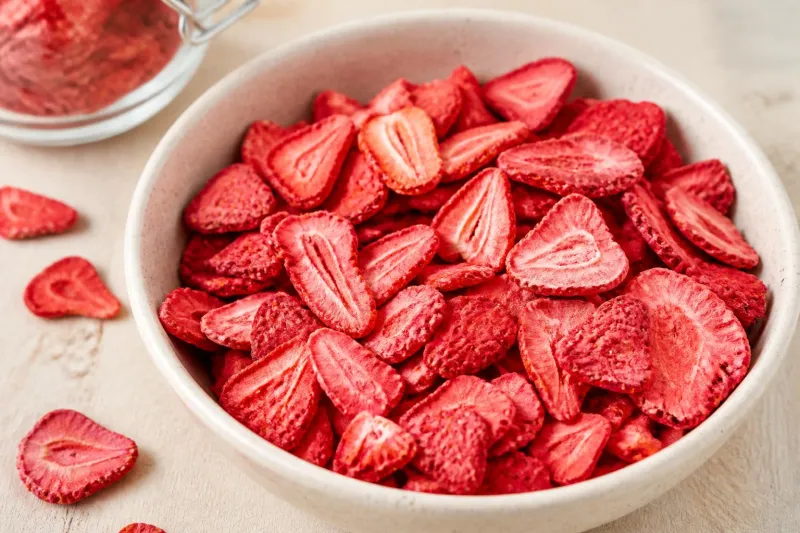
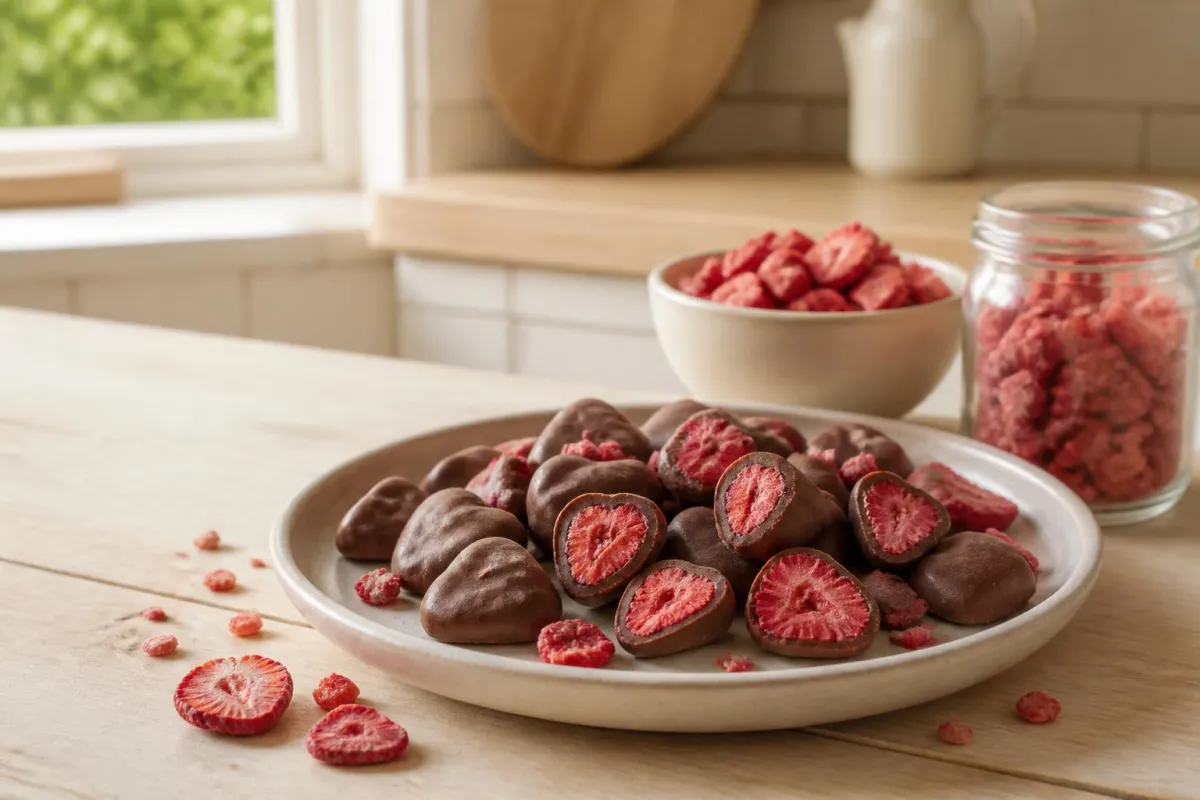
Chocolate-covered freeze-dried strawberries at home
freeze-dried strawberries stay crisp only if moisture is kept low
On this page
- What works well when combining freeze-dried strawberries with chocolate
- How to choose the strawberries and the chocolate
- Whole strawberries
- Slices and pieces
- Crumbs and crushed fruit
- Strawberry powder
- Matching fruit with dark, milk or white chocolate
- Compound coating or chocolate
- How to stop the fruit going soft or sticky
- Condensation is a common problem
- Steam from melting chocolate
- Warm kitchens and slow setting
- Quick handling matters
- Where softness is acceptable
- Simple ways to use them in baking and desserts
- Chocolate bark
- Traybake topping
- Cookie finish
- Cheesecake or dessert topping
- Fillings and frostings
- Truffle or cluster coating
- Labels, allergens and storage checks before you use them
- Allergen reading matters
- Check storage instructions, not assumptions
- Per 100g is not the same as a portion
- Keep perspective on how they fit into eating patterns
Chocolate-covered freeze-dried strawberries work very well at home, provided you treat them as a dry, crisp ingredient that dislikes moisture. The fruit brings sharp strawberry flavour and a light crunch, while the chocolate adds richness and a clean snap once set. That contrast is exactly why so many home bakers use them for bark, traybakes, cookie toppings and quick desserts.
The main point to remember is simple. Freeze-dried strawberries stay crisp only while they stay dry. Steam from a bain-marie, condensation from a cold bowl, or a warm kitchen where chocolate takes too long to set can make them soften or turn sticky quite quickly. If you handle them fast, add them at the right stage, and store the finished food properly, they are straightforward to use.
What works well when combining freeze-dried strawberries with chocolate
The appeal of strawberries and chocolate is already familiar, but freeze-dried fruit changes the texture in a useful way. Fresh strawberries release juice, which can seize melted chocolate, streak it, or shorten the life of a finished bake. Freeze-dried pieces bring the fruit flavour without adding free water, so they are much easier to fold through a topping, scatter over bark, or press into a chocolate coating.
That crispness matters. Whole or sliced freeze-dried strawberries tend to sit on the surface of set chocolate rather than sinking into it, especially if you add them just after spreading the chocolate. They also keep their shape better than fresh fruit in no-bake toppings and decorative finishes. If you crush them, they give a brighter colour and a more even distribution through white or milk chocolate.
Texture is the other reason the pairing is popular. Set chocolate is dense and smooth. Freeze-dried fruit is brittle and airy. Together they create contrast without much effort. This is particularly useful in home baking where you want something that looks finished with very little last-minute work.
For general background on formats and uses, our guides to freeze-dried strawberries for baking, snacking and breakfasts and different freeze-dried fruit formats are a good starting point.
How to choose the strawberries and the chocolate
The best format depends on where the strawberries will sit and how much crunch you want.
Whole strawberries
Whole pieces are the most dramatic visually. They suit chocolate bark, dipped clusters, dessert garnish and gift-style treats. Choose them when appearance matters and when you can place them by hand. Because they are larger, they are also more likely to soften on the outside first if left in a humid room, so they reward quick handling.
Slices and pieces
Slices are usually the easiest all-round choice for home use. They scatter neatly over melted chocolate, fit more easily on cookies and traybakes, and are simpler to portion. Small pieces also cling better to chocolate coatings because they have more contact points. If you want obvious fruit in every bite without large lumps, slices are often the most practical option.
Crumbs and crushed fruit
Crushed freeze-dried strawberries are useful when you want coverage rather than decoration. They work well around the edges of truffles, over cheesecake topping, or stirred through melted white chocolate for a speckled finish. Crush only what you need. Once broken down, the fruit has more exposed surface area and tends to pick up moisture faster.
Strawberry powder
Powder behaves differently again. It is best for flavouring and colouring fillings, icings and coatings rather than for crunch. Stirred into white chocolate, buttercream or cream cheese frosting, it gives an even strawberry note without visible pieces. It is also the easiest way to avoid sharp fragments in a smooth filling. For readers comparing formats, our pages on strawberry powder for baking and desserts and freeze-dried strawberries as an ingredient guide explain where each form is most useful.
Matching fruit with dark, milk or white chocolate
Dark chocolate gives the clearest contrast. Its bitterness balances the sweetness of the fruit, and the red colour stands out well against a dark background. Use it for bark, dipped clusters and toppings where you want the strawberry pieces to stay visually distinct.
Milk chocolate is softer in flavour and sweeter. It usually suits sliced pieces better than powder, because the fruit’s sharpness helps cut through the sweetness. For family-style traybakes and cookie toppings, this is often the most familiar pairing.
White chocolate makes the strongest visual effect with freeze-dried strawberries, especially crushed pieces or powder. It is very sweet, so the fruit helps stop it tasting flat. White chocolate is often the easiest base for a pink finish if you want a decorative drizzle or filling. The practical catch is that white chocolate can scorch more easily when melted, so gentle heat and short working times matter.
Compound coating or chocolate
If you are making casual bark or a topping for a traybake, some home cooks use compound coating because it sets quickly and can be easier to handle. If you are using real chocolate, tempering gives a firmer, glossier finish, but many home projects manage perfectly well with carefully melted chocolate that is chilled briefly to set. In either case, the strawberries should go on while the surface is still tacky enough to hold them.
How to stop the fruit going soft or sticky
Moisture is the main issue with freeze-dried strawberries in chocolate. The fruit is dry and porous, so it absorbs water from the air very readily. Once that happens, the crisp texture fades.
Condensation is a common problem
If strawberries or bowls are cold, and you bring them into a warmer kitchen, moisture can condense on the surface. That tiny amount is enough to soften delicate fruit pieces. The same problem can happen if you move finished chocolate straight from the fridge into a warm room and leave it uncovered.
A simple habit helps. Keep the fruit sealed until the rest of your preparation is ready. Open the packet only when the chocolate is melted, the tray is lined, and you are ready to scatter or dip.
Steam from melting chocolate
Steam is another easy way to spoil texture. If you melt chocolate over simmering water, make sure no steam escapes around the bowl and no droplets get into the chocolate or onto the fruit. A bowl that sits too low over the pan can collect moisture underneath, which then transfers to your hands, spoon or work surface.
Microwave melting in short bursts can be easier for small quantities because it avoids steam altogether. Whatever method you use, dry utensils matter.
Warm kitchens and slow setting
On a hot day, chocolate stays fluid for longer. That gives the fruit more time to absorb humidity from the room and from the chocolate surface. It can also mean that pieces slide, bleed colour slightly, or lose crispness before the chocolate has fully set.
In warm conditions, work in smaller batches. Spread one tray of bark, top it, and move it to a cool room before starting the next. If you chill chocolate to set it, keep that stage brief and then transfer the finished pieces to an airtight container once firm. The Food Standards Agency advises following product instructions for storage and handling, which is particularly relevant for finished foods that include dairy fillings or other perishable ingredients (Food Standards Agency guidance).
Quick handling matters
Quick handling is not about rushing for the sake of it. It is about reducing the time the fruit spends exposed to humid air. A practical order is:
- Prepare tray, tin or dessert first.
- Melt or temper the chocolate.
- Open the fruit packet.
- Add the strawberries immediately.
- Seal any leftovers straight away.
If you are decorating several items, pour a small amount of fruit into a dry ramekin and keep the main packet closed.
Where softness is acceptable
Not every use needs crunch. If you are folding strawberry powder into ganache, mousse topping or frosting, a crisp texture is not the goal. In those cases, a little softening is not a problem. The real issue is when you expect a crunchy finish on bark, cookies or dipped pieces and the fruit has already started absorbing moisture before serving.
Simple ways to use them in baking and desserts
These are idea prompts rather than tested recipes. Quantities, baking times and storage will depend on the rest of the ingredients.
Chocolate bark
Spread melted dark, milk or white chocolate on lined baking paper. Scatter sliced or crushed freeze-dried strawberries over the top, then add extras such as pistachios, toasted coconut or biscuit crumbs if wanted. Press lightly so the fruit adheres. This is one of the easiest ways to keep the strawberry pieces visible and crisp.
Traybake topping
For brownies, blondies or rocky-road style traybakes, let the base cool first, then add a layer or drizzle of melted chocolate and finish with strawberry slices. This keeps the fruit away from oven moisture. If the traybake itself is quite sticky on top, use the chocolate as a barrier layer rather than pushing the fruit directly into the bake.
Cookie finish
Press a few small pieces of freeze-dried strawberry into cookies as soon as they come out of the oven, or add them onto a chocolate drizzle after baking. Putting the fruit on before baking can work, but the oven’s heat and steam may soften it. For a cleaner texture, post-bake decoration is usually better.
Cheesecake or dessert topping
Use crushed strawberries over a chilled cheesecake, mousse pot or chocolate tart shortly before serving. If the dessert surface is wet, for example a glossy fruit topping or very soft cream, add the freeze-dried fruit at the last moment so it stays crisp.
Fillings and frostings
Blend strawberry powder into buttercream, whipped ganache or cream cheese frosting for colour and flavour without extra liquid. Add a little at a time and check the texture. Powder can thicken mixtures slightly, so it is easier to build up gradually than to correct an over-dosed filling.
Truffle or cluster coating
Roll soft truffles or chocolate clusters in crushed freeze-dried strawberries for a bright outer layer. This works best if the coating is added close to serving or if the finished sweets are stored very well sealed, because the exposed fruit can soften faster than fruit embedded in a solid chocolate surface.
Labels, allergens and storage checks before you use them
Before using any packet of freeze-dried fruit or chocolate, read the label in full. That includes the ingredient list, allergen information, storage instructions and any advice about using the contents promptly after opening.
Allergen reading matters
Chocolate products can contain or be made in environments that handle milk, nuts, peanuts, soya or gluten, and dessert add-ins vary widely. Freeze-dried strawberries themselves may be a single-ingredient product, but you should not assume that every packet is suitable for every household. The Food Standards Agency’s consumer guidance is clear that ingredient and allergen information matters, and that people should use the label to assess suitability rather than making assumptions from the product type alone (Food Standards Agency allergy guidance).
Where rules differ, the practical point for UK readers is to follow the label on the product sold here. UK food labelling broadly follows familiar allergen declaration principles, but details can differ from the EU generally after regulatory changes, so the on-pack UK information is the one to use for your kitchen.
Check storage instructions, not assumptions
Some packets simply say store in a cool, dry place. Others add instructions such as reseal immediately after opening or use within a stated period once opened. Follow the actual packet. Freeze-dried ingredients are particularly sensitive to moisture exposure after opening, so the maker’s storage wording matters more than general habit.
The same goes for chocolate. A bar intended for eating and a chocolate chip product intended for baking may behave differently when melted or stored. Read both labels before combining them.
Per 100g is not the same as a portion
Nutrition panels can be useful for comparing products, but only if you compare like with like. The NHS explains that per 100g information is designed to help compare foods, while a portion is a separate basis and the two should not be confused (NHS food label guidance).
This matters with freeze-dried fruit because it is very light. A small handful may weigh far fewer grams than it looks, while a decorative sprinkle on bark may be smaller still. If one packet gives values per 100g and another also gives values per portion, do not assume the portion is standard across brands. Check the actual weight in grams for the portion stated on that packet.
An illustrative example only, not a standard serving, shows why. If a packet lists nutrition per 100g and says a suggested portion is 8 grams, you would need to scale from 100g to 8 grams to understand that portion. Another packet might use a different portion size altogether. Compare the weights before comparing the numbers.
Keep perspective on how they fit into eating patterns
Chocolate-covered freeze-dried strawberries are best treated as an ingredient or snack component, not as a shortcut to broad diet claims. The NHS Eatwell Guide discusses overall balance across a day or week rather than expecting every individual food to do everything at once (NHS Eatwell Guide). For our purposes, the practical takeaway is simply to read labels accurately and use the ingredient in the way that suits your baking and snacking plans.
For adult home cooks, the combination is easy to manage once you respect the dry texture. Choose the right strawberry format, match it to the chocolate and the job, keep moisture away, and check the packet before you start. At Crispberry, published by Fleeta Limited, that is the approach we recommend throughout our ingredient guides: simple handling, clear label reading, and realistic expectations of how freeze-dried ingredients behave in a British home kitchen.