How to bake with freeze-dried raspberries without soggy results
freeze-dried raspberries add flavour and colour with very little moisture
On this page
Freeze-dried raspberries are one of the easiest ways to add raspberry flavour to bakes without introducing the extra water that fresh or frozen fruit brings. That is the main reason they help you avoid soggy streaks, collapsed sponge pockets and wet biscuit centres. Used well, they give a sharper berry taste, stronger pink colour and a cleaner texture because they contribute fruit solids more than fruit juice.
For baking, the key is choosing the right form and adding it at the right stage. Larger pieces give bursts of fruit, crumbs disperse more evenly, and powder colours and flavours mixtures with almost no visible pieces. If you treat them like a dry ingredient rather than a direct swap for fresh fruit, you will usually get a better result.
What freeze-dried raspberries change in baking
Freeze-dried fruit behaves very differently from fresh or frozen fruit because most of its water has already been removed. In practical baking terms, that means raspberries can add flavour and colour without loosening a batter or creating steam-heavy wet patches as they bake.
That changes three things straight away.
First, flavour. Freeze-dried raspberries often taste more concentrated than fresh ones in a cake or biscuit because you are not diluting the mixture with fruit moisture. In a buttercream, meringue or icing, that can make the raspberry note clearer and less jammy. In a sponge, it can also stop the fruit flavour from disappearing into the crumb.
Second, colour. Crushed or powdered raspberries can tint batters, fillings and icings pink without the purple-grey bleeding that sometimes happens with fresh or frozen fruit. The final shade still depends on the rest of the recipe. Cocoa, brown sugar, wholemeal flour and strong vanilla can all mute it. But in pale mixtures, raspberry powder is one of the simplest ways to add natural-looking colour.
Third, texture. Because freeze-dried fruit starts crisp, it behaves more like a dry inclusion at first. Once it sits in a moist batter or cream, it softens. That softening is useful when you want a tender berry speck through sponge, but less useful if you were expecting a crunchy topping to stay crisp after baking. Timing matters.
This is why many bakers keep a guide to freeze-dried raspberries in mind for decorating, fillings and low-moisture bakes. They are not just a substitute for fresh fruit. They are a different ingredient with their own strengths.
Compared with fresh raspberries, you will usually see less sinking, less bleeding and less localised sogginess. Compared with frozen raspberries, you also avoid the extra problem of thawing juice. Frozen berries can work well, but they often need more recipe adjustment and gentler handling to stop the batter from turning streaky and wet.
Choosing pieces, crumbs or powder for the job
The best form depends on what you want the finished bake to feel like when you cut, bite or spread it.
Larger pieces are best when you want visible raspberry pockets. Think traybakes, muffins, cookies, blondies and scattered toppings for cupcakes. In these recipes, the pieces soften slightly as they absorb moisture from the mixture or topping, but they still give distinct fruit spots. If the pieces are very large, crushing them lightly between your fingers can help them distribute more evenly.
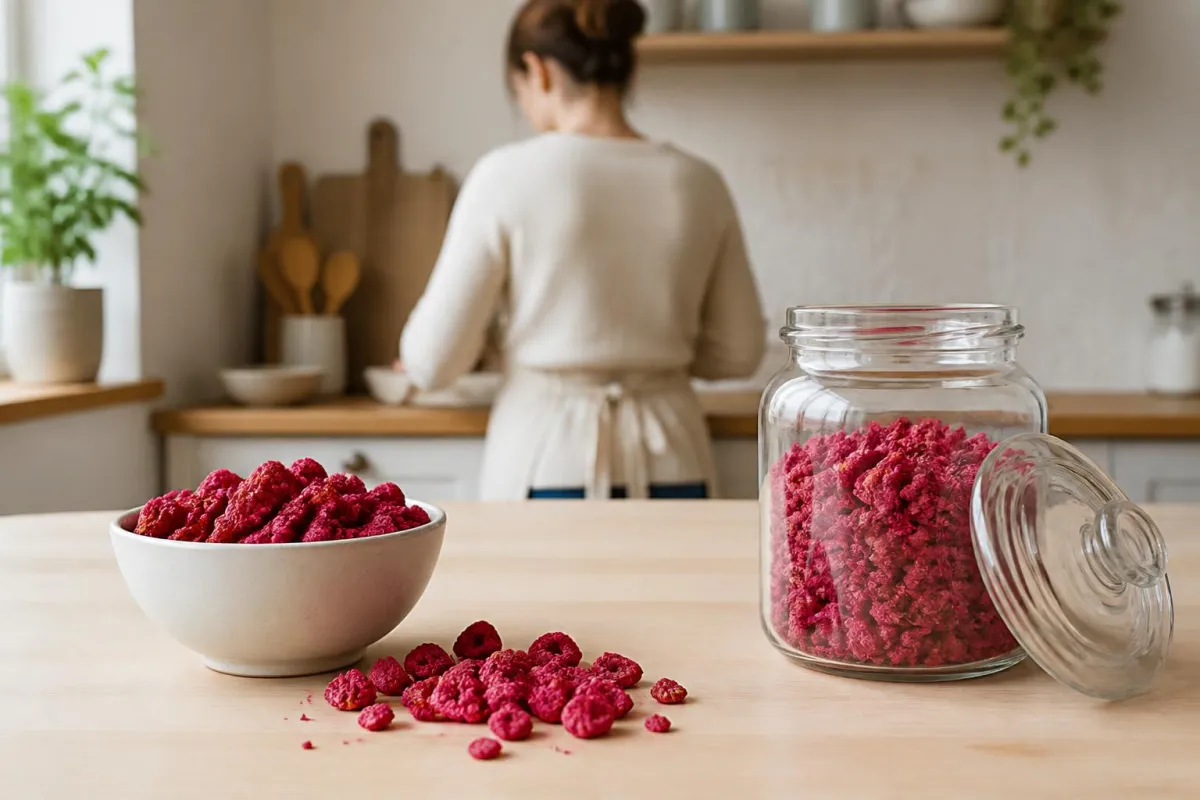
Crumbs, meaning small broken bits rather than a fine powder, are often the most versatile option. They work well in sponge batter, biscuit dough, crumble toppings and folded fillings because they spread the flavour further through the mix. You still see the fruit, but you do not get the occasional oversized hollow or soft patch that can happen with whole pieces.
Powder is best when texture needs to stay smooth. It is especially useful in icing sugar glazes, buttercream, whipped fillings, cheesecake-style mixtures, macarons and meringues. Because there are no pieces to soften, the result is more even in both flavour and colour. Powder also works well where you want to avoid adding liquid colouring or raspberry purée.
Here is a practical way to choose.
For cakes, use crumbs or small pieces if you want fruit through the crumb. Use powder if you want a pink sponge or buttercream without lumps.
For biscuits, use small pieces or crumbs in the dough. Whole large pieces can pull moisture into one spot and create softer patches around them. Powder is useful in shortbread or sandwich biscuit fillings, where a dry raspberry note is more helpful than fruit chunks.
For meringues, powder is usually the easiest choice. It blends into the sugar mixture more evenly and avoids wet pockets. A few fine crumbs can be folded through for a ripple effect, but larger pieces tend to soften and may weep if the surrounding mixture picks up moisture.
For icing, powder is the cleaner option. If you stir crushed fruit into icing sugar, you may get attractive speckles, but you can also get tiny seeds and uneven colour. That can be lovely for a rustic drizzle on loaf cake, less so for piping detail.
For fillings, it depends on the filling itself. In whipped cream or mascarpone-based fillings, powder gives flavour without making the filling looser. In jammy or compote-style fillings, pieces or crumbs can add texture, but they will soften fully.
If you use fruit powders regularly, our page on different forms of freeze-dried fruit powder is a useful companion to piece-based baking.
When to add them to avoid soft patches
There is no single right moment to add freeze-dried raspberries. The best stage depends on whether you want them to soften, stay visible, or remain crisp.
Add them into batter when you want an even raspberry presence through the bake. This suits loaf cakes, muffins, cupcakes and soft traybakes. The raspberries will absorb moisture from the batter during mixing and baking, so the final fruit pieces will be tender rather than crisp. To reduce soft clumps, fold them through near the end of mixing rather than leaving them sitting in a wet batter for a long time.
Add them into biscuit or cookie dough when you want fruit scattered through the dough but not melted into it. Because biscuit dough is usually lower in free moisture than cake batter, pieces often hold their shape better. Even so, they will soften somewhat during baking, especially in thicker cookies.
Add them on top before baking only if you are happy for them to soften and darken slightly. This can look attractive on muffins, frangipane tarts or raspberry-topped blondies, but the fruit will not stay crisp in the oven. If the topping is exposed to a moist batter underneath, it may become chewy rather than crunchy.
Add them after baking if crispness matters. This is the best choice for decorating iced cakes, topping cheesecakes, finishing pavlovas and scattering over cooled traybakes. The fruit keeps more of its original texture if it goes onto a dry or only lightly moist surface shortly before serving.
Add them into decoration at the last moment for the cleanest finish. Powder can be dusted over buttercream, stirred into white chocolate drizzle, or mixed into icing sugar. Pieces can be pressed onto the sides of a frosted cake or scattered over a tart. The later you add them, the more texture they keep.
For fillings and frostings, timing matters because moisture moves quickly into freeze-dried fruit. If you stir raspberry pieces into whipped cream in the morning for a cake you will serve in the evening, expect them to soften by then. If you want contrast between smooth cream and crisp fruit, add the fruit closer to serving.
This is also why we often suggest looking at related fruit uses, such as using freeze-dried strawberries in baking and breakfasts, because the same moisture logic applies across many freeze-dried fruits.
How to adjust moisture in cakes, biscuits and icing
The main advantage of using freeze dried raspberries for baking is that they contribute far less liquid than fresh or frozen fruit. The trade-off is that they can absorb moisture from the rest of the recipe. That can be useful or awkward, depending on the bake.
In cakes, start by thinking about how much fruit you are adding relative to the total batter. A small handful of crushed raspberries in a standard sponge may need no other change. A much heavier addition can make the batter feel thicker after a few minutes because the fruit starts drawing in liquid. If that happens, loosen the mixture cautiously with a small splash of milk or another recipe liquid, measured in millilitres, rather than making a large change all at once.
If you are using powder in a sponge, remember that powder behaves more like an extra dry ingredient than a fruit purée. If you add enough powder to noticeably colour and flavour the batter, you may need to reduce flour slightly or increase liquid slightly. Which route is better depends on the recipe. In a delicate Victoria sponge, reducing flour a touch may preserve tenderness. In a loaf cake, a little extra liquid may be simpler. There is no universal conversion, so treat it as a balance check rather than a formula.
In biscuits and cookies, freeze-dried raspberries can help avoid the spreading and wet centres that fresh fruit sometimes causes. But if you add a lot of powder or fine crumbs, the dough can become drier and more crumbly. In that case, let the dough stand briefly after mixing and reassess before adding more liquid. Butter softening, sugar dissolving and fruit hydration can change the texture within minutes.
In icing, the adjustment is usually more straightforward. Raspberry powder thickens icing because it adds solids without adding water. If you stir powder into a simple icing sugar glaze, add your liquid gradually and expect to need a little more than you would for plain icing. If you stir powder into buttercream, the buttercream may become slightly firmer, which is often helpful for piping. If you add crushed pieces instead, the icing may look speckled and can become harder to pipe through a fine nozzle.
For fillings based on cream cheese, mascarpone or whipped cream, powder is usually easier than pieces because it does not release obvious pockets of moisture later. Add it gradually and stop once the flavour is where you want it. Too much powder can turn a silky filling slightly chalky.
A good habit is to reserve a small amount of your recipe liquid until the end. That gives you room to adjust after the raspberries are in. It is especially useful in muffins, sandwich cake batter and soft cookie dough.
Keep your notes in grams and millilitres if you bake regularly. Even when we are not giving a fixed conversion, it helps to record what you changed in your own kitchen. Flour brand, egg size, humidity and how finely the raspberries are crushed all make a difference.
Storage, labels and kitchen checks before you start
Freeze-dried raspberries are at their best when they stay dry and crisp. Once they absorb moisture from the air, they soften quickly. That does not always make them unusable, but it does change how they behave in baking and decoration.
Store them sealed, cool and dry, and follow the packet instructions. The Food Standards Agency advises following product storage directions and using appropriate chilling or freezing where relevant for food safety and quality, rather than relying on guesswork alone Food Standards Agency. For freeze-dried ingredients, the biggest kitchen issue is usually moisture exposure after opening. Reseal the pack promptly, or transfer the contents to a fully airtight container if the original pack is not resealable.
Before you start baking, check the packet for three things.
First, the ingredient list. Some freeze-dried raspberry products are simply fruit. Others may be blended, sweetened or processed with other ingredients, especially in powdered mixes. Do not assume two raspberry powders behave the same way.
Second, allergen information. The Food Standards Agency advises consumers to read ingredient and allergen information carefully and not to infer suitability from a general impression of the product Food Standards Agency. In the UK, allergen labelling rules are specific, and for anyone cooking for others, checking the actual packet matters more than assuming a freeze-dried fruit product contains only fruit.
Third, the nutrition panel basis if you are comparing products. The NHS explains that a portion and 100g are different comparison bases, so make sure you are comparing like with like when reading labels NHS. That does not change how the fruit bakes, but it does matter if you are planning cupboard ingredients and trying to understand what is on the label.
Also give the fruit a quick visual check. If pieces look faded, sticky or partly collapsed, they may already have taken on moisture. They can still be useful in sponge, buttercream or fillings, but they are less likely to stay crisp as decoration. If you need powder and only have pieces, crush them just before use rather than long in advance.
Because Crispberry is an information site from Fleeta Limited, we focus on handling and kitchen use rather than product claims. The most useful habit is simple, check the packet, keep the fruit dry, and add it with a clear idea of whether you want softness, colour, flavour or crunch.
Used that way, freeze-dried raspberries are one of the most practical baking ingredients to keep in the cupboard. They give you raspberry flavour when fresh fruit is fragile, frozen fruit is too wet, or you want decoration and colour without extra liquid. The bake stays more controlled, and the result is far less likely to turn soggy.