How to read ingredient labels without missing the basics
Check whether figures are given per 100g, per serving or both.
On this page
Reading food labels well comes down to a few basics. Check what the product actually is, compare nutrition on the same basis, read the ingredients in order, and do not skip the storage or preparation wording. For home cooks and bakers, those details matter more than the front of pack claims.
That is especially true with freeze-dried ingredients. A packet may look simple, but the useful information is often in the small print. Is it whole fruit, pieces or powder? Is there anything added? Do you use it straight from the pack, or rehydrate it first? Good label reading helps us answer those practical kitchen questions without guessing.
What an ingredient label is actually telling you
On a UK food packet, the label usually combines a few different kinds of information. The most useful parts for everyday cooking are the name of the food, the net quantity, the ingredients list, allergen information, nutrition information, storage instructions, and any directions for use.
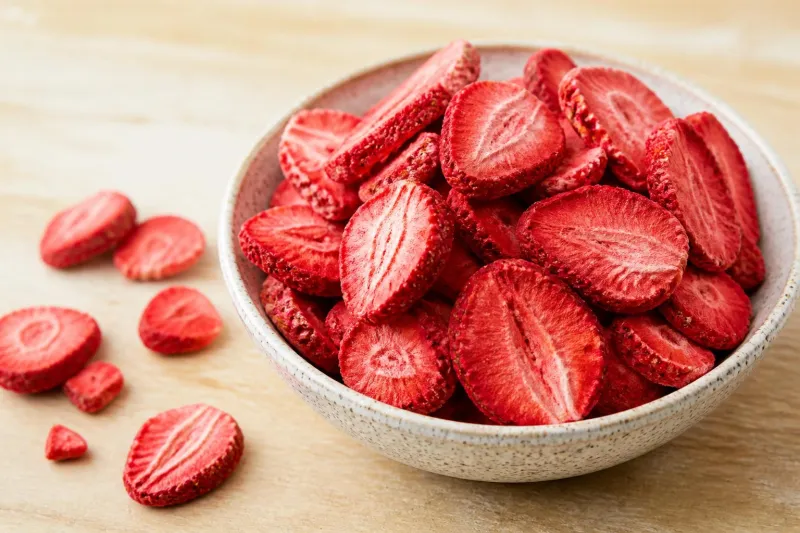
Start with the name of the food. This sounds obvious, but it stops a lot of mix-ups. “Freeze-dried strawberry pieces” tells us something different from “strawberry flavoured topping” or “fruit powder blend”. One is an ingredient for baking or mixing into yoghurt. Another may include sugar, flavourings or anti-caking agents. If we only glance at the front of the pack, we can miss that difference.
Next, look at the net quantity. This is the amount in the pack, usually shown in grams. For dry ingredients, that figure matters when we are planning recipes, stocking a cupboard or comparing value pack sizes. A small pouch of freeze-dried raspberries can look generous because the pieces are light and bulky, but the pack weight tells us what we actually have to work with.
Then come the ingredients and nutrition panel. These are often the parts people mean when they talk about ingredient labels, but they are only part of the picture. For a home cook, the storage wording can be just as important. “Store in a cool, dry place” is common. Some packets add “once opened, reseal promptly” or “use within a stated time after opening”. For moisture-sensitive ingredients such as freeze-dried fruit powders, that is not decorative wording. It tells us the product can pick up moisture from the air and lose its free-flowing texture.
Directions for use also deserve more attention than they usually get. Some freeze-dried ingredients are ready to use as they are. Others work better if crushed, sifted, or briefly rehydrated, depending on the recipe. If a packet gives preparation guidance, we should treat that as part of the ingredient information, not as an optional extra.
In the UK, mandatory food information rules set out what must appear on prepacked foods. Where a product is sold in Great Britain and in the EU, the broad structure may look familiar, but wording and presentation can still vary. That is one reason it helps to read the actual packet in front of us, rather than assuming two similar products will be labelled in exactly the same way.
Why per 100g and per serving are not the same thing
If we want to compare two foods fairly, the per 100g column is usually the cleanest place to start. The NHS explains that per 100g figures are useful for comparing foods, while portion or serving figures are a different basis and should not be confused with like-for-like comparison NHS guidance on reading food labels.
This matters because serving sizes are set by the manufacturer, not by our mixing bowl, spoon or baking tin. One packet may call 15 grams a serving. Another may call 30 grams a serving. If we compare those serving figures directly, we can end up thinking one product is much lower or higher in sugar, salt or energy when the stated serving is simply smaller.
Per 100g removes that distortion. It gives us a standard basis. When we are comparing two freeze-dried fruit powders, for example, the per 100g panel lets us see whether one is plain fruit and the other includes added sugar or other ingredients. It also helps when pack sizes differ.
Per serving figures still have a use. They can help us estimate what we might be adding to a bowl of porridge, a smoothie or a sponge mixture, but only if the serving resembles the amount we actually plan to use. In baking and cooking, that often is not the case. We may use 8 grams for decoration, 25 grams in a buttercream, or 40 grams in a traybake filling. The packet’s serving suggestion may have little to do with our recipe.
That is why we suggest a simple order of reading. First, compare products on a per 100g basis. Second, check the actual amount you expect to use in grams. Third, if needed, work out the nutrition for that amount from the packet information. This avoids treating a marketing-friendly serving size as if it were a neutral comparison tool.
With freeze-dried foods, bulk can also mislead the eye. A cup full of light berry pieces does not weigh the same as a cup of flour or sugar. So even when a product looks generous in volume, the nutrition panel remains tied to weight. If a recipe uses spoonfuls or cups, it is worth weighing the amount we actually add rather than assuming.
For more on fair comparisons, our guide to comparing freeze-dried labels without mix-ups goes into the common places readers get tripped up.
How to read the ingredient list and allergen information
Ingredients are listed in descending order by weight at the time they are used to make the food. In plain terms, the ingredient present in the largest amount comes first, then the next, and so on. That gives us a quick way to understand what a product mainly consists of.
If a packet says “freeze-dried banana slices” and the ingredients list is simply “banana”, that is straightforward. If the front says “berry powder” but the ingredients list starts with sugar, maltodextrin or another carrier, that tells us it is not just powdered fruit. Neither is automatically wrong, but they are different ingredients for different kitchen jobs.
Allergens on UK labels are usually emphasised in the ingredients list, often in bold. The Food Standards Agency explains that allergen information is important for consumers and should be checked carefully on the specific product Food Standards Agency allergy guidance. In practice, that means we should not rely on memory, old packaging or a quick glance at the front.
There may also be separate statements such as “may contain” wording. This is different from a named ingredient. It refers to the possibility of unintended presence, not a deliberate recipe ingredient. For someone managing an allergy, that distinction matters, but a label still cannot act as personal dietary advice. The NHS and Food Standards Agency publish general guidance, but individual allergies, intolerances and medical dietary needs need advice that fits the person, not just the packet.
For home cooks, there are also practical reasons to read beyond the headline ingredient. Added anti-caking agents may affect how a powder mixes. Acidity regulators may influence flavour. Added oils or syrups can change how a product behaves in icing, meringue, chocolate work or dry cake batters.
A short ingredients list is not automatically better, and a longer one is not automatically worse. What matters is whether the list matches the job we want the ingredient to do. If we want a bright fruit powder for dusting buttercream, we need to know whether it is pure fruit powder or a blend. If we want crisp fruit pieces for topping overnight oats, we need to know whether they will stay crisp or include ingredients that make them sticky.
If you often use dried fruit as well as freeze-dried fruit, our guide to what labels really tell you about sulphites in dried fruit is a useful companion read.
What to check on labels for freeze-dried ingredients
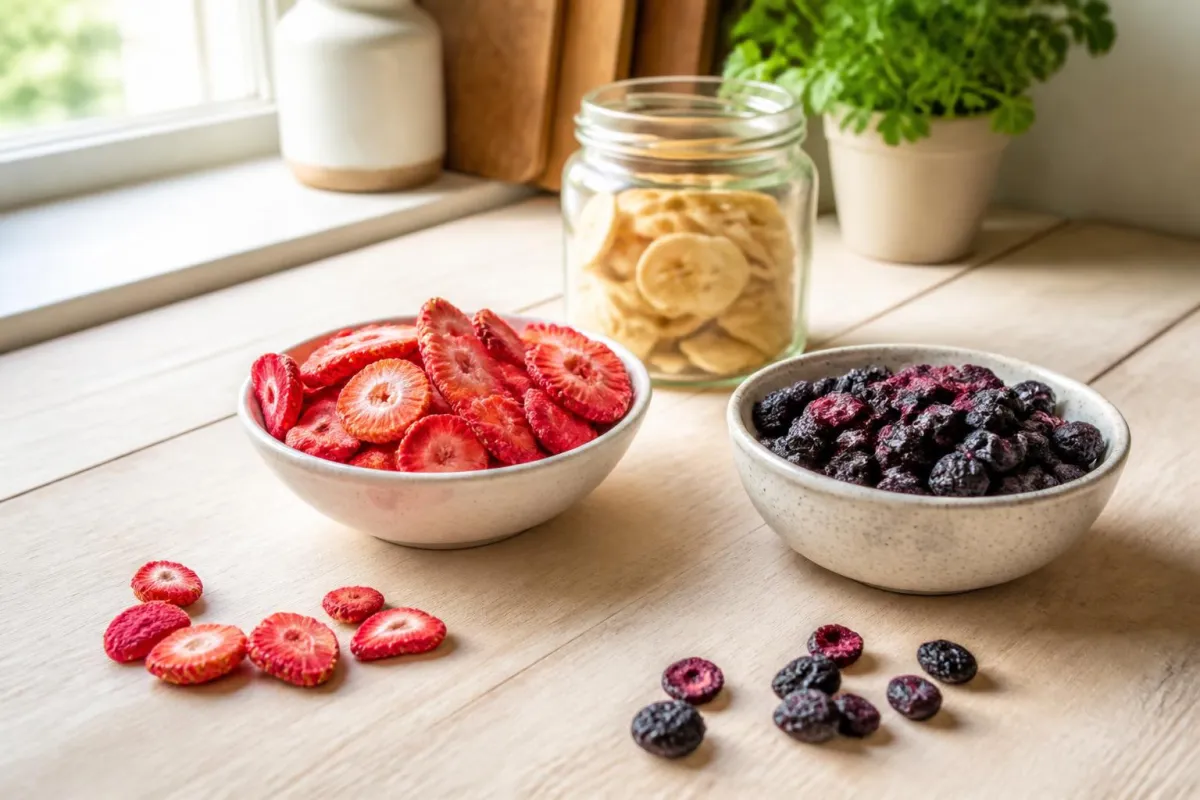
Freeze-dried foods deserve a slightly different reading habit because texture and moisture matter so much. The first thing to check is the ingredient form. Are we looking at slices, whole berries, pieces, crumbs or powder? Those forms are not interchangeable in the kitchen.
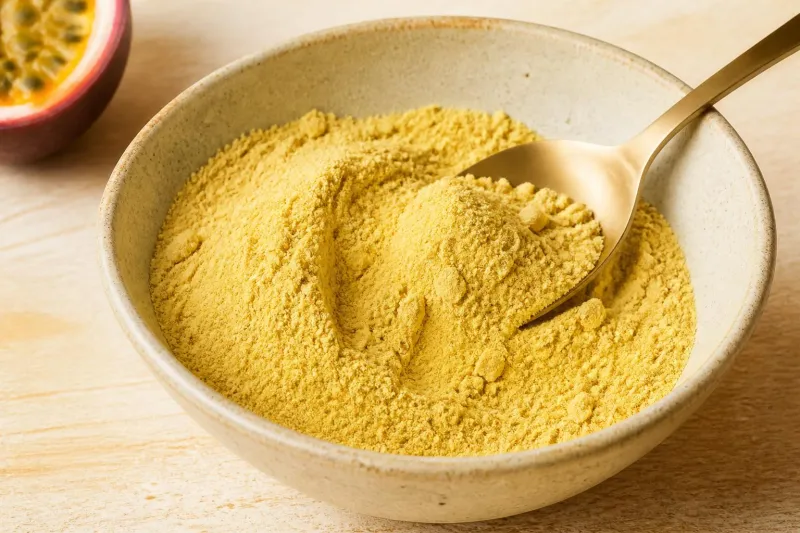
Pieces and slices can be folded into granola or scattered over desserts. Powders are better for colouring icings, flavouring buttercream or stirring into dry mixes. Crumbs may disappear into a batter more evenly than larger chunks. The label name usually tells us the form, and if it does not, the product description and directions often do.
Next, check whether anything has been added. Some freeze-dried ingredients are just the fruit or vegetable. Others may include sugar, starches, carriers, flavourings or anti-caking agents. That affects sweetness, texture, colour strength and how the ingredient behaves when mixed with liquid.
Storage wording is especially important here. Freeze-dried ingredients are dry and light because most of the moisture has been removed. Once opened, they can absorb moisture from the air quite quickly, which can soften crisp pieces or make powders clump. If the packet says to reseal, transfer promptly, or keep airtight, follow it. The Food Standards Agency’s storage advice is general rather than product-specific, but the core point is clear, follow the storage instructions on the food you have Food Standards Agency storage guidance.
That often means thinking ahead about where the packet will live after opening. If we buy freeze-dried ingredients for occasional baking rather than daily use, an airtight container that suits the pack size can make a real difference. We cover that in our guide to choosing kitchen containers that keep dry ingredients usable.
Preparation instructions are the next thing to check. Some packets are intended for snacking straight away. Others may suggest soaking, stirring into liquid, or using as an inclusion rather than a garnish. For vegetables in particular, there may be guidance on adding to soups, sauces or noodle dishes. For fruit powders, there may be notes about mixing into drinks, yoghurt or baking.
Do not assume rehydration is always necessary, or that it is never necessary. In some recipes, keeping the ingredient dry is the whole point. In others, a brief soak improves texture. The label may not give exact kitchen timings for every use, but it often tells us the manufacturer’s intended starting point.
Finally, check the best before date and any wording about use after opening. Best before relates to quality rather than safety in the same way that use by does, but it still matters for ingredients whose appeal depends on crispness, colour and aroma. A stale, softened berry piece may still be edible, but it is not doing the same job in a pavlova topping as a crisp one.
Using label information in everyday cooking and baking
Good label reading becomes useful when we turn it into kitchen decisions. The first decision is how to measure. With dry, lightweight ingredients, especially freeze-dried ones, volume can be misleading. A handful, spoonful or cupful may vary a lot depending on whether the pieces are whole, crushed or powdered. Where accuracy matters, weigh the amount in grams.
That does not mean every use needs laboratory precision. If we are scattering fruit over porridge, rough amounts are fine. If we are balancing a buttercream, adjusting a cheesecake topping or costing out repeated bakes, weighing gives us a more reliable result.
The second decision is storage after opening. If the label says reseal and keep dry, do that promptly. Do not leave the packet open on the worktop while the kettle boils and the dishwasher steams away. Moisture in the kitchen air is enough to change texture. If the original packet does not reseal well, move the ingredient to a suitable airtight container and keep the original label details until the pack is finished.
The third decision is how to use the ingredient form you actually bought. A powder absorbs and disperses differently from pieces. Whole freeze-dried berries may soften in a wet batter. Fine powder can colour icing more evenly than crushed pieces, but it may also clump if added to something damp too quickly. The label helps us identify the form, but we still need to match it to the job.
It is also worth resisting fixed conversions. There is no single rule that tells us exactly how much freeze-dried fruit equals a set weight of fresh fruit in every recipe. The right amount depends on the product form, the recipe, the moisture we want, and whether the ingredient is there for flavour, colour, texture or decoration. If we need a starting point, we can make an illustrative note for our own kitchen, but it should stay a starting point, not a universal rule.
The same goes for yield. A packet of powder does not automatically make a standard number of portions, and a pouch of fruit pieces does not guarantee a set number of traybakes. The label tells us the pack weight and sometimes the suggested use, but our actual yield depends on how heavily or lightly we use it.
For cupboard planning, label reading also helps us avoid buying ingredients that do not fit the way we cook. If a packet needs careful sealing, low humidity and quick use after opening, we may prefer a smaller pack. If we use fruit powders regularly in baking, a larger pack may make more sense. Our article on baking cupboard ingredients that actually earn their space looks at that question from a practical storage angle.
A final point worth keeping in mind is that labels give product information, not a full dietary verdict. The NHS Eatwell Guide places food choices in the context of an overall pattern across the day or week, not a pass or fail test for one ingredient NHS Eatwell Guide. For us as cooks and bakers, that means labels are tools. They help us compare, measure, store and use ingredients sensibly. They do not replace judgement, recipe context or personal medical advice.
At Crispberry, that is the approach we take across our guides. Read the packet carefully, compare like with like, and use the details to make better kitchen decisions. When we do that, ingredient labels stop being fine print and start being genuinely useful.